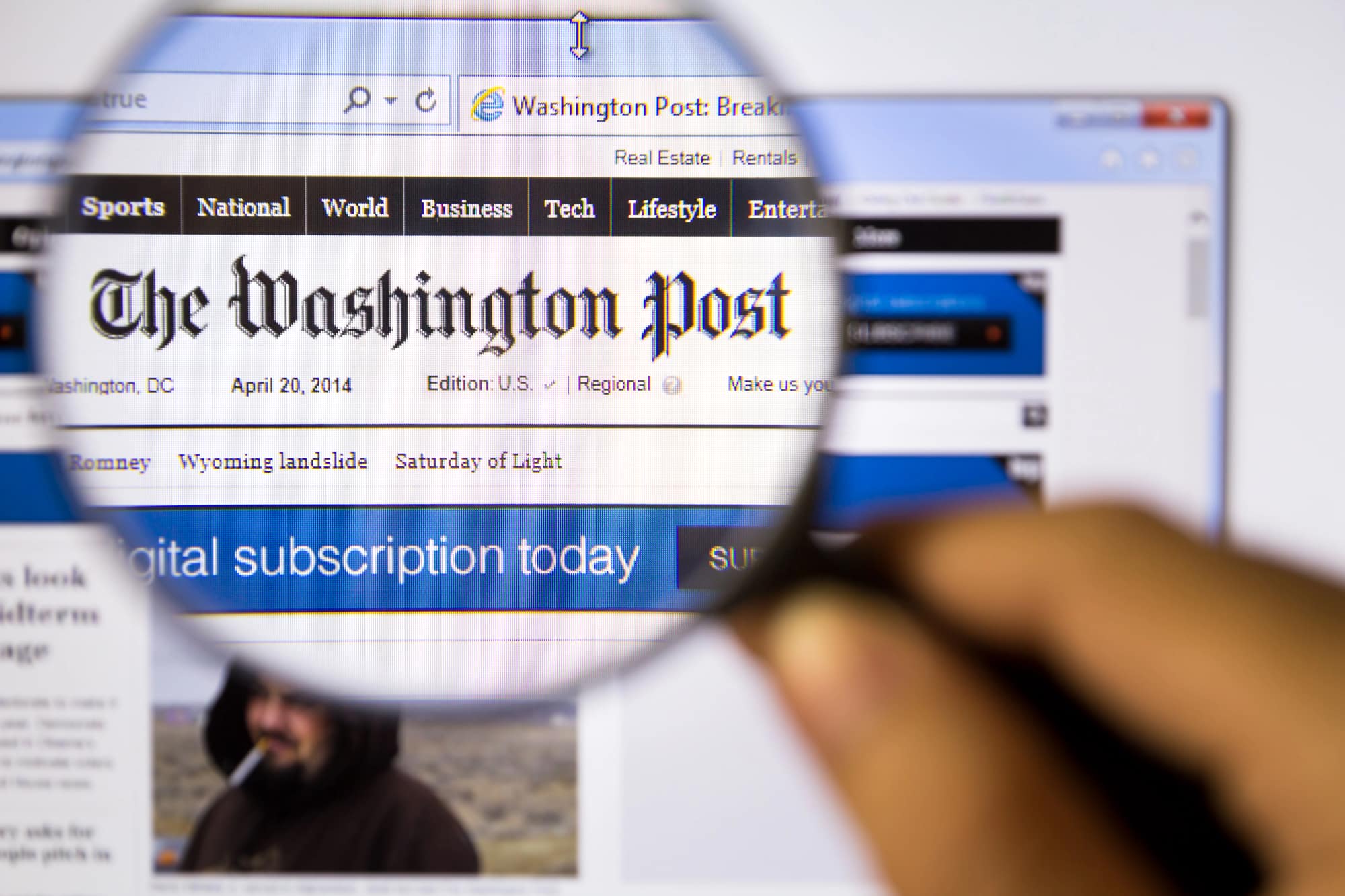
Why do so many Americans distrust The Washington Post? “Pro-Iran propaganda network gains traction with posts about Epstein” offers a tankerload of clues.
Social media is overflowing with bogus claims and A.I. videos related to the Iran War. Prudent folks are already wary about any wild-eyed claims of total victory or glorious destruction they see online. But can political shysters exploit the war to vaccinate President Donald Trump against his biggest scandal?
Long before Trump partnered with Israel to attack Tehran, Democrats, libertarians, and even decent Americans warned that the president would bomb Iran again to distract from the Jeffrey Epstein pedophile scandal. But now that Trump vindicated such fears, anyone who still complains about the Epstein scandal is propelling Iranian propaganda.
Or at least that’s what The Washington Post wants the world to think.
Early in the story, the Post flourishes nuggets of wisdom from a certified Washington expert. “There is a lot of Epstein-related content being pushed out to draw eyeballs…You come for the Epstein content, and you stay for the propaganda,” claims Bret Schafer, who the Post identifies as a research director “at the nonprofit Institute for Strategic Dialogue (ISD).”
The Post neglected to mention that nonprofit institute is bankrolled by the U.S. Justice Department and the U.S. State Department. If you can’t trust Pam Bondi and Marco Rubio to protect America from propaganda, who can you trust?
Touting a federally-funded entity as “independent” doesn’t count as propaganda because The Washington Post is the Oracle of Delphi—at least inside the Beltway.
The Post damn-near-breathlessly notes that “disinformation researchers have also taken note of the campaign to link U.S. and Israeli leaders to Epstein.” I was disappointed that the Post didn’t disprove any links between Trump and Epstein by slavishly quoting Trump’s denial that he’d ever been friends with Epstein (despite droves of video and photographic evidence to the contrary).
Later in the story, readers learn that “Posts on X that used the phrase ‘Epstein regime’ — a derogatory reference to the U.S.-Israel alliance — increased one hundred-fold on the first day of the missile strikes, said Emerson Brooking, director of strategy at the Atlantic Council’s Digital Forensic Research Lab.”
The Post four-alarm story on propaganda fails to mention that the Atlantic Council is heavily funded by the Pentagon and the U.S. State Department. Or does the Post consider such funding as proof that the Atlantic Council is trustworthy?
That passage in the story caught my eye because the Digital Forensic Research Lab sought to tar me as a Russian agent in 2024. In a post headlined, “Russian Outlets Amplify Conspiracies,” the Lab warned that Zero Hedge “is actively reprinting content from fringe sources that claims the establishment is manipulating legal and electoral system to ‘steal’ the election. Examples include an article by James Bovard originally published in The American Conservative, which alleges legal efforts to protect voting rights are part of a Democrat conspiracy to enable fraud.”
So I was part of a Russian-linked conspiracy because I objected to states counting mail-in ballots that arrived with no postmark long after Election Day? But my Rubles kickback never arrived.
Did a Post editor simply tell reporter Will Oremus to “Round up the usual suspects” and presume readers would swallow whatever the Post shoveled?
No such luck: the article evoked a head-snapping hostile backlash from hundreds of readers.
The Post article catalogued Twitter/X accounts that posted deceptive or false videos, especially connecting Trump to Epstein. By contacting Twitter/X headquarters, the Post succeeded in getting several of those accounts banned online.
But the Post has ignored or downplayed almost all the falsehoods that have permeated Trump and his administration’s tub-thumping for the Iran war. Trump changes the rationale and the goals for the war practically every daily news cycle. Does the president remain presumptively correct regardless of how often he brazenly contradicts himself?
In a Florida press conference on Monday, Trump was pressed by New York Times White House correspondent Shawn McCreesh on the U.S. Tomahawk missile that killed more than one hundred and fifty girls at an Iranian school. Trump falsely claimed that Iran had Tomahawk missiles. McCreesh followed up, “Even your Defense secretary wouldn’t say that when he was asked standing over your shoulder on your plane on Saturday. Why are you the only person saying this?”
Trump replied, “Because I just don’t know enough about it.”
Actually, that is the storyline for Trump and the entire war so far. Will The Washington Post grant total absolution to Trump based on his near-total ignorance?
That Tomahawk story got better on Tuesday. At a White House press briefing, Karoline Leavitt insisted that people should wait for the Department of War to issue their official storyline on how that girls school happened to get blown up. (Check back after the mid-term elections.) Then she asserted, “The president has a right to share his opinions with the American public.” The president has a First Amendment right to lie about U.S. war crimes, right? Leavitt talked as if Trump is akin to an innocent bystander who witnessed a fender bender during rush hour.
Leavitt then revealed the Rosetta Stone for the entire war:
“Frankly, we’re not going to be harassed by The New York Times, who has been putting out a lot of articles on this making claims [about the school bombing] that have been verified by the Department of War.”
The Trump administration supposedly still has a monopoly over defining truth—regardless of the false claims on Iran and the war in recent weeks. And anyone who exposes official falsehoods is guilty of “harassing” the politicians who are saving America.
Anyone tempted to defer to the president in this time of war should remember how badly that worked out a few decades ago. In the two years after the 9/11 terrorist attacks, President Geore W. Bush and his top administration officials made almost a thousand false public statements regarding the national security threat posed by Iraq, according to a 2008 study by the Center for Public Integrity. Pervasive U.S. government deceit made that war far more ruinous for both Americans and Iraqis.
Will The Washington Post succeed in ludicrously stretching the notion of “conspiracy theory” to insulate President Trump and his latest bombing campaign? Thus far, The New York Times is doing a far better job than the Post of exposing some of the follies and frauds of the Trump war effort.
Happily, Americans can tap plenty of other sources for more reliable information on the war, including this website and Antiwar.com.