
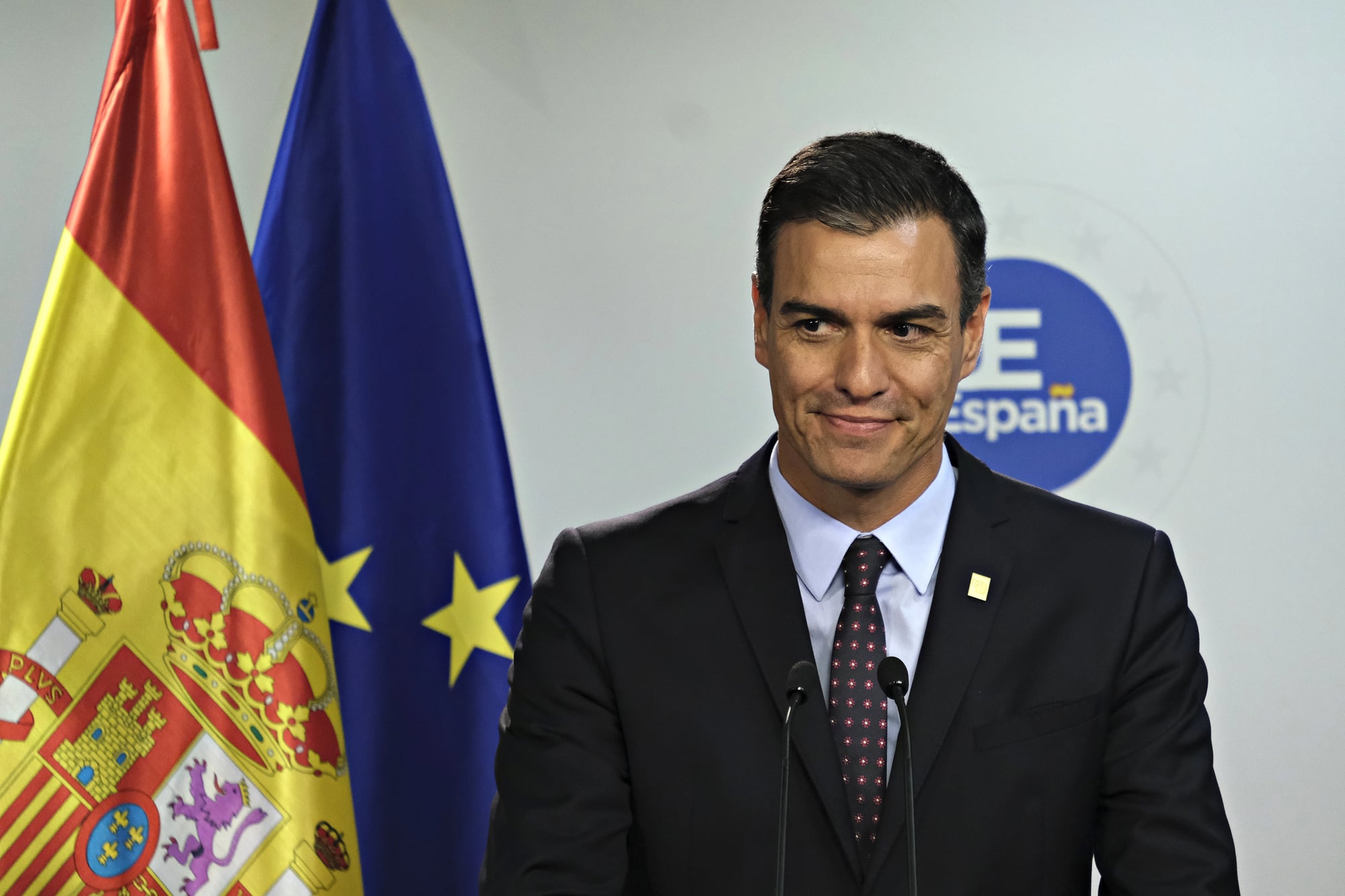
When American and Israeli warplanes struck Iran on February 28, 2026, launching what Washington dubbed Operation Epic Fury, most NATO allies fell into line. Spain did not. In the days that followed, the government of Prime Minister Pedro Sánchez barred American forces from using the Rota and Morón de la Frontera air bases in southern Spain. Defense Minister Margarita Robles declared that Spain had provided “no assistance of any kind, absolutely none” from either base in connection with the Iran strikes, while Sánchez called the operation an “unjustified, dangerous military intervention that is outside international law.”
Flight tracking platforms recorded at least fifteen U.S. military aircraft departing the two Andalusian bases, with most heading toward Ramstein, Germany, in the days after the announcement. In a televised address, Sánchez warned that Trump was playing “Russian roulette with the destiny of millions” and declared, “We are not going to be complicit in something that is harmful to the world and contrary to our values and interests simply out of fear of someone’s retaliation.”
As this author has noted a previous piece, Spain has been carving out a path that could make it the West’s most unexpected rebel. Spain’s independent streak on matters relating to Israel and the Middle East did not begin with Sánchez. It began with Francisco Franco. The dictator’s regime refused to recognize the State of Israel from its creation in 1948, driven by his belief in a mythical “contubernio judeo-masónico” conspiracy and his strategic alignment with the Arab world. In an ironic twist, Franco’s regime made overtures toward diplomatic relations with Israel beginning in 1949, hoping that warmer ties might help lift international sanctions on fascist Spain. Israel rejected the overtures, having voted against lifting United Nations sanctions on Spain in 1949 because of Franco’s close ties to Nazi Germany and the Axis powers.
Franco’s death in 1975 did not immediately change Spain’s stance. The transitional government of Adolfo Suárez maintained the policy of non-recognition, conditioning it on Israeli withdrawal from occupied territories and fearing backlash from the Arab world, while building close ties with the Palestine Liberation Organization and hosting Yasser Arafat in September 1979. The PLO had opened an office in Madrid in 1976. It was only after Spain joined NATO and sought accession to the European Economic Community that Prime Minister Felipe González moved to establish diplomatic relations with Israel.
On January 17, 1986, Spain became the last Western European nation aside from the Vatican to formally recognize Israel, signing the agreement discreetly in The Hague while simultaneously issuing what became known as the Hague Declaration, reiterating Spain’s “non-recognition of any measures aimed at annexing Arab territories occupied since 1967” and pledging continued friendship with the Arab world.
The October 7, 2023 Hamas attack on Israel and the subsequent Israeli military campaign in Gaza triggered a dramatic rupture. In May 2024, Spain formally recognized Palestine as a state alongside Ireland and Norway, with Sánchez declaring this was “not only a matter of historic justice” but also “an essential requirement” for achieving peace. Israel responded by recalling its ambassador from Madrid.
In September 2025, Sánchez announced sweeping sanctions, using the word “genocide” for the first time to describe Israel’s actions in Gaza. He declared that “This is not self-defence…it is the extermination of a defenceless people.” The package included a total arms embargo on Israel later ratified by parliament on October 8, 2025 by a vote of 178 to 169, a ban on ships carrying fuel for Israel’s military from docking at Spanish ports, a ban on aircraft transporting defense material from using Spanish airspace, a bar on entry to Spain for individuals “directly involved in genocide” potentially including Netanyahu and members of his government, and an embargo on products from Israeli settlements.
Most significantly, Spain terminated military contracts with Israeli companies worth approximately $1 billion. This included canceling a 700 million euro contract for Israeli-designed SILAM rocket launchers derived from Elbit Systems‘ PULS platform and a 285 million euro deal for Spike anti-tank missiles from Rafael Advanced Defense Systems.
Spain’s response to the United States and Israeli strikes on Iran in February 2026 represented the culmination of this independent trajectory. Sánchez condemned the strikes as an “unjustified, dangerous military intervention outside international law,” calling them a war “started without the authorization of the United States Congress or the United Nations Security Council.” The Spanish government barred the United States from using the Rota and Morón de la Frontera air bases in southern Spain for operations against Iran.
Trump’s reaction was swift and punitive. On March 3, 2026, during an Oval Office meeting with German Chancellor Friedrich Merz, Trump declared, “We’re going to cut off all trade with Spain. We don’t want anything to do with Spain.” He called Spain “terrible” and said “Spain has absolutely nothing that we need” aside from “great people.” Trump instructed Treasury Secretary Scott Bessent to “cut off all dealings” with Spain and raised the possibility of a full trade embargo.
What distinguishes Spain’s approach from mere political posturing is its grounding in geographic realism. In March 2025, Sánchez explicitly stated that “our threat is not Russia bringing its troops across the Pyrenees,” referring to the mountain range separating Spain from France. He elaborated that “defense in the east of Europe has nothing to do with the security challenges we have in Spain” and added that “we are not going to have a physical attack from Russia like some of the Baltic or Nordic countries, such as Finland, might have.”
This geographic realism has translated into concrete policy differences. Spain has become one of the few NATO members to refuse the alliance’s new 5% GDP defense spending target, with Sánchez citing budgetary constraints and social priorities. A compromise allows Spain to maintain only 2.1% of GDP while other allies commit to 5%, exposing fundamental disagreements about threat perception and burden sharing within the Western alliance.
The Spanish case reveals the limitations of America’s universalist foreign policy agenda, which assumes that all countries face identical threats and should adopt identical foreign policy postures. Spain’s geographic position means it faces different security challenges than Baltic states. Its economic interests sometimes align more closely with China than with American preferences. Its historic and cultural connections to the Arab world create different perspectives on Middle Eastern conflicts.
Most importantly, Spain’s independent course has not resulted in international isolation or economic catastrophe. Instead, Madrid has successfully diversified its partnerships while maintaining its position within European and transatlantic institutions. This demonstrates that countries can hedge against American hegemony without completely abandoning Western institutional frameworks. As the dust settles on America’s unipolar moment, Spain’s example will likely be remembered not as an aberration, but as the opening chapter of a new multipolar age where nations prioritize their own interests over the machinations of distant superpowers.
Spain’s rebellion is not ideological but practical. As Eldar Mamedov of Responsible Statecraft describes it, Sánchez’s foreign policy is “circumstantial, not convictional” in nature. Yet it is precisely this pragmatism that makes Spain’s example so significant. It demonstrates that even traditional Western allies are beginning to exercise strategic autonomy in ways that challenge American global leadership, not out of anti-American ideology, but out of a rational assessment of their own national interests.