
By the summer of 2000, Yugoslav President Slobodan Milošević appeared firmly entrenched in power.
A decade earlier, he had risen to prominence by harnessing Serbian nationalism as Yugoslavia began to fracture. Over time, he consolidated control over political institutions and much of the media while leading Serbia through wars, sanctions, and NATO’s 1999 bombing campaign. Yet beneath the surface, public frustration was growing. The economy was struggling, unemployment remained high, and many Serbians had grown weary of international isolation and authoritarian rule.
When Milošević changed election rules in July 2000 to allow the presidency to be decided by popular vote, he likely expected another victory. Instead, the move created an opportunity for a united opposition.
On September 24, voters went to the polls. Milošević faced Vojislav Koštunica, the candidate of the Democratic Opposition of Serbia (DOS). Election observers from the Organization for Security and Co-operation in Europe later described the vote as fundamentally flawed, citing irregularities, restricted monitoring, and unequal media access. State television overwhelmingly favored Milošević while opposition voices received little coverage.
When results were announced, the opposition claimed Koštunica had won outright. The government election commission insisted that no candidate had received a majority and ordered a runoff election. The opposition rejected the decision and called for nationwide resistance.
The first major challenge came from the Kolubara coal mines, where thousands of workers launched a strike. The mines were critical to Serbia’s electricity supply, giving the protest movement leverage over the government. Despite a heavy police presence, authorities proved unwilling to use significant force. Officers were instructed to appear tough, but many showed little enthusiasm for confronting the workers.
The regime’s position weakened further as demonstrations spread across the country.
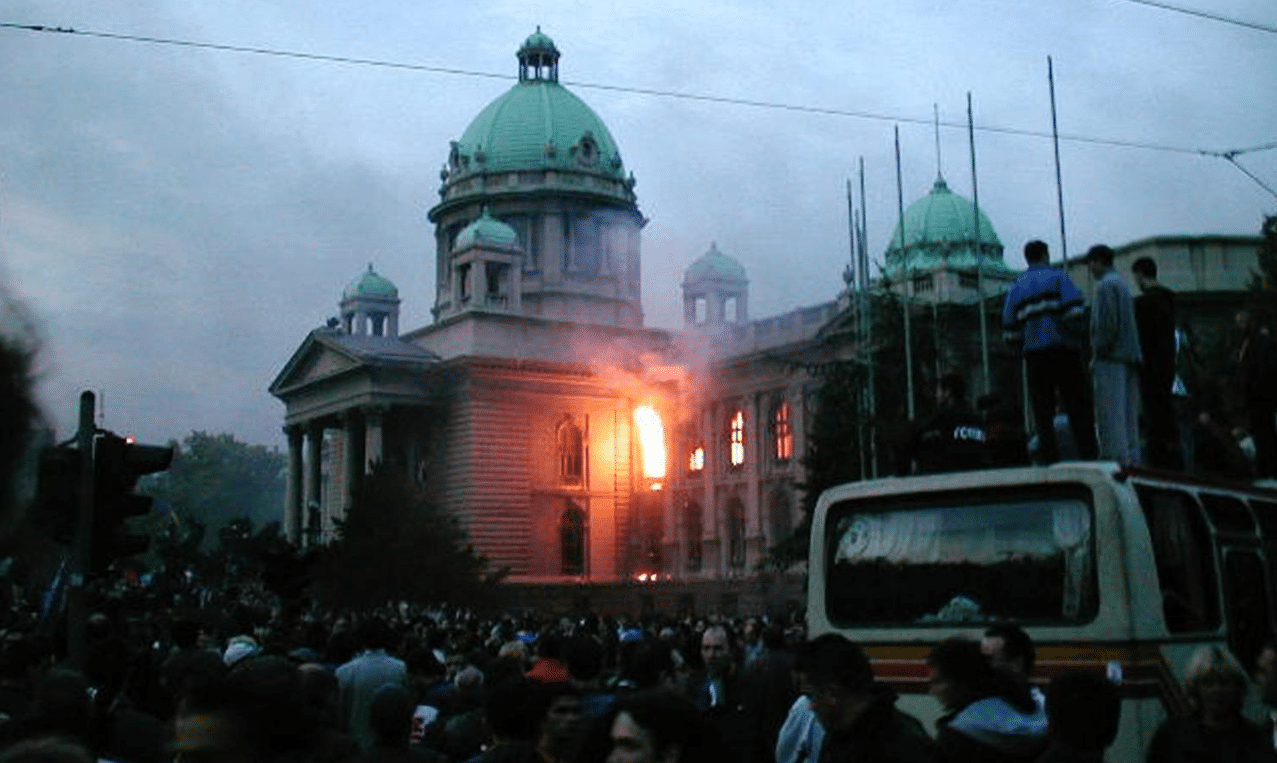
On October 5, hundreds of thousands of protesters converged on Belgrade. Opposition leaders issued an ultimatum demanding Milošević step aside. When he refused, demonstrators stormed parliament and the headquarters of Radio Television Serbia (RTS), long viewed as a symbol of state propaganda.
The moment that gave the uprising its name came when construction worker Ljubisav Đokić drove a wheel loader through police lines and into the parliamentary complex. Yet the decisive factor was not the wheel loader itself. Police units increasingly refused orders, roadblocks collapsed, and security forces largely stood aside. Within days, Milošević’s rule unraveled.
The protests were undeniably driven by genuine domestic grievances. Yet Serbia’s opposition was not operating alone.
According to the U.S. Agency for International Development (USAID), its Office of Transition Initiatives began programs promoting political transition in Serbia as early as 1997—three years before Milošević’s removal. USAID later acknowledged that it intensified support in the run-up to the 2000 election.
Between 1999 and 2000, at least $41 million flowed into Serbia through USAID, the State Department, the National Democratic Institute, and the International Republican Institute. The money supported opposition coordination, polling, election monitoring, media projects, and mass political messaging. Thousands of cans of spray paint, millions of stickers, and tons of campaign materials helped spread anti-Milošević messaging throughout the country.
The overt funding was only part of the story.
Journalist David Shimer reports that the CIA spent millions of dollars supporting efforts to unseat Milošević. Former CIA officer John Sipher later acknowledged that one successful American election-interference operation involved “certainly millions of dollars” directed against the Serbian leader. Outgoing President Bill Clinton defended assistance to the opposition, stating that while the United States did not rig the vote, he had no objection to CIA involvement.
Perhaps the most influential opposition organization was Otpor, a youth movement founded in 1998.
Otpor became famous for its clenched-fist logo, creative activism, and the slogan “Gotov Je!”—”He’s Finished!” Rather than building around charismatic personalities, organizers sought to create a decentralized movement capable of surviving arrests and repression. Small actions such as sticker campaigns gradually escalated into mass demonstrations.
Western organizations played a significant role in Otpor’s development. The National Endowment for Democracy provided funding—$282,000 in 2000 alone—while retired U.S. Army Colonel Robert Helvey trained activists using concepts developed by political theorist Gene Sharp. Sharp’s work on nonviolent resistance became so influential that some activists referred to it as Otpor’s unofficial manual.
George Soros’ Open Society network was another important source of support for Serbia’s opposition. According to Ivan Vejvoda of the Fund for an Open Society-Yugoslavia, the organization provided one of Otpor’s first grants in 1998, helping support the student movement before it became a national force. The organization’s Belgrade branch also funded independent media and opposition-linked groups such as the G-17 economists. Velimir Curgus of the Soros network later stated that “most of our work was undercover,” while another Open Society official described the organization as one of Otpor’s earliest financial backers. Foreign financial support also helped fund the production of roughly 60 tons of posters and leaflets distributed before the election.
The movement’s success later became a model for future political campaigns abroad. Otpor veterans established the Center for Applied Nonviolent Action and Strategies (CANVAS), which advised activists in countries ranging from Georgia and Ukraine to Egypt.
European governments were also involved. According to reports in Der Spiegel, U.S. Secretary of State Madeleine Albright and German Foreign Minister Joschka Fischer coordinated with Yugoslav opposition figures before the election. Germany and other European actors provided substantial financial support to opposition-controlled municipalities and political organizations.
None of this means the Bulldozer Revolution was simply a foreign creation. Milošević was genuinely unpopular, and hundreds of thousands of Serbians willingly participated in the protests that ended his rule.
But the historical record leaves little doubt that Western governments were more than passive observers. Through funding, training, media support, election monitoring, and covert intelligence operations, they actively worked to shape Serbia’s political future.
The Bulldozer Revolution became a blueprint. The combination of grassroots activism, youth mobilization, foreign funding, independent media networks, and nonviolent resistance training would reappear in later movements across Eastern Europe and beyond. Whether viewed as democracy promotion or regime change, Serbia in 2000 became one of the clearest examples of domestic opposition and foreign intervention operating side by side to bring down a government.