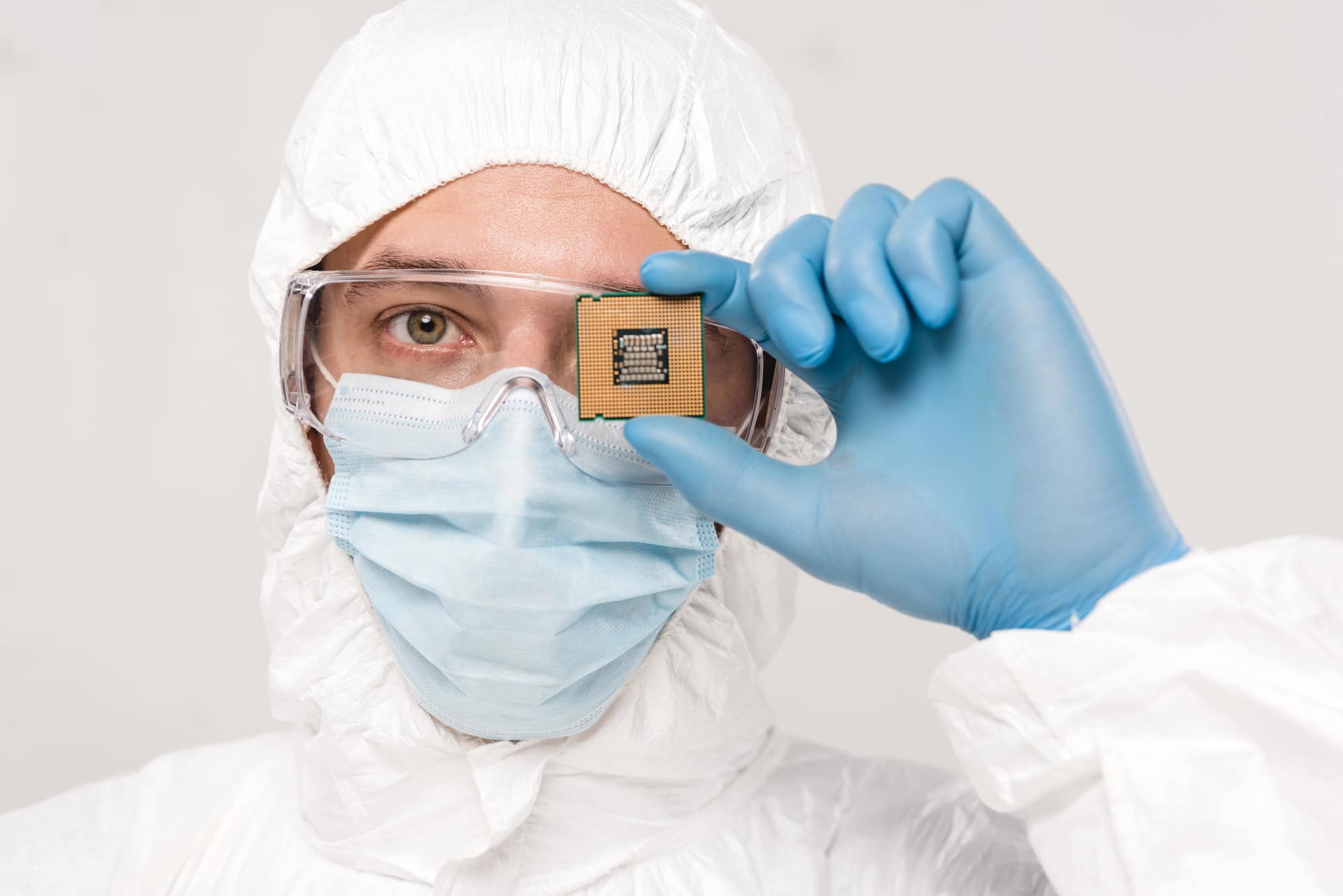
Today, Taiwan occupies a uniquely important position in the global economy. The island produces the overwhelming majority of the world’s most advanced semiconductors, manufacturing the chips that power everything from smartphones and artificial intelligence systems to automobiles, satellites, and advanced weapons platforms. Taiwan has become so central to the modern technological order that analysts since the 1990s have routinely described its semiconductor industry as a “silicon shield,” a strategic asset so important that no major power can afford to see it disrupted.
As the debate continues over whether to de-risk or re-shore American semi-conductor supply chains, how we arrived at this point can be instructive.
Taiwan’s emergence as the world’s semiconductor superpower was neither inevitable nor accidental. It was the product of decades of Cold War strategy, economic development, entrepreneurship, and statecraft. Ironically, the same American effort to contain communist China that helped secure Taiwan’s survival also helped create one of the most significant strategic vulnerabilities in the contemporary international system.
The story begins not with semiconductors, but with the Chinese Civil War.
When Mao Zedong’s Communist forces defeated Chiang Kai-shek’s Nationalist government in 1949, the remnants of the Republic of China retreated to Taiwan. Viewing the island as an important bulwark against communist expansion in East Asia, Washington extended military protection and substantial economic assistance.
Over the next several decades, Taiwan became one of the largest per-capita recipients of American aid in the world. Between direct assistance, military support, educational exchanges, and preferential access to American markets, the United States helped create the conditions necessary for Taiwan’s rapid industrialization. American policymakers were motivated primarily by strategic considerations. They wanted a prosperous anti-communist ally capable of resisting pressure from Beijing.
Taiwan’s economic development during the postwar era differed from that of many developing countries. Rather than pursuing the import-substitution policies fashionable throughout much of the Global South, Taiwan increasingly oriented itself toward export-led growth. Land reform, relatively stable institutions, high rates of savings, and a strong emphasis on education laid the foundation for industrial expansion.
The Taiwanese government also played an active role in identifying and cultivating sectors deemed strategically important. Beginning in the 1970s, policymakers concluded that advanced electronics offered an opportunity to move beyond labor-intensive manufacturing and into higher-value industries.
To facilitate that transition, Taiwan established institutions specifically designed to acquire foreign technology and foster domestic innovation. Among the most important was the Industrial Technology Research Institute (ITRI), founded in 1973. Through partnerships with foreign firms and government-supported research initiatives, ITRI became a conduit for transferring advanced technological knowledge into Taiwan’s emerging electronics sector.
This was not a matter of government planners attempting to micromanage a complex economy. Rather, Taiwanese policymakers sought to create an environment in which entrepreneurs and engineers could thrive while accelerating the acquisition of technological capabilities already developed elsewhere. The distinction is important. Taiwan’s semiconductor success ultimately depended upon market competition and private initiative, but those forces operated within an institutional framework deliberately cultivated by the state.
The decisive turning point came in the 1980s with the arrival of Morris Chang.
Born in China and educated in the United States at Harvard, MIT, and Stanford, Chang had spent decades working at Texas Instruments, one of America’s leading semiconductor companies. By the time Taiwanese officials, most prominently Premier Sun Yun-suan, recruited him to help develop the island’s technology sector, he possessed both technical expertise and deep familiarity with the global semiconductor industry.
Chang recognized something many of his contemporaries did not.
Most semiconductor firms at the time were vertically integrated. Companies designed chips and manufactured them in-house. Building and operating fabrication facilities required enormous investments, making entry prohibitively expensive for many innovative startups.
Chang proposed a different model.
Rather than competing directly with American and Japanese firms in chip design, Taiwan could specialize in manufacturing chips for other companies. Designers would focus on innovation while Taiwan would provide world-class fabrication services. The arrangement would allow firms to outsource production without sacrificing quality.
In 1987, with support from the Taiwanese government, Chang founded Taiwan Semiconductor Manufacturing Company, better known as TSMC.
The idea proved revolutionary.
By specializing exclusively in manufacturing, TSMC achieved economies of scale that competitors would struggle to match. As the semiconductor industry became increasingly complex and capital-intensive, more firms abandoned in-house production and turned to specialized foundries. TSMC was perfectly positioned to benefit from the shift.
Over time, companies ranging from Silicon Valley startups to the world’s largest technology firms came to depend upon Taiwanese fabrication capacity. The rise of the foundry model transformed both Taiwan and the global semiconductor industry.
The result was one of the most remarkable examples of economic specialization in modern history.
As globalization accelerated during the 1990s and 2000s, firms throughout the world prioritized efficiency and cost reduction. Semiconductor manufacturing became increasingly concentrated in a handful of locations, with Taiwan emerging as the dominant center for advanced chip production. In a textbook example of cumulative causation and agglomerative economies, a dense network of universities, engineers, facilities, suppliers, and companies grew up within thirty minutes of Hsinchu Science Park—which in turn attracted more of the same.
This is not something that can simply be picked up and moved.
Today, American consumer electronics depend upon Taiwanese chips. American data centers depend upon Taiwanese chips. Advanced military systems, including aircraft, missile-defense networks, and communications equipment, depend upon Taiwanese chips. China itself relies heavily upon semiconductors produced in Taiwan.
This concentration has transformed Taiwan from a regional security issue into a matter of global strategic significance.
The concept of Taiwan’s “silicon shield” emerged from this reality. The theory holds that Taiwan’s semiconductor dominance makes military conflict less likely because all major powers have an interest in preserving the island’s productive capacity. A war that disrupted Taiwan’s chip industry would inflict enormous economic damage on the United States, China, and much of the broader global economy.
There is certainly merit to this argument.
At the same time, however, strategic assets do not merely deter competition; they also attract it. Throughout history, economically vital regions have often become focal points of geopolitical rivalry precisely because of their importance. Taiwan’s semiconductor industry has elevated the island’s value to the international system, but that value may also increase the stakes surrounding its future.
The irony is difficult to miss.
The United States spent decades helping Taiwan develop as part of a broader effort to contain communist China. American aid, security guarantees, technological exchanges, and access to markets all contributed to the island’s remarkable transformation. Policymakers in Washington sought to preserve an anti-communist ally and demonstrate the superiority of the capitalist model.
They succeeded beyond their wildest expectations.
What they did not anticipate was that the resulting economic ecosystem would eventually become indispensable not merely to Taiwan or the United States, but to the entire world. The semiconductor industry that emerged from this Cold War partnership has become one of the central pillars of the modern global economy.
Whether Taiwan’s silicon shield ultimately preserves peace or intensifies great-power competition remains uncertain—even before its rise to the status of global economic importance, it was the central flashpoint in the relationship between Washington and Beijing. Uncertain, too, is how efforts by Washington and Beijing to build up their own capacity to manufacture high-end chips will affect the decades old deterrent value of Taipei’s silicon shield.
What is clear is that the island’s semiconductor dominance did not emerge spontaneously. It was the product of historical choices made by governments, entrepreneurs, and policymakers over many decades.
What is also clear is that there is no alternative anywhere on the near-term horizon.