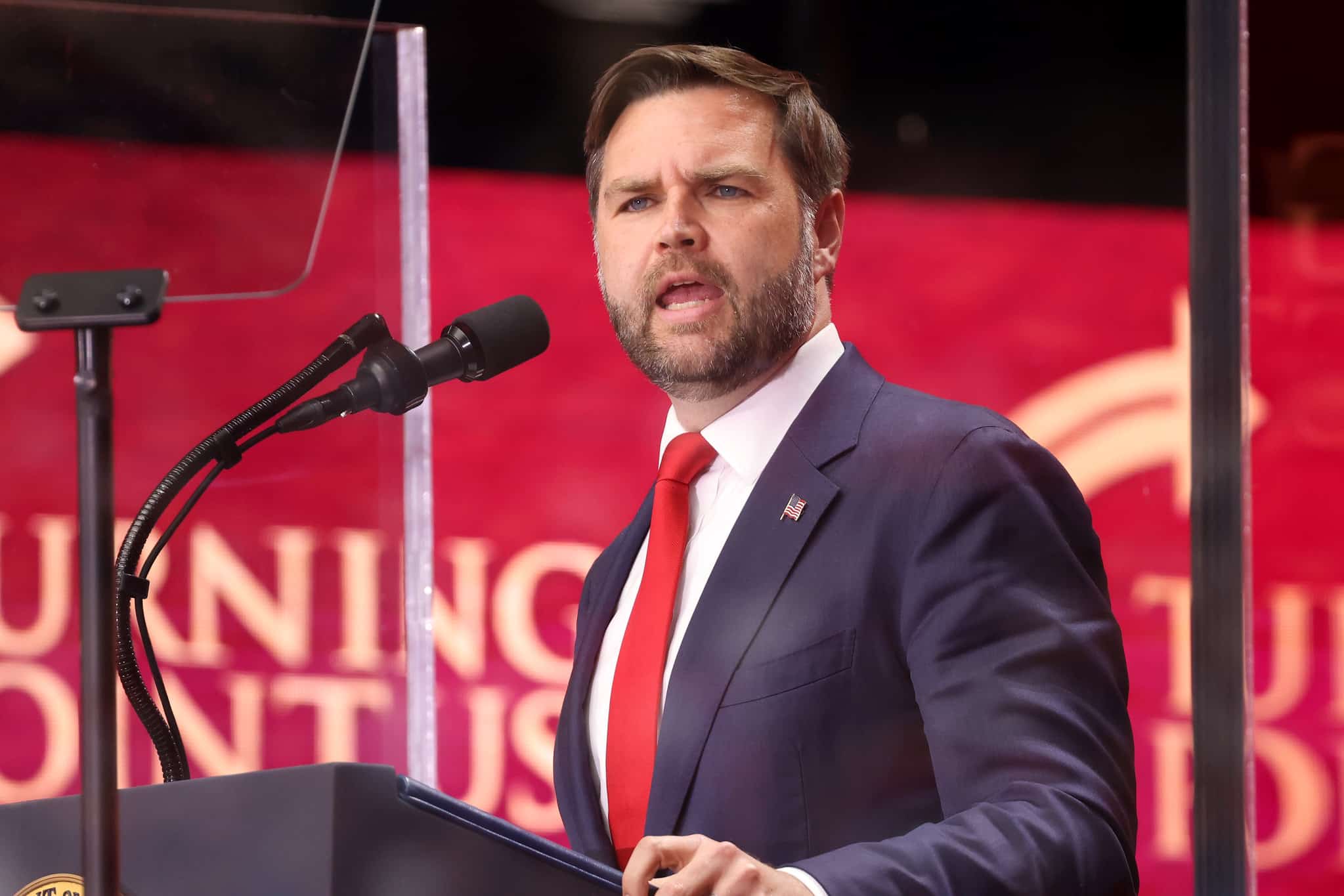
In an interview with conservative political commentator and best-selling author Michael Knowles released at the end of June, Vice President JD Vance repudiated the free-market elements of the pre-MAGA Republican agenda. He bemoaned the influence of many names associated with free-market ideology, including economist Milton Friedman, philosopher Ayn Rand, and British Prime Minister Margaret Thatcher.
“I do think that, for our friends who are on the more laissez faire side of the American right, in hindsight, part of why Milton Friedman’s ideas made more sense in the 1980s is because they were being advocated in a country that still had a very rich and powerful institutional Christianity,” the vice president argued. “And so, being laissez faire in a world where there are Christian guardrails on everything is a much different proposition than being laissez faire in a world where globalized liberalism has become the sort of status quo of American elites.”
At first glance, this chain of reasoning may appear compelling. We don’t want people shooting up heroin in the streets, starting OnlyFans accounts instead of families, and teaching Karl Marx in middle schools. A deeply Christian society has cultural norms to disincentivize such behaviors, so it doesn’t need Congress to write bills prohibiting them, but perhaps twenty-first century secular society does.
This argument unfortunately relies on a conception of government whereby tax-funded institutions are better equipped than free markets to define and enforce human virtue. This conception is a fairytale. A more realistic understanding of tax-funded institutions reveals that they are far more likely to damage the moral character of society and diminish the prevalence of human virtue than free markets are. Therefore, diminishing the power of markets on behalf of government regulation is more likely to further damage the social fabric than to heal it.
To understand why, the fundamental difference between market and tax-funded institutions must be remembered: the former is a system of private property, while the latter is a system of coercive redistribution of resources. This difference is key to the discussion of human virtue because private property rewards virtuous stewardship of resources (time and effort as well as material wealth) while coercive redistribution punishes such virtue or at least enables vice in its stead.
This is because when you make decisions about your own private property, you are the principal beneficiary or victim of the quality of your decisions. When, however, as a voter or policymaker, you make decisions about property that is not yours (so called “public goods” or property that is nominally owned privately by someone else but is regulated on behalf of your policy preferences), you are not forced to worry as much about the quality of your decisions, because it is someone else who will primarily suffer the consequences of your folly.
As George Mason University economist Bryan Caplan writes in his book The Myth of the Rational Voter: Why Democracies Choose Bad Policies, “When a consumer has mistaken beliefs about what to buy, he foots the bill. When a voter has mistaken beliefs about government policy, the whole population picks up the tab.” This is why, as the Nobel Prize-winning economist Milton Friedman hyperbolically but astutely explained:
“Nobody spends somebody else’s money as carefully as he spends his own. Nobody uses somebody else’s resources as carefully as he uses his own. So if you want efficiency and effectiveness, if you want knowledge to be properly utilized, you have to do it through the means of private property.”
If you’re wondering what this has to do with virtue and vice, perhaps an example will help. Consider the vice of heroin consumption. Heroin use is outlawed by U.S. government policy, whereas in a purely free market people would be legally free to produce, purchase, and use heroin on their private property. JD Vance and Michael Knowles, therefore, probably hold the common view that government regulation is reducing the vice of heroin use while free market policy would proliferate it. But life is so much more complicated than that, and really the opposite is probably true.
Heroin regulation obviously does prevent certain instances of heroin use at the margins. But think of all the government policies that enable heroin use by decoupling people’s decisions from the costs of those decisions. If heroin use makes you unreputable and employers don’t want to hire you, you can file for “unemployment benefits” and live off other people’s money against their will through taxation. If you overdose on heroin and need emergency care you can’t pay for, U.S. hospitals are required by law to care for you. If you lose your home or live in a horrible home because heroin use has reduced your wealth to virtually zero, there are publicly funded facilities you can use, such as libraries, public transportation, and public parks, that taxpayers are forced to invest in on your behalf. And the list goes on.
Broadly speaking, the fact that over a third of the landmass of the United States is owned “publicly,” meaning that taxpayers are forced to bankroll its maintenance and you can use most of these facilities without anyone inviting you or having voluntarily agreed to associate with you at all, means that you’re shielded to a large degree from the reputational consequences of your actions and lifestyle generally. This doesn’t just include marginal resources such as public parks and libraries. It also includes some of the most important infrastructure of our civilization, such as most of the roads and schools in America. Much of the cost of your bad decisions are socialized.
In a society in which people are constantly forced to fund shared “public works,” and thus coerced into interacting with each other both physically and financially, people are able to sit back and relax their adherence to reputable conduct on the faith that they’ll be “taken care of” regardless of their merit and that “we’re all in this together,” sort of like communists. Conversely, in a society of private property, where the freedom of association restricts you to interacting with people who voluntarily interact with you, you have to be very concerned with your reputability, because you’re constantly rewarded for your virtue and punished for your vices, to the degree that others are able to track them, by people’s voluntary association with you, or lack thereof.
The biggest tax funded-programs can generally be relied on most to erode precisely the family values that Vance purports to champion. But he supports these tax-funded programs, while the more “laissez faire” conservatives of the pre-MAGA era correctly criticized them on free-market grounds.
For example, while Republicans such as Presidents Ronald Raegan and George W. Bush advocated limiting the scale of Social Security (by slowing its growth or reducing its payments to higher earners), Vance opposes cutting it at all. But for the reasons described above, Social Security has done immense damage to the institution of family. Before Social Security, a primary incentive to have children, and therefore also to get married, was that children would grow up and create a familial safety net, providing care and support for their elderly parents and grandparents.
Social Security, which is the largest single item in the annual federal U.S. budget, has destroyed this major incentive to build families by providing an alternative safety net while taking money away from young people and thereby making it much harder for them to build families in the first place.
This should horrify Vance and anyone else who agrees with Christianity about the fundamental importance of building families. And of course, once young people have been disincentivized from concerning themselves with the prospect of family-building, they will be much less hesitant to try heroin, go on OnlyFans, or engage in any number of other vices. Such behavior is far less rational for those seeking long-term monogamous relationships and self-made financial stability than it is to those expecting a lifetime of exorbitant income taxes followed by a government-funded retirement.
For reasons such as all of these, Vance has his causal chain reversed. The diminution of markets, such as through increased regulation and government spending, has probably been partly to blame for the decline of Christian values. If this is true, his anti-market policies are probably counter-productive for accomplishing his stated aims.
If JD Vance wants to promote morality and virtue through public policy, he should do it by advancing an agenda of recoupling people’s decisions with the consequences of those decisions. Divergences from the system of private property create moral hazard by allowing people to externalize the cost of their vices and leech off of each other’s virtue. This is a recipe for enabling vice and punishing virtue. Pro-market policies do the opposite. They reward the construction of strong, reliable social institutions and punish short-term thinking and licentiousness. That is how to foster the healthy social fabric that Vance and the New Right claim to care about.