With Maggie Haberman’s new book Regime Change: Inside the Imperial Presidency of Donald Trump generating plenty of headlines—including from President Trump himself—I decided to give it a listen on Spotify.
One passing comment stuck with me. During a segment, Haberman notes how the Russia investigation impacted Donald Trump Jr.’s marriage. Later in the book, Haberman mentions former Director of National Intelligence Tulsi Gabbard’s return to the president’s good graces after her 2025 disclosures surrounding the Russia investigation.
These moments gave instant flashbacks to the Russia saga that was a part of our lives for years. While late night host Stephen Colbert was renting the hotel room in Moscow alleged to be used in the ”pee tape” from the Steele Dossier, the real consequences continued to unfold in Washington.
Russiagate didn’t just dominate on cable news. It impacted Washington politically, changed perceptions of foreign policy, and made any attempt at improving relations with Russia politically undoable.
The allegations started absurdly enough: Donald Trump’s presidential campaign was involved in a conspiracy with the Kremlin in order to steal the 2016 election. Much of the public perception relied on the Steele Dossier—opposition research funded by the Hillary Clinton presidential campaign and put together by former British intelligence officer Christopher Steele.
After years of investigations, Special Counsel Robert Mueller found no evidence that the Trump campaign conspired or coordinated with the Russian government regarding the 2016 election. The Durham Special Counsel investigation in 2023 further criticized the origins of the investigation, including the FBI’s handling of it.
Still, the story of collusion dominated headlines. Stories included Trump personal attorney Michael Cohen secretly traveling to Prague, campaign advisor Carter Page acting as a Russian asset, Russian hackers infiltrating Vermont’s power grid, and countless other claims. Anonymous sources routinely drove reporting, often with little skepticism.
As the dust settled, a number of journalists began to debunk the story. Matt Taibbi compared the Russia coverage to Iraqi weapons of mass destruction. Aaron Maté spent years following the story including how many of the allegations collapsed under scrutiny.
Jeff Gerth’s exhaustive Columbia Journalism Review investigation remains one of the most comprehensive examinations of how the story developed—and how few news organizations seriously examined their own mistakes afterward.
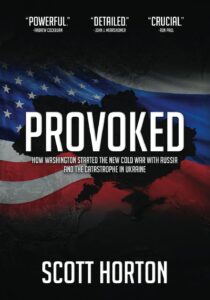
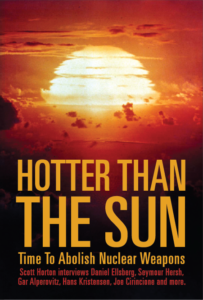
Libertarian Institute Director Scott Horton also devotes considerable attention to Russiagate in Provoked, arguing that the controversy pushed Trump toward a much more confrontational Russia policy than he had originally campaigned on.
Whether one agrees with that assessment or not, the foreign policy implications are difficult to ignore.
Trump entered office repeatedly expressing interest in improving relations with Moscow. Given the possibility of cooperation on issues like counterterrorism, nuclear arms control, and regional conflicts, it was not an unreasonable objective. But under the constant cloud of collusion accusations, attempts at diplomacy risked being portrayed as evidence that he was a “Putin puppet.”
Political voices in the United States reflected these accusations. Former CIA case officer Robert Baer argued on CNN that “the country that attacked us in the 2016 elections, you can’t go into business with them. It’s truly like working with the Japanese after Pearl Harbor to defend Hawaii.” Hillary Clinton similarly compared the alleged Russian interference to the September 11 attacks.
As a result, the administration remained boxed in.
Trump approved lethal Javelin missile sales to Ukraine during his first term after the Barack Obama administration declined to do so. His administration expanded NATO by admitting Montenegro and North Macedonia, carried out strikes against Russian-backed Syrian government forces, expelled Russian diplomats, and imposed sanctions targeting projects like Nord Stream 2. Whether these decisions were driven entirely by Russiagate is debatable, but the political pressure surrounding the investigation undoubtedly narrowed the administration’s options.
The perception of undue Russian influence even extended to statements provided by the Trump family in relation to policy decisions. After the United States launched missiles at Syria in 2017, Eric Trump stated, “If there was anything that Syria did, it was to validate the fact that there is no Russia tie.” The president himself in an opinion piece for Newsweek declared that “instead of having a better relationship with Russia as I worked to build, we now have a proxy war with Russia, fueled in part by the lingering fumes of Russiagate delirium.”
Years later, new information continues to emerge.
As Director of National Intelligence, Tulsi Gabbard oversaw the release of documents surrounding what her office has called the “Manufactured Russia Hoax.” Among other things, the declassified material alleges that senior intelligence officials sidelined dissenting analysts during the 2017 Intelligence Community Assessment, were aware of significant credibility problems surrounding the Steele Dossier, and discussed intelligence connected to what became known as the “Clinton Plan” to link Trump politically to Russia.
Those claims, like many aspects of Russiagate, will continue to be debated for years to come. With the potential of additional FOIA releases in the future, this story may continue to evolve in the decades to come.
The impact of Russiagate cannot be overstated. It remained everpresent in the media during most of Trump’s first presidency, decreased trust in major institutions, and developed a political relaity where even attempts at diplomacy could be viewed as collusion.
With Trump recently discussing the possibility of granting Ukraine a license to produce Patriot missiles, it highlights that while the main Russiagate story has largely faded from public attention, the effects of that period continue to shape Washington’s relationship with Moscow.