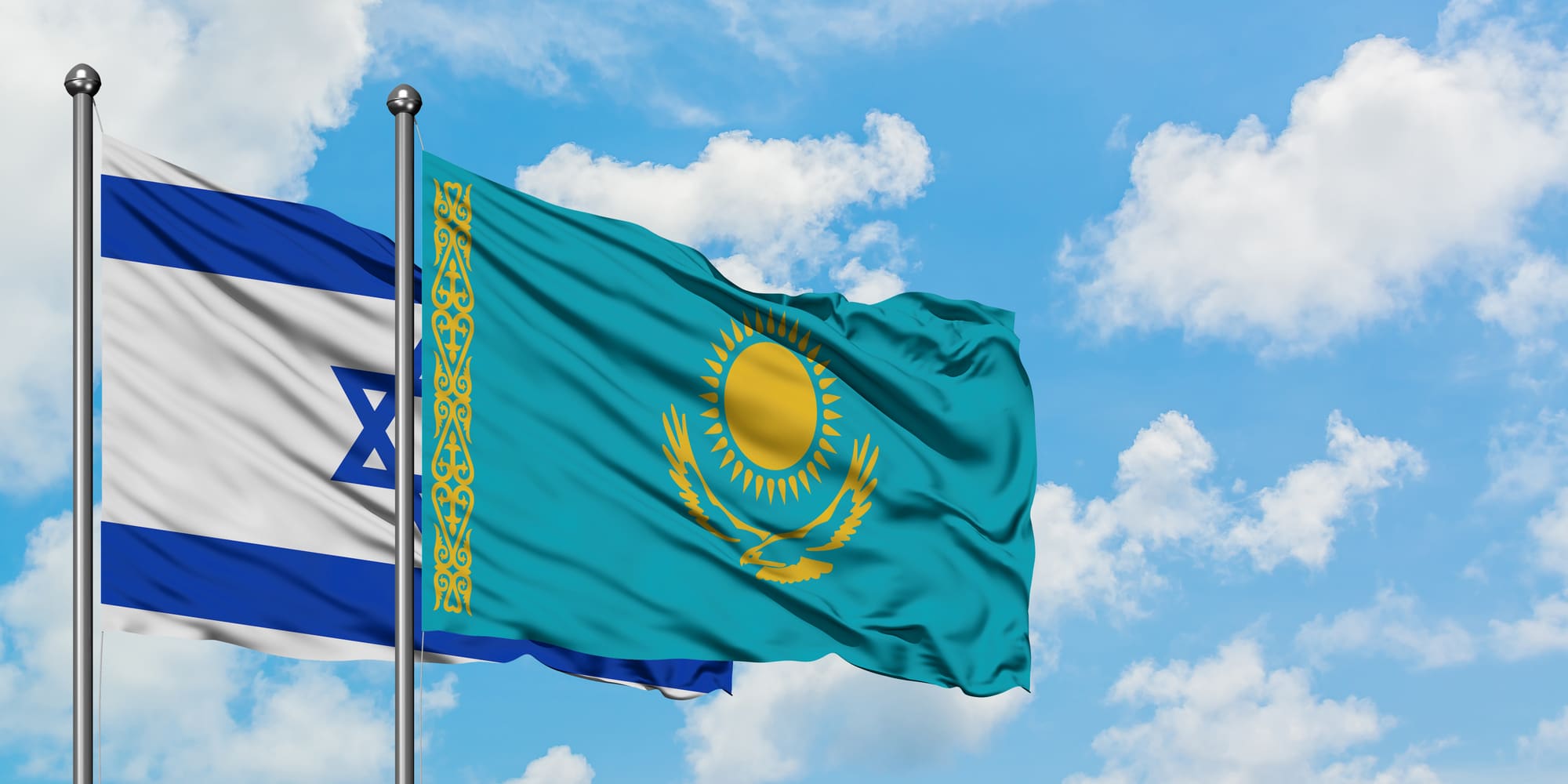
When President Donald Trump announced that Kazakhstan would join the Abraham Accords after a celebratory call with Israeli Prime Minister Benjamin Netanyahu and Kazakhstan President Kassym Jomart Tokayev, he treated the move as another triumph of personal diplomacy and a fresh step toward Middle East peace. The White House framed the development as a sign that the accords still attract eager applicants despite the carnage in Gaza.
The substance tells a different story. Kazakhstan already lives in Israel’s diplomatic inner circle. The two states recognized each other in the early years after the Soviet collapse and moved quickly to create a full relationship. Israel opened an embassy in Almaty in August 1992 and later shifted it to Astana. Kazakhstan opened its own embassy in Tel Aviv in 1996.
From the start, the partnership rested on clear interests rather than lofty rhetoric. Israeli officials saw in Kazakhstan a rare majority Muslim state that remained receptive to close ties with the West and wanted to diversify its external relationships. Analysts who studied this alignment noted that Israeli policymakers sought alliances in the Muslim world to break their regional isolation, while Kazakh leaders wanted Israeli expertise in technology, water management, agriculture, and defense.
High-level visits gave the relationship a ceremonial sheen long before anyone uttered the phrase Abraham Accords. The late Israeli President Shimon Peres visited Kazakhstan several times and made a notable trip in June 2009. In 2016, Prime Minister Netanyahu traveled to Astana for a Kazakh Israeli business forum. The visit marked the first appearance of an Israeli head of government in Kazakhstan and confirmed that both governments already regarded each other as strategic partners.
This history matters because Trump officials now present Kazakhstan’s accession as a diplomatic breakthrough that revitalizes a stalled process. American envoys tell reporters that the shift shows how many states want to join what one described to Anadolu as a club of peace. The same official claimed that Kazakhstan’s move helps turn the page on the war in Gaza and moves the region toward cooperation.
Kazakh leaders do not pretend that a sudden conversion drove this decision. They call the step a natural and logical continuation of a foreign policy that emphasizes dialogue, balance, and regional stability. They also understand the utility of public support from Washington. The State Department already hails what it calls a new era in relations with Kazakhstan and celebrates an enhanced strategic partnership.
The broader record of the Abraham Accords follows a similar pattern. The main signatories do not fit the image of historic enemies who finally set aside existential quarrels. They belong instead to a loose network of regimes that already cooperated with Israel in secret or never posed a serious military threat in the first place.
The United Arab Emirates (UAE) serves as the most obvious example. Israel and the UAE formalized relations in 2020. Commentators in Washington described that agreement as the first public recognition of Israel by an Arab state since Jordan and treated the move as a thunderclap. In reality, the two sides had built quiet contacts for decades. Reports in The New Yorker describe ongoing security coordination from the 1990s onward and stress how shared hostility toward Iran drew the two together.
The UAE never fought Israel in the classic Arab Israeli wars. The federation only came into existence in 1971, long after the battles of 1948 and 1967. During the 1973 Yom Kippur War, the country’s founding ruler, Sheikh Zayed bin Sultan Al Nahyan, spoke of Israel as the enemy of Arab countries, but the federation did not engage in meaningful combat.
Behind the scenes, Israeli and Emirati officers trained and flew together. In 2016, pilots from both states took part in Red Flag exercises in Nevada. The next year the two air forces joined a multinational drill in Greece, an event that Haaretz noted with restrained surprise.
Bahrain follows a similar journey. The kingdom joined the Arab League boycott after independence and denounced Israel in public settings. During the 1973 war, Bahrain joined the Arab oil embargo and shut down operations at a United States naval facility to display solidarity with Egypt and Syria. The Institute for Defence Studies and Analyses notes that the island state never sent its own forces into battle against Israel.
Contacts deepened quietly in the 1990s. Israel sent an environmental minister to a regional meeting in Manama in 1994. Haaretz later recalled how officials in both capitals opened trade missions after the Oslo accords. Those missions closed after the second intifada, but they left behind a network of contacts. Bahrain then scrapped its boycott of Israel in 2005 in exchange for a free trade agreement with the United States.
Wikileaks cables added another layer to that story. In a 2005 meeting with the American ambassador, King Hamad bin Isa Al Khalifa bragged about his contacts with Mossad and promised broader cooperation. He told his ministers not to refer to Israel as an enemy or as a Zionist entity in official statements. The New York Times later traced these steps in a long retrospective on the road to the formal accord.
Morocco offers a case that looks more dramatic at first glance and becomes less so upon close inspection. Moroccan troops fought Israel in the war of 1948 and in the Six Day War. Rabat denounced Israel for decades and joined the regional boycott. Yet the palace also cultivated one of the most intimate covert relationships that Israel ever enjoyed with an Arab monarchy.
In a remarkable account published in The Times of Israel, a former Israeli general Shlomo Gazitl credits Moroccan intelligence with a decisive role in Israel’s victory in 1967. Two years earlier King Hassan II invited Arab leaders to a summit in Casablanca and secretly recorded their private deliberations. Moroccan services then provided those recordings to Israeli counterparts. The tapes revealed confusion and unpreparedness among the Arab commanders. Israeli planners drew confidence from that knowledge.
The ties reached far beyond espionage. A large Moroccan Jewish community migrated to Israel after 1948 and created a deep social bridge. The BBC notes that roughly 900,000 Israelis claim Moroccan ancestry. Israeli agencies equipped and trained Moroccan forces and assisted in the murder of Medhi Ben Barka, a prominent opposition leader. Morocco eased Jewish emigration and helped Israel keep tabs on other Arab regimes.
During the 1990s Rabat opened low level diplomatic offices with Israel. The Washington Institute recalls how both governments closed those offices when the second intifada erupted, but they never severed their intelligence and security channels. When Morocco decided to sign the Abraham Accords in 2020, its leaders did not act out of sudden affection for Zionism. They pursued U S recognition of their control over Western Sahara, an outcome that analysts at The Security Distillery correctly identify as Rabat’s main motive. The accord formalized a very old relationship and delivered a long sought territorial prize.
Sudan appears at first to break the pattern. Sudanese units joined Arab armies in the wars of 1948 and 1967. Khartoum long served as a center of anti-Israeli rhetoric and aligned itself with the most rejectionist currents in Arab politics. Analysts at MERIP stress how Sudan’s rulers used hostility toward Israel as part of a broader anti Western posture.
Even here, the story loses some of its drama. Israeli strategists saw opportunity in Sudan’s internal wars and supported the Anya Nya rebels in the south. Research published by RAHS describes how Israeli agents supplied arms and training to southern forces to weaken Egypt’s southern flank and punish Khartoum for its alignment. Sudan responded by moving troops to the Suez Canal and accusing Israel of subversion.
The same research shows that the two states cooperated at key moments. In the 1950s Israel cultivated links with the Ummah Party and held a secret meeting between Golda Meir and Prime Minister Abdallah Khalil. That channel collapsed after a coup. Years later Israel and Sudan worked together on the airlift of Ethiopian Jews in Operation Moses. Sudanese rulers received much needed aid and diplomatic support for participating in this operation but cut off the arrangement after yet another overthrow.
When Sudan agreed to sign the Abraham Accords in 2020, its rulers sought escape from crippling sanctions. Observers at The Security Distillery emphasize that point. In return for the announcement, the United States removed Sudan from its list of state sponsors of terrorism. That change opened access to international financing and aid. Civil war now ravages Sudan, and no one can speak honestly of full normalization. The signatures exist on paper while the country burns.
Taken together, the accords do not represent a clean break with the past. They function as public ceremonies that ratify existing alignments and deliver targeted benefits. Israel expands its network of open relationships with regimes that either never fought it or already worked with it in secret. Partner governments secure sanctions relief, territorial recognition, trade deals, and closer access to American weapons and technology.
Kazakhstan’s entry fits this pattern but adds even less. The Central Asian republic never participated in Arab wars against Israel. It never joined a boycott and never framed Israel as an existential enemy. Its leaders looked outward after independence, saw a small state with advanced technology, and decided to work with it.
The Trump administration touts this development as proof that the accords endure. Special envoy Steve Witkoff speaks in confident tones about future announcements. Analysts at the Heritage Foundation note ongoing conversations with Syria and Lebanon. Officials hint at future deals with Saudi Arabia, Libya, Azerbaijan, and Armenia.
Washington may celebrate each new signatory as a historic breakthrough, but the pattern remains unchanged: states that never fought Israel or already worked with it in secret now receive public credit and tangible rewards for acknowledging what they long ago accepted in private.