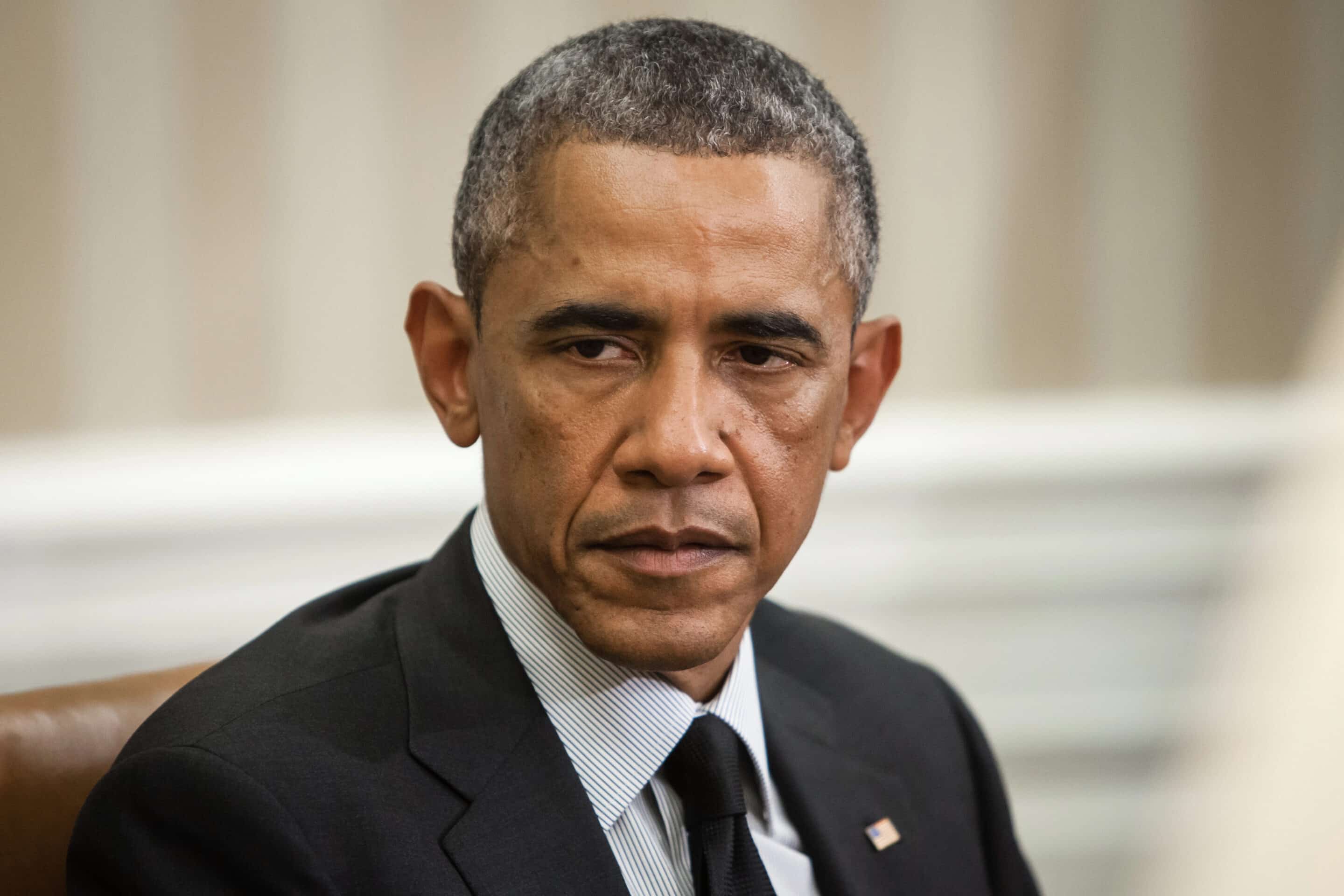
The Trump administration’s killings of scores of Venezuelans are justifiably provoking outrage. Secretary of War Pete Hegseth recently proclaimed, “We have only just begun to kill narco-terrorists.” Donald Trump and Hegseth are cashing a blank check for carnage that was written years earlier by President Barack Obama.
In his 2017 farewell address, Obama boasted, “We have taken out tens of thousands of terrorists.” Drone strikes increased tenfold under Obama, helping fuel anti–U.S. backlashes in several nations.
As he campaigned for the presidency in 2007, then-Senator Barack Obama declared, “We will again set an example for the world that the law is not subject to the whims of stubborn rulers.” Many Americans who voted for Obama in 2008 expected a seachange in Washington. However, from his first weeks in office, Obama authorized widespread secret attacks against foreign suspects, some of which spurred headlines when drones slaughtered wedding parties or other innocents.
On February 3, 2010, Obama’s Director of National Intelligence Dennis Blair stunned Washington by announcing that the administration was also targeting Americans for killing. Blair revealed to a congressional committee the new standard for extrajudicial killings:
“Whether that American is involved in a group that is trying to attack us, whether that American has—is a threat to other Americans. We don’t target people for free speech. We target them for taking action that threatens Americans.”
But “involved” is a vague standard—as is “action that threatens Americans.” Blair stated that “if we think that direct action will involve killing an American, we get specific permission to do that.” Permission from who?
Obama’s first high-profile American target was Anwar Awlaki, a cleric born in New Mexico. After the 9/11 attacks, Awlaki was showcased as a model moderate Muslim. The New York Times noted that Awlaki “gave interviews to the national news media, preached at the Capitol in Washington and attended a breakfast with Pentagon officials.” He became more radical after he concluded that the Geoge W. Bush administration’s Global War on Terror was actually a war on Islam. After the FBI sought to squeeze him into becoming an informant against other Muslims, Awlaki fled the country. He arrived in Yemen and was arrested and reportedly tortured at the behest of the U.S. government. After he was released from prison eighteen months later, his attitude had worsened and his sermons became more bloodthirsty.
After the Obama administration announced plans to kill Awlaki, his father hired a lawyer to file a challenge in federal court. The ACLU joined the lawsuit, seeking to compel the government “to disclose the legal standard it uses to place U.S. citizens on government kill lists.” The Obama administration labeled the entire case a “State Secret.” This meant that the administration did not even have to explain why federal law no longer constrained its killings. The administration could have indicted Awlaki on numerous charges but it did not want to provide him any traction in federal court.
In September 2010, The New York Times reported that “there is widespread agreement among the administration’s legal team that it is lawful for President Obama to authorize the killing of someone like Mr. Awlaki.” It was comforting to know that top political appointees concurred that Obama could justifiably kill Americans. But that was the same “legal standard” the Bush team used to justify torture.
The Obama administration asserted a right to kill U.S. citizens without trial, without notice, and without any chance for the marked men to legally object. In November 2010, Justice Department attorney Douglas Letter announced in federal court that no judge had legal authority to be “looking over the shoulder” of Obama’s targeted killing. Letter declared that the program involves “the very core powers of the president as commander in chief.”
The following month, federal judge John Bates dismissed the ACLU’s lawsuit because “there are circumstances in which the Executive’s unilateral decision to kill a U.S. citizen overseas” is “judicially unreviewable.” Bates declared that targeted killing was a “political question” outside the court’s jurisdiction. His deference was stunning: no judge had ever presumed that killing Americans was simply another “political question.” The Obama administration’s position “would allow the executive unreviewable authority to target and kill any U.S. citizen it deems a suspect of terrorism anywhere,” according to Center for Constitutional Rights attorney Pardiss Kebriae.
On September 30, 2011, a U.S. drone attack killed Awlaki along with another American citizen, Samir Khan, who was editing an online Al Qaeda magazine. Obama bragged about the lethal operation at a military base later that day. A few days later, administration officials gave a New York Times reporter extracts a peek at the fifty-page secret Justice Department memo. The Times noted, “The secret document provided the justification for [killing Awlaki] despite an executive order banning assassinations, a federal law against murder, protections in the Bill of Rights and various strictures of the international laws of war, according to people familiar with the analysis.” The legal case for killing Awlaki was so airtight that it did not even need to be disclosed to the American public.
Two weeks after killing Awlaki, Obama authorized a drone attack that killed his son and six other people as they sat at an outdoor café in Yemen. Anonymous administration officials quickly assured the media that Abdulrahman Awlaki was a 21-year-old Al Qaeda fighter and thus fair game. Four days later, The Washington Post published a birth certificate proving that Awlaki’s son was only 16-years old and had been born in Denver. Nor did the boy have any connection with Al Qaeda or any other terrorist group. Robert Gibbs, Obama’s former White House press secretary and a top advisor for Obama’s reelection campaign, later shrugged that the 16-year-old should have had “a far more responsible father.”
Regardless of that boy’s killing, the media often portrayed Obama and his drones as infallible. A Washington Post poll a few months later revealed that 83% of Americans approved of Obama’s drone killing policy. It made almost no difference whether the suspected terrorists were American citizens; 79% of respondents approved of preemptively killing their fellow countrymen, no judicial niceties required. The Post noted that “77 percent of liberal Democrats endorse the use of drones, meaning that Obama is unlikely to suffer any political consequences as a result of his policy in this election year.” The poll results were largely an echo of official propaganda. Most folks “knew” only what the government wanted them to hear regarding drones. Thanks to pervasive secrecy, top government officials could kill who they chose and say what they pleased. The fact that the federal government had failed to substantiate more than 90% of its terrorist accusations since 9/11 was irrelevant since the president was omniscient.
On March 6, 2012, Attorney General Eric Holder, in a speech on targeted killings to a college audience, declared, “Due process and judicial process are not one and the same, particularly when it comes to national security. The Constitution guarantees due process, it does not guarantee judicial process.” TV comedian Stephen Colbert mocked Holder, quipping “Trial by jury, trial by fire, rock, paper scissors, who cares? Due process just means that there is a process that you do.” One purpose of due process is to allow evidence to be critically examined. But there was no opportunity to debunk statements from anonymous White House officials. For the Obama administration, “due process” meant little more than reciting certain phrases in secret memos prior to executions.
Holder declared that the drone attacks “are not [assassinations], and the use of that loaded term is misplaced; assassinations are unlawful killings. Here, for the reasons I have given, the U.S. government’s use of lethal force in self-defense.” Any termination secretly approved by the president or his top advisers was automatically a “lawful killing.” Holder reassured Americans that Congress was overseeing the targeted killing program. But no one on Capitol Hill demanded a hearing or investigation after U.S. drones killed American citizens in Yemen. The prevailing attitude was exemplified by House Homeland Security Committee Chairman Peter King (R-NY):
“Drones aren’t evil, people are evil. We are a force of good and we are using those drones to carry out the policy of righteousness and goodness.”
Obama told White House aides that it “turns out I’m really good at killing people. Didn’t know that was gonna be a strong suit of mine.” In April 2012, The New York Times was granted access for a laudatory inside look at “Terror Tuesday” meetings in the White House:
“Every week or so, more than 100 members of the government’s sprawling national security apparatus gather, by secure video teleconference, to pore over terrorist suspects’ biographies and recommend to the president who should be the next to die.”
It was a PowerPoint death parade. The Times stressed that Obama personally selected who to kill next:
“The control he exercises also appears to reflect Mr. Obama’s striking self-confidence: he believes, according to several people who have worked closely with him, that his own judgment should be brought to bear on strikes.”
Commenting on the Times’ revelations, author Tom Engelhardt observed, “We are surely at a new stage in the history of the imperial presidency when a president (or his election team) assembles his aides, advisors and associates to foster a story that’s meant to broadcast the group’s collective pride in the new position of assassin-in-chief.”
On May 23, 2013, Obama, in a speech on his targeted killing program at the National Defense University in Washington, told his fellow Americans that “we know a price must be paid for freedom”—such as permitting the president untrammeled authority to kill threats to freedom. The president declared that “before any strike is taken, there must be near-certainty that no civilians will be killed or injured—the highest standard we can set.”
Since almost all the data on victims was confidential, it was tricky to prove otherwise. But NBC News acquired classified documents revealing that the CIA was often clueless about who it was killing. NBC noted, “Even while admitting that the identities of many killed by drones were not known, the CIA documents asserted that all those dead were enemy combatants. The logic is twisted: If we kill you, then you were an enemy combatant.” Killings are also exonerated by counting “all military-age males in a strike zone as combatants…unless there is explicit intelligence posthumously proving them innocent.” And U.S. bureaucrats have no incentive to track down evidence exposing their fatal errors. The New York Times revealed that U.S. “counterterrorism officials insist…people in an area of known terrorist activity…are probably up to no good.” The “probably up to no good” standard absolved almost any drone killing within thousands of square miles in Pakistan, Yemen, and Somalia. Daniel Hale, a former Air Force intelligence analyst, leaked information revealing that nearly 90% of people who were killed in drone strikes were not the intended targets. Joe Biden’s Justice Department responded by coercing Hale into pleading guilty to “retention and transmission of national security information,” and he was sent to prison in 2021.
Sovereign immunity entitles presidents to kill with impunity. Or at least that is what presidents have presumed for most of the past century. If the Trump administration can establish a prerogative to preemptively kill anyone suspected of transporting illicit narcotics, millions of Americans could be in the federal cross-hairs. But the Trump administration is already having trouble preserving total secrecy thanks to controversies over who ordered alleged war crimes. Will Trump’s anti-drug carnage end up torpedoing his beloved Secretary of War Hegseth and his own credibility with Congress, the judiciary, and hundreds of millions of Americans who do not view White House statements as divine revelations handed down from Mt. Sinai?