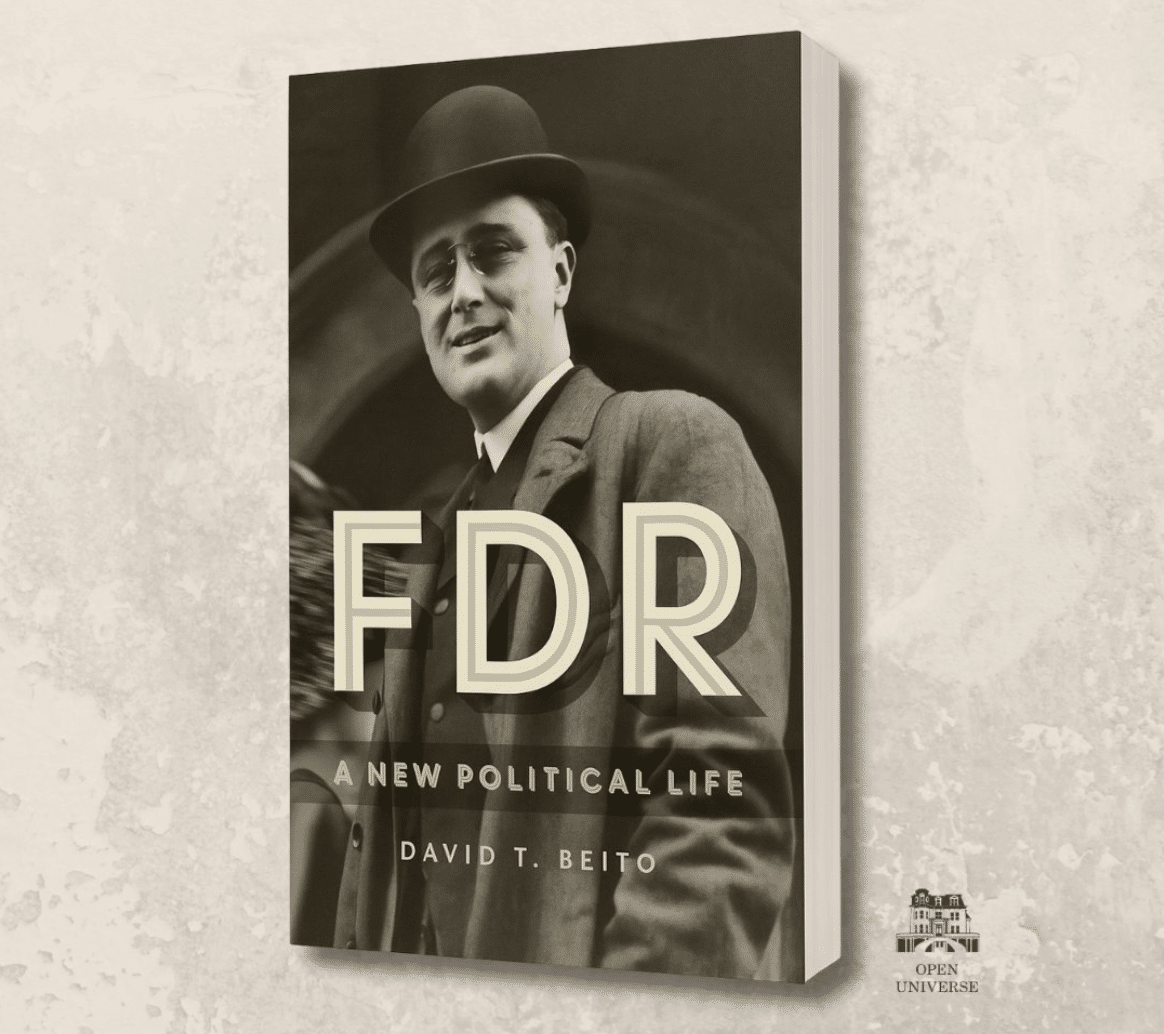
David T. Beito’s FDR: A New Political Life offers a bracing, deeply researched, and welcome reassessment of Franklin Delano Roosevelt, one that decisively breaks with the hagiographic tradition that has dominated twentieth century American historiography. The book’s central thesis is clear and consistently sustained: far from being a reluctant savior who rescued the nation from economic collapse and foreign aggression, Roosevelt was a highly ambitious political operator whose domestic and wartime policies entrenched executive power, prolonged economic dislocation, eroded civil liberties, and left a dangerous institutional legacy that still shapes American governance. In short, the Roosevelt myth obscures a presidency that failed on its own terms while profoundly transforming the American state for the worse.
Beito is perfectly positioned to write such a study. His earlier work—most notably The New Deal’s War on the Bill of Rights—has already established him as one of the leading scholars documenting the civil-liberties costs of the New Deal and World War II. This new volume broadens that project into a full political biography, tracing Roosevelt’s rise, rule, and legacy with an emphasis on incentives, institutions, and unintended consequences rather than sentimentality or hero worship.
The opening chapter situates Roosevelt firmly within the elite, patrician world that shaped his worldview and ambitions. Beito traces FDR’s upbringing, education, and early political grooming, emphasizing how his aristocratic confidence and inherited assumptions about authority translated into a paternalistic vision of governance. Roosevelt’s admiration for Theodore Roosevelt and Woodrow Wilson emerges early, foreshadowing his later embrace of administrative centralization, moral crusading, and executive dominance.
Beito then turns to the crucible of the Great Depression, dismantling the popular notion that the New Deal represented a coherent or effective response to economic collapse. Instead, Roosevelt exploited fear and emergency rhetoric to justify continuing expansions of federal power. Programs were improvised, contradictory, and frequently destructive, undermining price signals, freezing labor markets, and discouraging private investment. The chapter makes clear that emergency governance became not a temporary expedient, but a permanent style.
If the first New Deal was chaotic, the second was deliberately hostile to market processes. Beito shows how labor cartels, wage mandates, and regulatory entrenchment deepened unemployment and delayed recovery. Drawing on economic scholarship that has steadily accumulated over the past several decades, he reinforces the now well-supported conclusion that New Deal interventions prolonged the Depression rather than ending it—an argument once controversial but increasingly accepted among economic historians.
One of the book’s most disturbing chapters examines Roosevelt’s weaponization of the federal government against political opponents. Beito details how tax audits, investigations, and administrative harassment were deployed selectively to punish critics and reward loyalists. This “Black Inquisition” exposes the darker underside of New Deal governance and underscores how centralized power invites abuse regardless of rhetorical intentions.
Here Beito skillfully reconstructs a largely forgotten episode: the emergence of an unlikely coalition of civil libertarians from across the political spectrum resisting Roosevelt’s assaults on free speech. The chapter highlights how repression was not merely a wartime phenomenon but a recurring feature of Roosevelt’s political toolkit, resisted by principled dissenters whom later histories have marginalized or ignored.
Beito’s analysis of Roosevelt’s path to war challenges the conventional narrative of reluctant involvement forced by unprovoked aggression, demonstrating that Roosevelt actively maneuvered the United States toward conflict while publicly claiming neutrality. Executive secrecy, rhetorical manipulation, and incremental escalation defined a presidency that increasingly governed through deception rather than democratic consent (something acknowledged even by Roosevelt apologists such as Robert Dallek).
Beito then goes on to explore the long-term consequences of Roosevelt’s wartime decisions, particularly the doctrine of unconditional surrender. Beito argues that these choices prolonged the war, hardened enemy resistance, and empowered totalitarian allies—most notably Stalin—while laying the groundwork for postwar instability. The analysis underscores how moral absolutism and strategic miscalculation often went hand in hand.
The final chapter assesses Roosevelt’s legacy with unsparing clarity, determining that the New Deal failed economically, the wartime state corroded constitutional norms, and the postwar order reflected compromises that betrayed liberal principles and a vision of American global power that necessitated the sustaining of a totalitarian bureaucracy in the United States.
FDR: A New Political Life is a major contribution to the revisionist literature that seeks to dismantle the enduring legend of Franklin Delano Roosevelt. Beito does not argue that Roosevelt was uniquely evil or historically anomalous; rather, he shows how ambition, ideology, and unchecked power combined to produce outcomes at odds with their stated aims. In doing so, he invites readers to reconsider not only Roosevelt himself, but the broader assumptions about crisis governance, executive authority, and historical “necessity” that continue to shape American political thought.
At a moment when executive overreach is again justified in the language of emergency and moral urgency, Beito’s work is both timely and essential. Scholars, students, and general readers alike owe him thanks for a rigorous, courageous, and deeply unsettling book—one that reminds us that myths may comfort, but history, properly told, should challenge.