In late January 2026, China’s Ministry of National Defense announced investigations into two of the People’s Liberation Army’s (PLA) most senior officers: General Zhang Youxia, long-time vice chairman of the Central Military Commission (CMC) and a close Xi Jinping ally, and General Liu Zhenli, chief of the CMC’s Joint Staff Department. These investigations capped a wave of high-level purges that began in 2023 and steadily hollowed out the PLA’s senior leadership. At one point, the CMC, China’s supreme military decision-making body, was reduced in functional terms to Xi himself as chairman and the anti-corruption chief Zhang Shengmin as vice chairman.
The scale of the purge is unprecedented in the post-Mao era. It surpasses even the upheavals of the Cultural Revolution in targeting the military’s apex during peacetime. Officially framed as anti-corruption measures, the removals—including the earlier fall of Defense Minister Li Shangfu (2024), CMC Vice Chairman He Weidong, and Political Work Department head Miao Hua (both 2025)—signal something deeper: Xi Jinping’s relentless drive to ensure absolute personal and party loyalty at the highest levels of the armed forces.
In a rare February 2026 address to senior officers, Xi praised the PLA’s “strengthened fight against graft” and reaffirmed the CMC chairman responsibility system, a formulation underscoring that ultimate military authority rests in his hands alone. The message was unmistakable: no one, not even long-time confidants, is untouchable.
To understand what these developments mean, one must understand the architecture of Chinese politics. China is not merely an authoritarian state. It is a Leninist party-state in which the Chinese Communist Party (CCP) dominates every lever of power, the PLA functions as the party’s armed wing, and central authority increasingly overrides provincial discretion. The recent purges illuminate not dysfunction, but design.
At the apex of China’s political system stands the CCP, not the state.
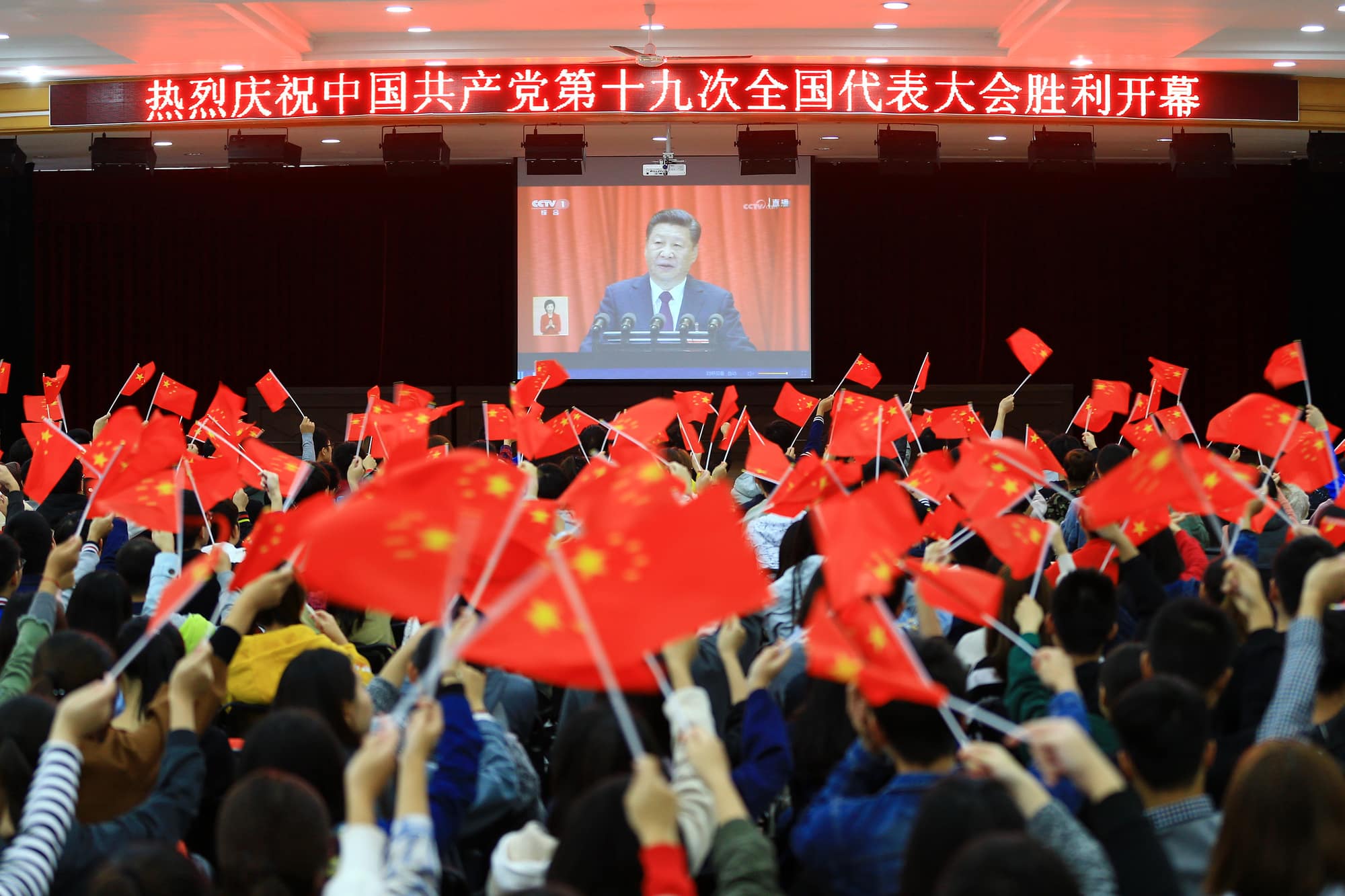
The Party’s formal hierarchy begins with the National Party Congress, convened every five years. Roughly 2,300 delegates select the Central Committee (about two hundred full members), which in turn selects the Politburo (currently twenty-four members) and its most powerful organ, the Politburo Standing Committee (PSC), typically seven members. Real authority flows upward through this structure and consolidates at the PSC, chaired by Xi Jinping.
The National People’s Congress (NPC) is constitutionally “the highest organ of state power,” but in practice it ratifies decisions already made within party channels. The State Council, led by the premier, administers policy, but it does so under party supervision.
Xi has further strengthened this arrangement by reasserting the primacy of party organs over state institutions. Since the reform era of the 1980s, there had been limited experimentation with separating party and government functions. Xi has reversed that trend. Party committees now penetrate every major state institution, state-owned enterprise (SOE), university, media outlet, and increasingly even private firms. In strategic sectors, such as technology, finance, and energy, party cells are embedded directly into corporate governance structures.
The nomenklatura system cements this dominance. The CCP Organization Department controls personnel appointments across thousands of key positions: governors, mayors, SOE executives, university presidents, regulators, and military officers. Advancement depends not merely on performance but on political reliability and demonstrated loyalty to party leadership.
In recent years, “leading small groups” have been elevated into formal Central Commissions, on National Security, Finance and Economics, Deepening Reform, and others, many chaired directly by Xi. These bodies coordinate policy across bureaucracies and effectively bypass the State Council. Decision-making has therefore shifted even more decisively into party channels and, within them, toward Xi personally.
This fusion produces formidable strengths: policy coordination is swift; implementation is disciplined; opposition is minimal. But it also concentrates informational bottlenecks. When loyalty becomes synonymous with competence, dissent and corrective feedback diminish.
China’s political system cannot be understood as a simple authoritarian government. It is a dual structure: party and state institutions exist in parallel, but the party always outranks the state.
Every major state organ has a corresponding party organ:
- The State Council is mirrored by party policy commissions.
- Courts operate under the oversight of party political-legal committees.
- Ministries answer not only to administrative superiors but to party secretaries embedded within them.
- Provincial governments are led administratively by governors but politically by provincial party secretaries, who hold ultimate authority.
This architecture ensures that “the Party leads everything.” The 2018 constitutional amendments formalized this principle, embedding party supremacy directly into state law.
Xi’s tenure has marked a decisive move away from the more collective leadership style of the Hu Jintao and Jiang Zemin eras. Term limits were abolished. Personal authority was elevated. Ideological discipline tightened. The result is not institutional collapse, but intensified coherence.
Mao Zedong’s dictum “the Party commands the gun” remains the bedrock principle of Chinese civil-military relations.
The PLA is not a national army in the Western sense. It is the armed wing of the CCP. Its loyalty oath is to the Party, not to the constitution or state.
The Central Military Commission (CMC) exists in two nominal forms: a party CMC and a state CMC. In practice, they are identical in membership and leadership, both chaired by Xi Jinping. The distinction is legalistic; the authority is political.
Within the PLA, a dual-command system operates. Commanders oversee operations; political commissars oversee ideology, discipline, and personnel. Promotions and assignments are controlled through party channels. The PLA’s Political Work Department ensures that ideological alignment accompanies operational reform.
Xi’s sweeping 2015–2017 military reforms reorganized seven military regions into five theater commands, streamlined the chain of command, and emphasized joint operations. The goal: build a “world-class military” by mid-century, capable of high-intensity modern warfare.
Yet repeated purges, particularly within the Rocket Force and procurement apparatus, suggest persistent corruption and factionalism. The removal of senior commanders with real combat experience (such as those who participated in the 1979 Sino-Vietnamese conflict) underscores a potential shift toward prioritizing political reliability over battlefield expertise.
The CMC chairman responsibility system formalizes hyper-centralization with ultimate command authority rests solely with Xi. While this reduces collective ambiguity, it also personalizes accountability. In a crisis, especially one involving Taiwan, decision-making may depend on a narrow circle reluctant to contradict the chairman.
The recent hollowing of the CMC raises an uncomfortable question: does intensified political control enhance or degrade military effectiveness? A force of loyalists may be politically secure but strategically brittle.
China is constitutionally a unitary state. Provinces are administrative subdivisions, not sovereign entities.
Yet the reform era produced significant local discretion. Provinces competed for investment, experimented with policy innovation, and financed infrastructure through local government financing vehicles (LGFVs). Economic dynamism often depended on decentralized experimentation.
Xi has rebalanced that model.
Anti-corruption campaigns have disciplined local officials. Central inspection teams audit provincial governments. Fiscal reforms have strengthened Beijing’s oversight over debt accumulation. Cadre evaluation metrics now emphasize political loyalty, social stability, environmental compliance, and debt management alongside economic growth.
Provincial party secretaries remain powerful figures, but they are rotated frequently to prevent the entrenchment of local power bases. Beijing’s control of appointments ensures vertical accountability.
This system reduces centrifugal pressures in a vast country of 1.4 billion people. But it also encourages bureaucratic caution. During the COVID era, local officials often over-enforced central directives rather than risk accusations of laxity. Today, economic policy implementation can be similarly risk-averse.
The recent military purges intersect with this centralization. Theater commanders once wielded significant operational autonomy. Tightened oversight reduces the risk of regionalism but may limit initiative in high-stakes scenarios.
Beyond formal institutions lies another critical apparatus: the United Front system.
The United Front Work Department coordinates relations with non-party elites, such as business leaders, religious figures, ethnic minorities, overseas Chinese communities, and foreign influencers. It is not decorative; it is integral to regime resilience.
Under Xi, the United Front’s role has expanded, particularly in technology, diaspora engagement, and influence operations abroad. Party committees have been strengthened within private firms. Civil society space has narrowed. Media and digital platforms are tightly monitored.
The party-state fusion thus extends beyond ministries and military structures. It encompasses society itself.
Xi’s system has delivered undeniable coherence. Infrastructure expansion, technological mobilization, military modernization, and global diplomatic outreach all benefit from centralized direction.
The CCP’s penetration of the state ensures discipline. The PLA’s subordination ensures regime security. Provincial oversight ensures unity.
But the very mechanisms that produce strength can also generate fragility.
Over-centralization reduces the flow of corrective information. Elite purges create fear, not debate. A military leadership selected primarily for loyalty may hesitate in crisis or conceal operational shortcomings. Provincial officials conditioned to avoid risk may fail to innovate during economic slowdown.
As the 21st Party Congress approaches in 2027, the PLA’s centenary year and a symbolic benchmark for modernization, Xi is likely to refill the CMC with trusted loyalists. The architecture of power will become even more vertically aligned.
History offers a cautionary parallel: imperial China’s bureaucratic systems often prized harmony over candor. When emperors grew insulated, policy miscalculations multiplied.
China today is not imperial China, but the structural tension between control and adaptability remains.
The recent purges reveal less about instability than about design. Under Xi Jinping, the CCP’s survival, and Xi’s dominance, supersede all other considerations. The Party commands the gun. The state implements the Party’s will. The provinces answer to Beijing. And within that hierarchy, power has narrowed toward a single center.
The system is formidable. It is also increasingly personal.
Whether that concentration proves decisive or dangerous will depend not on slogans, but on how the architecture performs under stress.