
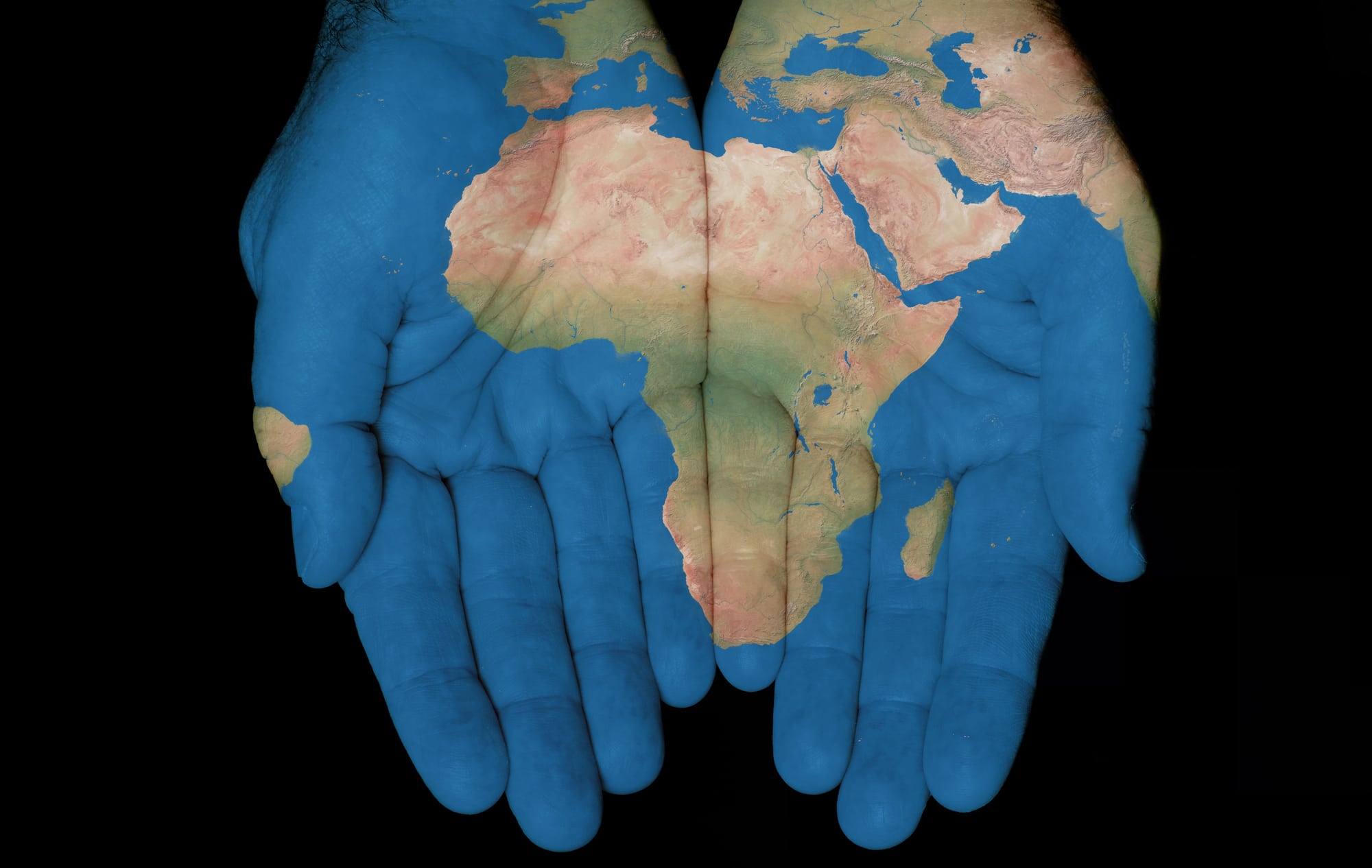
The increasing arc of instability running across Africa today resembles less a series of isolated crises than a single, widening belt of state collapse, insurgency, proxy war, and foreign intervention stretching from the Atlantic coast to the Red Sea. From Mali and Niger to Nigeria, Sudan, Somalia, and the eastern Democratic Republic of Congo, the same themes recur with grim consistency: weak post-colonial states, ethnic and religious fragmentation, weapons flows across porous borders, foreign meddling, and Washington repeatedly insisting it can manage extraordinarily complex societies with bombs, military trainers, intelligence partnerships, and favored clients.
It cannot.
Indeed, many of these crises are not merely unrelated disasters occurring simultaneously. They are connected. Weapons, fighters, refugees, ideologies, and military doctrines move across borders with ease. The consequences of one intervention cascade into neighboring states. Militias defeated in one country simply reappear in another. Governments arm proxies abroad while barely controlling territory at home. And through it all, Washington continues to operate as though enough special operations raids, airstrikes, and “security partnerships” can somehow stabilize regions whose problems are rooted in generations of colonial partition, corruption, sectarian division, economic underdevelopment, and, yes, foreign intervention.
A big part of this current round of catastrophe began with NATO’s destruction of Libya in 2011. The regime change war against Muammar Gaddafi was sold as a humanitarian intervention. In reality, it shattered one of the few functioning states in North Africa and unleashed enormous stockpiles of weapons across the Sahel. Tuareg fighters who had served in Libya returned to Mali heavily armed. Jihadist groups, like the Islamic State Sahel Province (ISSP), flourished in the resulting chaos. Military coups followed in Mali, Burkina Faso, and Niger, many involving officers who had received American training or maintained ties with Washington’s security apparatus.
This is one of the great ironies of Washington’s Africa policy. The United States spends decades training militaries in the name of “stability,” only to watch those same militaries overthrow civilian governments once conditions deteriorate. Washington then condemns the coups while continuing to insist the answer is still more security cooperation—and, more often than not, going ahead and supporting the new government anyway.
Meanwhile, the humanitarian consequences spread outward. Mass migration toward neighboring states like Mauritania threatens to destabilize already fragile societies. Entire regions of the Sahel have become effectively ungovernable. Yet even now, few in Washington seem willing to admit that the Libya intervention was among the great foreign policy disasters of the twenty-first century.
The violence did not stop there, but flowed directly south into northern Nigeria, where arms trafficking and jihadist networks have strengthened insurgent groups already terrorizing the country. Boko Haram and Islamic State West Africa Province (ISWA) remain active in vast stretches of the northeast, while banditry and Islamist militancy expand in the northwest under a group calling itself Lakuwara (in fact, a cell of the ISSP). Washington continues conducting bombing campaigns and special operations missions in the region, supposedly to contain extremism. But as has occurred from Afghanistan to Yemen, mistaken bombings and civilian casualties frequently radicalize local populations rather than pacify them.
America’s policymakers seem perpetually unable to understand a simple truth: when foreign aircraft bomb villages in distant countries, the survivors rarely conclude that liberal international order has arrived. More often, they conclude they are under attack by an outside power backing a corrupt central government they already distrust.
Sudan provides perhaps the clearest example today of how outside powers transform internal crises into regional infernos. The civil war between the Sudanese Armed Forces (SAF) and the Rapid Support Forces (RSF) is no mere domestic conflict: regional actors back competing factions. The United Arab Emirates supports the RSF. Egypt has backed the SAF. Chad and Ethiopia increasingly serve as staging grounds and logistical corridors for the former. Refugees pour across borders while famine and atrocities spread.
What makes the situation particularly revealing is that Washington’s own partners stand on opposite sides of the conflict. American policymakers speak constantly about democracy and human rights, yet their regional clients fuel one of the world’s worst humanitarian catastrophes. Nor is this even meaningfully about Russia anymore. Moscow reportedly shifted from supporting the RSF toward cultivating ties with the SAF two years ago. The conflict persists not because of some simplistic new Cold War framework, but because regional powers pursue their own interests while ordinary Sudanese civilians are trapped in the middle.
At the same time, Ethiopia itself edges closer to renewed conflict. Tensions with Eritrea are rising again. The fragile aftermath of the Tigray war remains unresolved. Addis Ababa increasingly behaves like a regional power seeking maritime access and strategic depth, while Washington continues cautiously backing Ethiopia because of its perceived geostrategic importance in the Horn of Africa. Yet recent history should make Americans deeply skeptical of such calculations. Washington long viewed various African governments as useful strategic partners during the Cold War and War on Terror, only to watch those relationships contribute to far bloodier outcomes later.
Uganda offers a sobering example. During the 1980s and 1990s, Washington supported Yoweri Museveni as part of a broader regional strategy in Central Africa. Uganda’s influence in Rwanda and the region helped shape the political and military dynamics preceding the Rwandan genocide and the later Congo wars. The plain fact is that foreign backing alters regional balances of power in ways American policymakers scarcely understood and certainly cannot foresee.
Indeed, the same pattern appears in Somalia. Washington’s efforts to destroy the Islamic Courts Union in the mid-2000s helped create the conditions for al-Shabaab’s rise. Nearly two decades later, the United States continues bombing Somalia at a record pace while claiming counterterrorism progress remains just around the corner. Now the situation grows even more dangerous as Israel recognizes Somaliland, potentially transforming the region into a strategic platform overlooking the Bab el-Mandeb Strait and the conflict with the Houthis in Yemen, with whom Tel-Aviv no doubt plans to start a fight down the road.
Finally, there is eastern Congo, where horrifying violence persists despite repeated diplomatic agreements between Rwanda and the DRC and separate negotiations involving M23 in Doha. Here again Washington speaks reverently about sovereignty while remaining unwilling to seriously pressure Rwanda, long viewed as a useful regional security partner. M23 continues operating. Civilians continue dying. Ebola outbreaks compound the suffering. And amid it all, foreign powers eye the region’s vast mineral wealth.
In a tragic and familiar pattern, diplomats frequently negotiate agreements they possess little ability to enforce on the ground. Former U.S. Ambassador to Rwanda David Rawson experienced similar frustrations during efforts surrounding the Arusha Accords before the Rwandan genocide. Peace frameworks crafted in conference rooms mean little if armed factions, regional patrons, and local commanders have no intention of abiding by them once cameras disappear.
For decades, Washington has approached Africa as a chessboard of security partnerships, drone bases, proxy forces, and strategic corridors. What stretches across the continent today is the result. To argue this is to deny the agency of African actors themselves. These conflicts are rooted in real historical grievances, ethnic divisions, religious tensions, colonial borders, resource competition, and domestic political failures. It is to argue that intervention consistently exacerbates them, because the presence of outside powers changes incentives, empowers certain factions over others, and internationalizes conflicts that might otherwise remain more limited.
And whether Washington genuinely believes it is extending an altruistic hand helping or whether strategic access, mineral interests, counterterrorism objectives, or geopolitical competition plainly drive policy, either way, the results look remarkably similar: shattered states, endless insurgencies, refugee crises, and expanding regional wars.
As Americans, our first responsibility is not to redesign Africa according to whatever strategic vision currently dominates Washington. It is to recognize the limits of our own power, the unintended consequences of intervention, and the extraordinary arrogance required to believe distant bureaucrats and military planners can successfully manipulate some of the world’s most complicated political environments, as millions of dead over the past two decades attest.
Enough already.