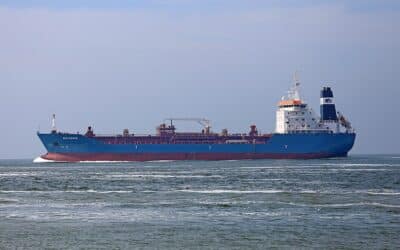

The Persian Gulf is the jugular vein of global oil supply. Roughly one-fifth of all oil traded on earth transits the Strait of Hormuz. Since the war picked back up on February 28th, data reported to Goldman Sachs show an estimated hit to Persian Gulf oil exports that has since reached approximately 16% of global supply.
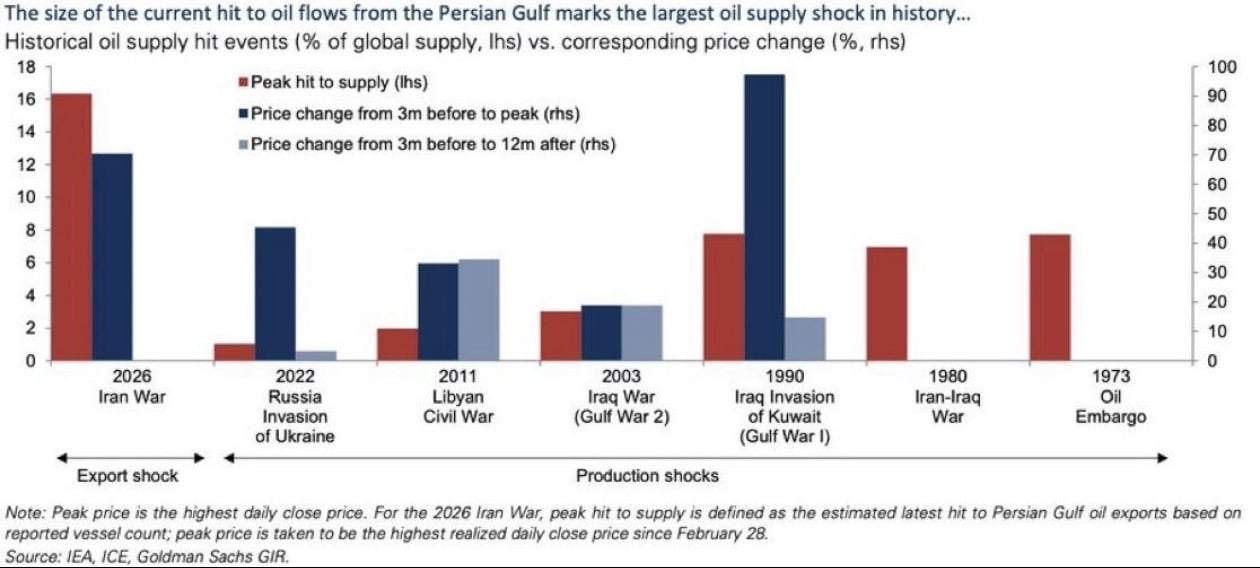
The conflict that has been simmering for decades, but had been rather quiet since last summer, has now cascaded from a regional war into the largest oil supply shock in recorded history. To appreciate the scale: the Iraqi invasion of Kuwait in 1990 — long considered the benchmark for supply shock severity — removed roughly 8% of global supply and sent prices surging nearly 100% from three months prior to their peak. The 1973 OPEC oil embargo, which brought Western economies to their knees, disrupted around 7–8%. The 2026 Iran conflict has already doubled those figures. GS classifies it as an export shock, not a production shock. This means the oil exists and is being pumped, but it cannot leave the Gulf. The longer the war goes on, additional production and refining capacity will be destroyed in both Iran and the GCC, compounding the crisis.
JPM Commodities Research mapped exactly where Persian Gulf oil was flowing before the disruption — and the picture reveals how deeply embedded Gulf crude is in the world economy. The routes stretch out in every direction: westward around Africa’s Cape of Good Hope to Europe’s Atlantic ports; eastward to China, Japan, South Korea, and the Philippines; south to Australia and East Africa.
China faces the largest single-country exposure by far, receiving an estimated 5.2 million barrels per day from Persian Gulf sources — roughly a third of its total consumption. Europe is heavily exposed too, with France taking 0.25 mbd, Spain 0.15 mbd, and significant volumes flowing to the Netherlands, Belgium, Greece, and Turkey. The United States, less dependent at 0.65 mbd, is more insulated from direct supply loss — but no country is shielded from the price effects that follow a shock of this magnitude. JPM’s map notes that most deliveries to these regions will be complete by the end of April.
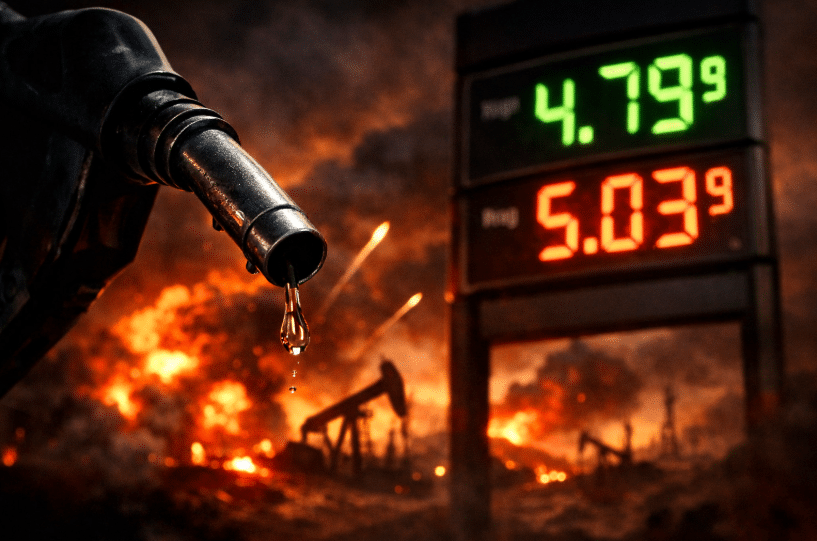
The world’s oil system is under stress it has never experienced before, and the full consequences have yet to be priced in due to the historical scale of the shock. In many parts of the world, the most visceral evidence of the crisis playing out in real time won’t be in the markets, but in the form of loadshedding, gas lines, food shortages, and economic malaise.