
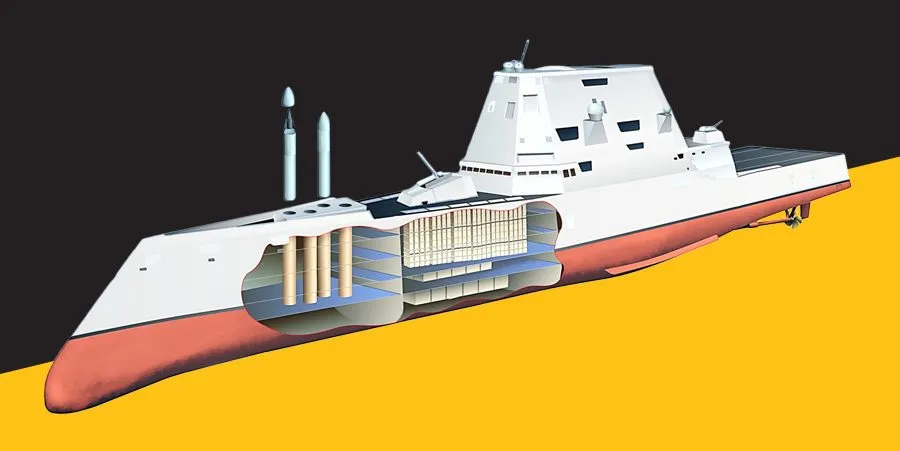
The DDG-1000 Zumwalt-class, originally slated for 30+ hulls but only commissioning three has been haunted by failure and late delivery on everything. Now the first hull is being delivered after being retrofitting for Conventional Prompt Strike (CPS) hypersonic weapons. The CPS doesn’t carry nukes. Hence the term ‘conventional‘ prompt strike. We shall see how that fares, if history is an indicator, it will take years to make it right. This is the ship that took five years after commissioning to launch its first missile out of the Vertical Launch System (VLS) tubes installed on the vessel.
CPS missiles are already hyper-expensive, niche weapons with limited value. It’s a huge waste of money to build a hyper-expensive ship to carry them thus the retrofit tot he Zumwalt. Modifying the three existing DDG-1000s is fine though, since the USN already owns them and they don’t have a real mission right now anyway. Three basically means that when something kicks off, you’ll have one that’s actually ready for action with maybe one more on deck.
Hypersonic missiles are harder to intercept and can be used to hit reinforced bunkers which even 64 Tomahawks would fumble against unless you literally daisy chain them and use BROACH warheads on each. Speed not only helps against interception where a smaller gap is already enough to slip a couple of these through but also adds a time element. It’s in the name, Conventional Prompt Strike. The missile can hit a key facility minutes after a gap has been opened in the defenses and it’d make Gulf War’s tempo look like slow motion.
Hypersonic weapons are actually adding a lot of complications into the standard air defense calculus.Their speed makes typical trajectory calculations actually fail. This could be fixed down the line but then the system needs more computational power and more expensive electronics in general. Another aspect is the defense envelopes. Air defense is often displayed as circles yet in practice it’s more complex. The further away a missile’s trajectory is from intersecting with the SAM battery, the less capable they are at intercepting it. This gets multiplied with speed. So in very dumb math, a subsonic AShM can be intercepted by an escort ship at about six times further away than against a hypersonic missile.
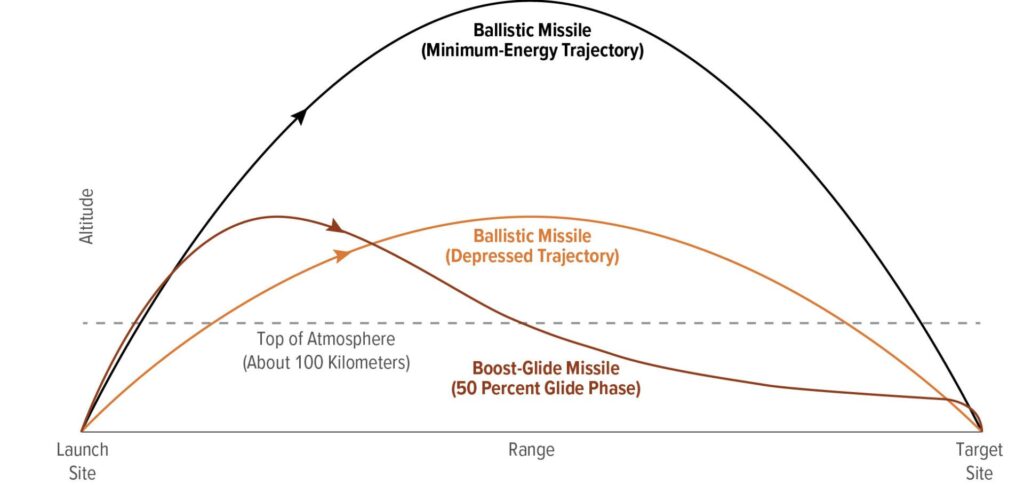
The CPS is not a typical hypersonic cruise missile. It is actually a ballistic missile which also has hypersonic glide capabilities (a more shallow trajectory. While it can be used to strike ships read what it’s meant to do: replace nuclear weapons with conventional strike. While that sounds sensationalist the basic idea is to have a weapon which can deliver strategic strikes against ground targets, be it something like an underground facility or just a high-priority asset in a country still having formidable air defenses.
Observers confuse the current CPS, which the Army already is deploying, which is called ‘Dark Eagle‘ with the original ‘concept’ CPS, which involved a conventionally armed Minuteman Missile. The conventional Minuteman WAS canceled because as some have pointed out, it looks and smells like a nuke. Dark Eagle is fully funded and is closer to the old Pershing Missiles from the cold war.
There is the issue of a target trying to discern if an incoming missile is a nuke or not was resolved with hypersonic munitions that creates problems of of its own. This was a big reason CPS predecessors were cancelled.
“Hey China, this isn’t a nuke” stenciled on it doesn’t work.
The warship, part of an $8 billion development programme for the Zumwalt-class, is the first of its kind to be retrofitted with the U.S. military’s Common Hypersonic Glide Body (C-HGB). Designed to travel at speeds above Mach 5, these weapons are central to the Pentagon’s Conventional Prompt Strike (CPS) initiative, which seeks to deliver precise, non-nuclear strike capabilities at global distances within minutes.