
“We’ve won. Let me tell you, we’ve won. You know, you never like to say too early you won. We won. We won the – in the first hour it was over. We won,” President Donald Trump declared, claiming “we won” five times in just thirteen seconds at a Kentucky rally on March 11.
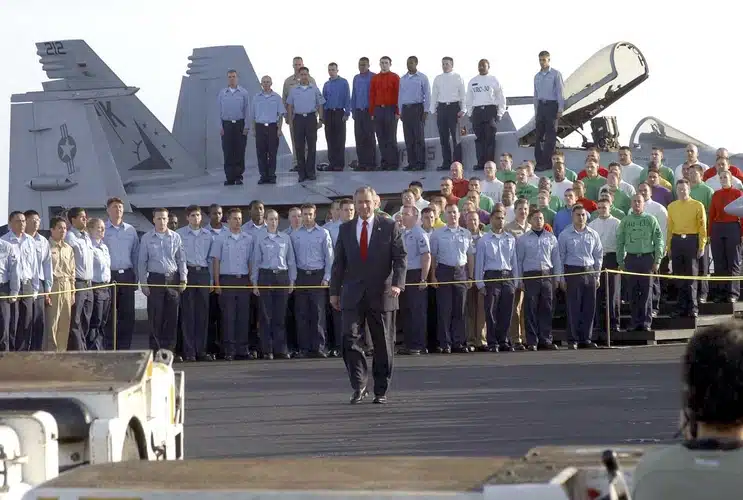
We’ve seen such misbegotten braggadocio before. Six weeks into the elective invasion of Iraq, President George W. Bush starred in a campaign stunt when he landed on the deck of the USS Abraham Lincoln aircraft carrier wearing a flight suit. He stood under a “Mission Accomplished” banner ordered up and paid for by White House spinmeisters. It was the “end of major combat operations,” Bush said.
Only it wasn’t. Bush’s Iraq War lasted almost nine years.
No one starts a war expecting to lose. Napoleon thought he would defeat Russia. Japan attacked Pearl Harbor in the desperate belief it could somehow prevail. The United States escalated to a peak of 543,000 military personnel on the ground in Vietnam on April 30, 1969. Our war lords never imagined that the humiliating end would come six years later to the day, when the last U.S. Marine guards were airlifted from the roof of the U.S. embassy on April 30, 1975.
How could that have happened? Didn’t we have “Big Belly” B-52s’ carpet bombing with their 1,000 pound bombs? Didn’t we have F-4 Phantoms and A-1’s delivering walls of napalm? The enemy had no defense from the Agent Orange herbicide sprayed from C-123’s that disclosed their jungle hiding places. And what about cluster bombs, helicopter gunships, howitzers, and naval gunfire, or our cutting edge communications and radar technology? We even had IBM computers processing logistics and body counts.
And yet…
For all the might and plans, plans, plans, no one knows what will happen when the war starts. In Mike Tyson’s telling, “Everyone has a plan until they get punched in the mouth.”
Trump was nonplussed that Iran did not sue for peace after the initial waves of U.S. bombing. How could Iran not quickly capitulate since force and might were so overwhelmingly on the global American military empire’s side?
If the administration’s war visionaries like Marco Rubio, Pete Hegseth, Jared Kushner, and Trump himself had bothered to consider the possibilities of asymmetric warfare, they would have discovered a breathtaking lesson right under their own noses in the Pentagon’s war gaming. Even better to serve them as a precedent, it was set in the Persian Gulf.
Millenium Challenge was a massive 2002 war exercise, the biggest and most costly at that time, which combined computer simulations and live exercises. It pitted distinct capabilities and philosophies. The Blue Team, a stand-in for the United States, was highly sophisticated in its approach: centralized and controlled, awash in plans, data bases, information gathering, and metrics. The Red Team, led by a remarkable retired Marine general, Paul Van Ripper, was the opposite. As the rogue commander of a fictitious Persian Gulf state, Van Ripper’s decision making was decentralized. He trusted his men to draw upon their own experiences and make necessary judgements accordingly. They were guided by a shared strategic objective, yet were allowed to be innovative and their tactics unforeseen by their opponent’s computerized predictions.
From devastating early success in the fog of war, to preemptive strikes with explosive laden speedboats, Van Ripper’s team was easily victorious over the Blue team’s cutting-edge technology. When the Red Team lost fiber optics and microwaves, rather than turning to satellite communications that could be intercepted, they turned to couriers on motorcycles and light signals. They even embedded messages in the local calls-to-prayer.
The Pentagon stopped the game, re-floated the Blue Team’s sunken ships, and re-wrote the rules of the game and started over. At one point in the simulation, the Red Team was forbidden to shoot down any of the enemy’s approaching aircraft. Van Riper was forced to turn on his radars and reveal positions, while several of his successful asymmetrical tactics were banned. The exercise was scripted to guarantee a Blue win.
Van Riper resigned in protest.
Interviewed afterwards about Millenium Challenge, General Van Ripper harkened back to his experience as a young officer in Vietnam:
“The computers in Saigon said we were winning the war, while out there in the rice paddies we knew damn well we weren’t winning the war.”
On May, 15, 2007 in a Republican presidential primary debate, moderator Brit Hume of Fox News asked Dr. Ron Paul, “What would be your strategy for ending the war in Iraq?”
Congressman Paul answered, “We just marched in. We can just march out.”
From that date forward the Iraq War that so many of its champions now disavow went on for another four and one-half years, with all of the additional lives and money lost.
When the president declares victory, he would do well to remember the rest of the expression that was born in the Vietnam War: “Declare victory and come home.”