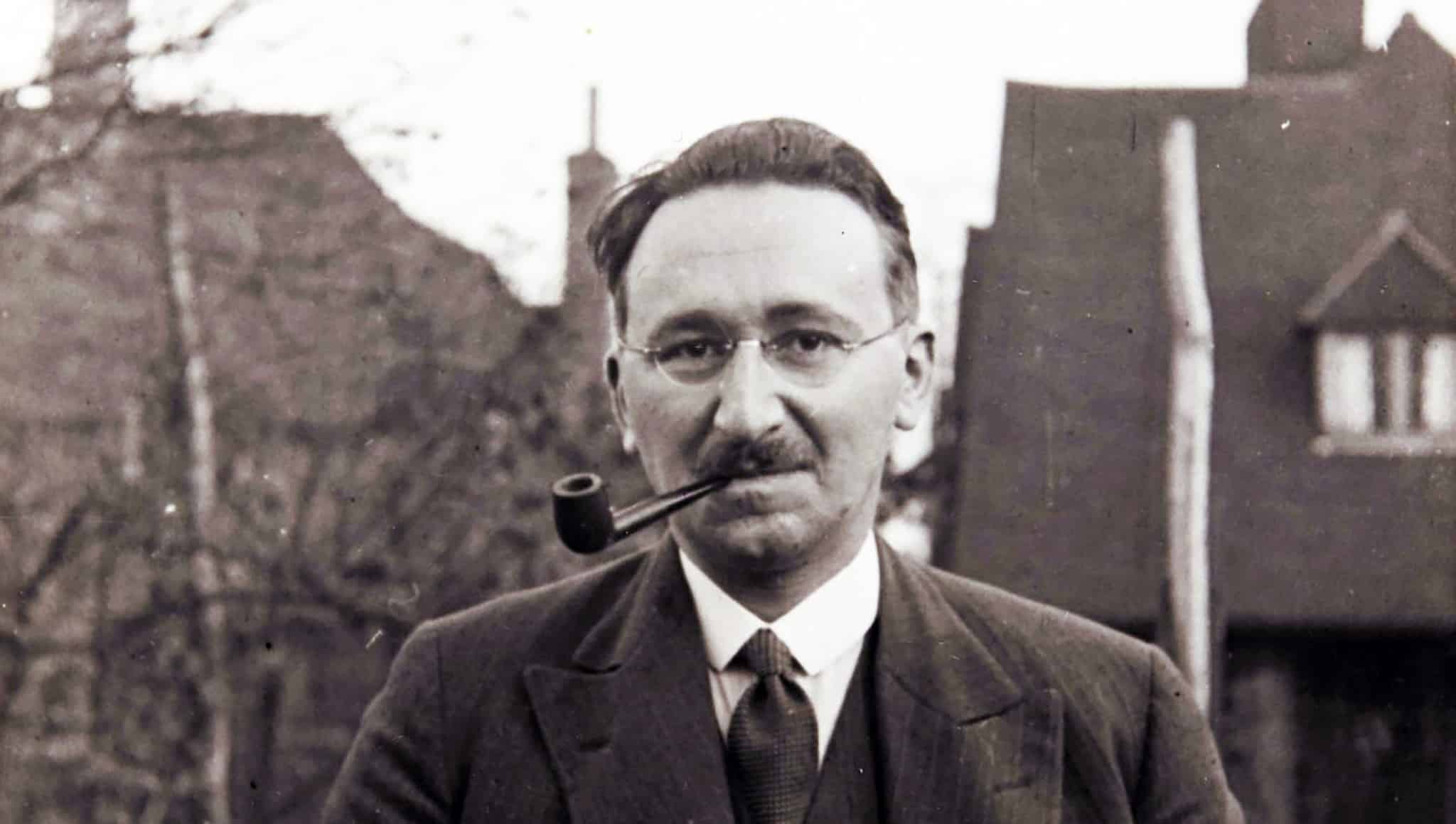
Austrian economics gets its name not from a particular connection to the country in technical terms, but rather because it was born there in the 1870s from great minds such as Carl Menger, Eugen von Böhm-Bawerk, and Friedrich von Wieser. One generation later, another native Austrian would pick up the mantle.
Friedrich A. Hayek, the famed Austrian economist and political philosopher, was born in Vienna on May 8, 1899. His father August was a physician and professor of botany, and his mother hailed from a prominent Viennese family. Like so many young men of his generation, Hayek served during the First World War in an artillery unit. After the war, he returned to University of Vienna to continue his education, studying law, psychology, and eventually economics. It was in his final year at the university that he met Ludwig von Mises, whose critique of socialism convinced him that economic planning by the state was both ignorant and coercive. With Mises’s support, he joined the Austrian Institute for Business Cycle Research, where he would embark in earnest on an intellectual career that would span from the 1920s to the 1990s.
Hayek’s earliest works in a career that produced eighteen books focused on monetary policy and capital theory. In books such as Monetary Theory and the Trade Cycle (1929) and Prices and Production (1931), he argued that business cycles are not inherent to markets, but are created by central bank interventions. When credit expansion drives interest rates below their natural level, entrepreneurs are misled into long-term investments that cannot be sustained. The resulting boom is followed by a painful bust as malinvestments are liquidated. This concept, known as Austrian business cycle theory, directly challenged the Keynesian view that recessions stem from insufficient demand. Hayek maintained that the only cure is to avoid the boom in the first place by allowing interest rates to reflect real market values. His emphasis on monetary stability would later influence conservative and libertarian critiques of inflation and state-managed economies. In other words, Hayek would have been proud to hear Dr. Ron Paul blame the boom/bust cycle of the American economy on “quantitative easing” by the Federal Reserve.
Hayek brought these ideas to English-speaking audiences after Lionel Robbins invited him to lecture at the London School of Economics in 1931. The following year, Hayek joined the faculty there, becoming a central figure in the interwar debate over macroeconomic policy. His seminars exposed young economists like Ronald Coase to the rigor of Austrian reasoning and highlighted the dangers where political activism meets economic reality. His analysis during this period would continue to garner attention all the way through to the inflationary crises of the 1970s.
The devastation of World War II drove Hayek to write his most famous book, The Road to Serfdom (1944). His fear was that calls for more state economic planning on the auspices of good intentions would repeat Europe’s tragic descent into totalitarianism. Hayek did not equate all planning with dictatorship, but he did argue that comprehensive planning inevitably required coercion. Once the state tries to organize society according to a single blueprint, it must suppress competing visions and, most importantly, centralize authority. Hayek wrote, “the unscrupulous are likely to be more successful,” and there arises a demand for an “economic dictator.” Since such planning subjugates all of society to a single end, leaders must silence dissent and extinguish individual choices; the more comprehensive the plan, the greater the power required to execute it. In this, Hayek diagnosed the totalitarian temptation at the heart of collectivist projects.
Hayek also criticized the way collectivists manipulated language to cater to their own ends. In totalitarian societies, planners appropriate noble terms like “liberty” to justify their control, promising “collective freedom” that is actually the unchecked power of the state. Hayek insisted that the dividing line between such societies and ones that truly value liberty above all else is the rule of law. A state bound by rules, codified into law and popularly understood, allows individuals to live their lives free from a government exercising arbitrary power. By contrast, central planning demands discretionary decisions that cannot be codified into law. It inevitably leads to arbitrary usurpation of power and undermines liberty. The Road to Serfdom was a bestseller and influenced public opinion around the globe. Decades later, British Prime Minister Margaret Thatcher lauded it as the most powerful critique of socialist planning she had ever read.
In The Constitution of Liberty (1960), Hayek brought together his scholarship on economics, jurisprudence, and political philosophy. He began by distinguishing equality before the law from material equality. Because individuals differ in talents, preferences, and circumstances, equal treatment under law necessarily results in unequal outcomes. Any attempt to enforce equality of condition necessarily requires discriminatory policies and infringement on individual liberty. Hayek therefore argued that a free society must accept inequality as the price of legal equality. He proposed that government should be confined to a short list of rules—prohibitions against violence, fraud, and breach of contract—that apply equally to all.
Hayek defined coercion as forcing a person to serve another’s purposes by threatening harm. For Hayek, nothing was more dangerous than the state’s monopoly on violence. He argued that coercion turns individuals into tools, and so long as government was restricted from exercising arbitrary power, individuals would remain free to pursue their own separate interests. In the opposite case, the people would be subject to the whims of the political class. Hayek vociferously refused acquiescence to an expansion of state power, no matter what “emergency” may be invoked by central planners as an excuse for it. His concluding essay, “Why I am Not a Conservative,” rejected reactionary politics and championed a classical liberalism grounded in liberty under law.
Hayek retired from the University of Chicago in 1962 and moved to Freiburg, Germany, where he wrote Law, Legislation and Liberty (1973-79). In his three-volume treatise, he distinguished between law, abstract rules of just conduct that evolve spontaneously, and legislation, commands formulated for particular purposes. A free society arises where individuals pursue their own separate interests within a framework of general principles. Even democratic majorities, he stressed, must be bound by these principles. Conflating legislation and law, Hayek argued, transforms the spontaneous order into an organization subject to arbitrary abuse. Hayek warned that modern politics confuses “law” with “administration” and thereby turns the “Great Society” into a managerial nightmare.
Among his later writings, such as “Denationalization of Money” (1976), Hayek advocated for competing currencies and argued that governments should not maintain a monopoly on money. His final work, The Fatal Conceit (1988), referred to the belief by central economic planners that they can design a better social order than the spontaneous process of the free market. Throughout his many works, he emphasized the evolutionary nature of cultural and moral rules, and cautioned against the tendencies of so-called “reformers” to enact sweeping interventions.
Hayek’s accomplishments and influence are vast and enduring. He is responsible for bringing together such renowned minds as Milton Friedman and Karl Popper at the inaugural meeting of the Mont Pèlerin Society in 1947 to articulate classical liberal principles. Perhaps his most notable achievement, winning the Nobel Prize in Economics in 1974, led to his becoming a symbol of the free-market of the late twentieth century. His warnings about inflation resonated across both academia and politics during the stagflation of the 1970s and influenced policymakers in the 1980s. Friedman proclaimed that many advocates of a free society owe their awakening to Hayek’s writings. Ronald Coase admired his intellectual rigor, while Peter Drucker called him “our time’s preeminent social philosopher.” Historian Daniel Yergin mused that the Austrian school’s ideas moved to center stage thanks to Hayek’s work, and Margaret Thatcher credited The Road to Serfdom with showing why socialism leads to tyranny.
Although Hayek never called himself a libertarian—he preferred the term “Old Whig”—his writings form a cornerstone in libertarian thought. His arguments that decentralized markets make better use of knowledge than central planners, that coercion must be limited by law, and that spontaneous order outperforms designed systems underpin modern libertarianism. Bruce Caldwell, the editor of the Collected Works of FA Hayek, notes that Hayek sought to build a bridge between classical liberals from John Locke to Ludwig von Mises, threading a path between laissez-faire and a stable legal order. Confronted with fascism and communism, Hayek championed a liberalism rooted in the dignity of the individual and humility about human knowledge.
Friedrich A. Hayek spent his life working to unify economics, law, and philosophy around a single insight: liberty is possible only when we recognize the limits of our knowledge and restrain arbitrary power. His scholarship on Austrian business cycle theory lambasted central banking for causing the boom and bust cycle. His essays on spontaneous order revealed how free markets coordinate vast amounts of information and why central planning inevitably fails in comparison. The Road to Serfdom warned that collectivism, no matter how benevolent its intentions, concentrates power in the hands of those who will abuse it. The Constitution of Liberty and Law, Legislation and Liberty endorsed equality before the law, limits on government power, and the evolutionary wisdom of customs. In honor of his birthday, we call not only a towering figure in economics, but a thinker who dared to remind us how little we know and how dangerous it is to grant power over others.