
The Old Right journalist Garet Garrett, writing in 1952, understood that empires do not arrive with heralds. They come instead through “quiet aggrandizements of power,” accretions so gradual and so dressed in the language of necessity that the citizen scarcely notices the republic he was born into has become something else. The first requisite of empire, Garrett wrote, is that “the executive power of government shall be dominant.” He was tracing the long constitutional erosion by which the war-making prerogative—the power the Framers most deliberately withheld from any single man—migrated to the presidency, where it has resided ever since, exercised without declaration and answerable to no one.
Garrett did not live to see the prerogative privatized. He could not have imagined that the strategic interests of the United States would one day be acquired not even by the executive he feared, but by the executive’s family, through a private equity fund, on a banker’s yacht. Yet that is what is now underway on a fortified island off the coast of Albania. And because it arrives wrapped in the softest possible packaging, it is worth the trouble of naming plainly what it actually is.
The cover story is a beach. The product is a fortress.
On a podcast this spring, Ivanka Trump described how she and her husband Jared Kushner came upon Sazan Island. A friend’s boat, a stop to swim, a captivation that would not release them. “We swam to the island. We went on a hike, barefoot all the way up to the top, and we were just captivated.”
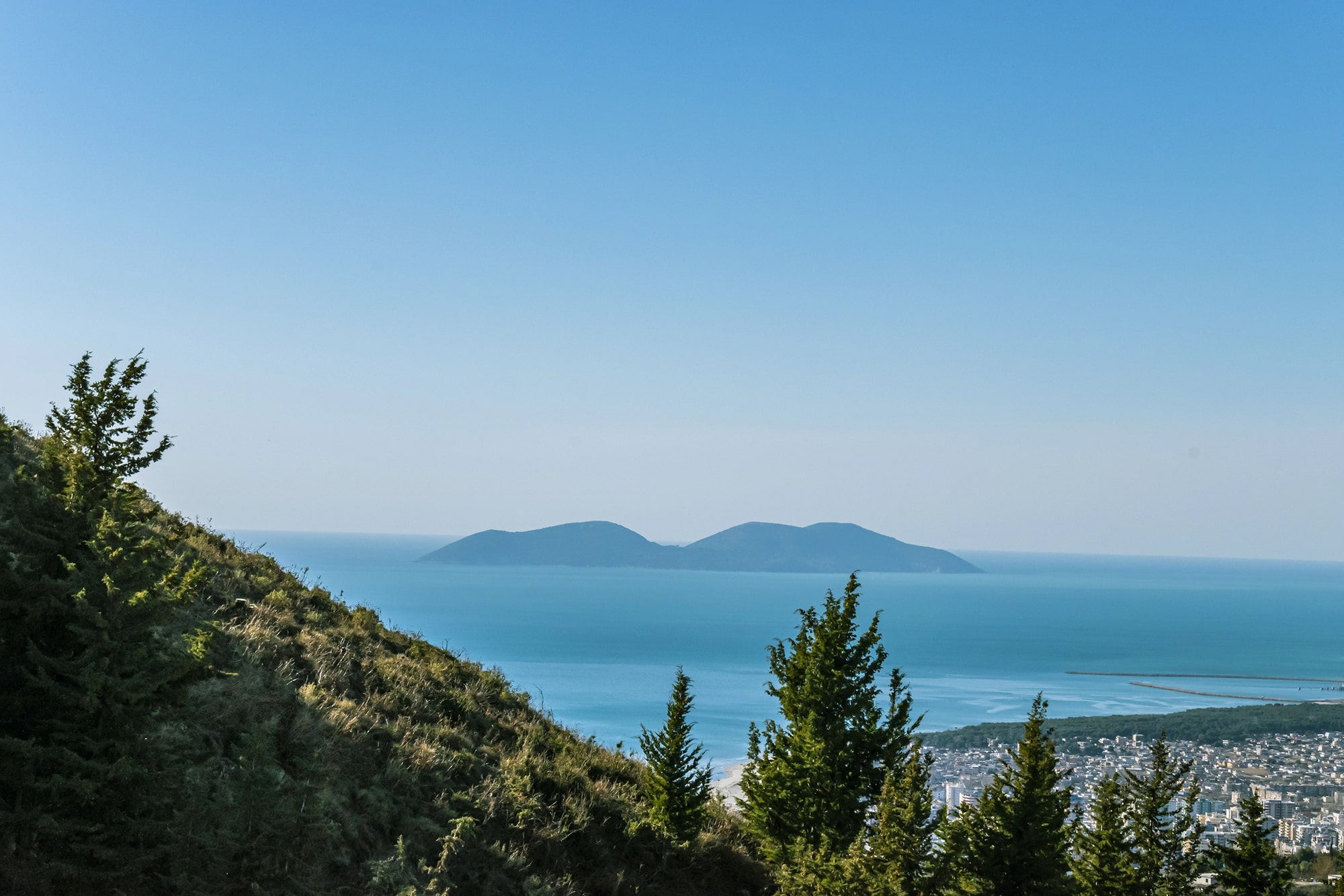
It is worth lingering on the ground she claims to have crossed barefoot, because the landscape refutes the story. One stretch of Sazan’s coastline is so forbidding that sailors gave it a name: Gryka e Xhehenemit, the Gorge of Hell. The slopes are studded with some 3,600 concrete bunkers, most of them one-man domes built to survive a nuclear blast, threaded together by ten miles of reinforced tunnels and a buried command center. In the water around the island lie World War II artillery shells, anti-submarine mines, and tons of undetonated ordnance, enough that the area is mapped as a hazard.
Nobody walks barefoot up that. The detail is not an innocent embellishment, the kind of harmless gilding anyone adds to a fond memory. It is a deliberate softening. And the cover has already cracked, by the family’s own hand. On a different podcast, Kushner gave a version of the origin story with no barefoot summit in it at all: “We were on a friend’s boat, Nat Rothschild’s, on vacation.” The friend, it emerges, is a scion of the Rothschild banking house, and the vacation was not entirely a vacation. Aboard that same yacht, by Kushner’s own telling, he held a private meeting with the Prime Minister of Albania, Edi Rama. A separate account has Rama boarding the boat in 2021 for a meeting, with investment talks following inside a year.
So there are two creation myths, told by two spouses. In one, a financier’s heir and a head of state transact on a billionaire’s deck. That’s what the public should attend to.
The men who wrote the Constitution had just clawed their way out from under a monarchy, and they understood with peculiar clarity which kingly powers were the dangerous ones. Foremost among them was what William Blackstone called “the sole prerogative of making war and peace.” A king could commit a nation to ruin on his own appetite, and the people would pay in blood and treasure for a decision in which they had no voice. The Framers’ remedy was structural and deliberate: they took the prerogative away from the executive and lodged it in Congress, in the open, where the disposition of the nation’s strategic interests would require deliberation and a vote.
James Madison stated the reasoning to Thomas Jefferson without ornament:
“The constitution supposes, what the History of all Governments demonstrates, that the Executive is the branch of power most interested in war, and most prone to it. It has accordingly with studied care vested the question of war in the Legislature.”
Jefferson, for his part, warned that to take “a single step beyond the boundaries thus specially drawn around the powers of Congress is to take possession of a boundless field of power, no longer susceptible of any definition.” The architecture was meant to make foreign entanglement difficult, slow, public, and accountable. That was not a flaw in the design. It was the design.
Now set that principle against what is happening at Sazan. The acquisition of a strategically decisive island, at the mouth of one of Europe’s principal maritime chokepoints, is being conducted not by the United States government—where it would be subject, however imperfectly, to congressional oversight and public scrutiny—but by the private investment firm of the president’s son-in-law. There is no declaration. There is no debate. There is no vote, no committee hearing, no record the people may inspect. The strategic interest is unmistakably real, and it has been removed from the constitutional order altogether and lodged in a family portfolio.
This is worse, in a precise sense, than the abuse Madison feared, which was an executive too eager for war; at least an executive remains, in theory, a public official bound by oath and removable by the people. What is unfolding here is the prerogative stripped even of that thin accountability—the strategic terrain of a NATO ally passing into private hands, brokered in settings to which the public has no access and over which it holds no check. Madison imagined a president prone to war. He did not imagine a first family quietly buying the ground on which wars are fought.
Strip away the swim and read the coordinates, because the coordinates are the whole argument. Sazan guards the entrance to the Bay of Vlorë, Albania’s only deep-water bay capable of sheltering large naval vessels, at the exact seam where the Adriatic meets the Ionian. Beyond it lies the Strait of Otranto, the forty-five mile passage between Albania and the heel of Italy that is the sole maritime exit from the Adriatic into the wider Mediterranean.
Every power that ever held this rock understood exactly what it was holding. Mussolini’s Italy fortified it to control access to the Adriatic. Enver Hoxha boasted that communist Albania possessed the “keys to the Otranto Channel.” When Nikita Khrushchev visited the neighbouring submarine base in 1958, he said it without euphemism: from there he could “control the Mediterranean to Gibraltar.” For five centuries the island was coveted in turn by Romans, Venetians, Ottomans, Italians and Soviets, and not one of them wanted it for the swimming.
A chokepoint is a place where a small force can watch, slow, or shut a sea lane on which everyone else depends. Otranto’s narrowest crossing is comparable in width to Hormuz and Bab al-Mandab, the two most fought-over straits on earth. Whoever holds influence over the positions inside it can monitor, restrict, and potentially interdict the traffic passing through. This is why the island was sealed to civilians from 1946 until 1991. And it is why the man buying it is no idle vacationer: Jared Kushner is, at the very same time, serving as a U.S. envoy in talks with Russia over the war in Ukraine. The same family that helps arrange the security architecture of Europe is acquiring the terrain that has commanded its southern flank for a hundred years. The conflict of interest is not a side issue. It is the entire shape of the thing.
It is worth investigating what NATO is in this story, because the honest account is also the libertarian one. The objection to the alliance has never required sympathy for whatever adversary Washington has chosen to name in a given decade. The objection is that NATO functions as the instrument of an American empire that treats the borders of small client states as extensions of its own, that requires member nations to adopt the policies Washington prefers, and that, without the United States underwriting it, does not exist at all. An arrangement in which one nation can use the territory of its “allies” as staging ground and bargaining chip is not a partnership of equals. It is empire with better manners.
Sazan is that arrangement rendered literal. A sovereign member’s most strategic ground is being rezoned and handed over—not because the Albanian people deliberated and chose it, but because their government is eager to please the Trump administration and to grease its own path toward the European Union. The choreography is the proof, and it is brazen. In February 2024, Albania’s parliament approved a law lifting the ban on construction in protected areas. In December 2024, the government declassified Sazan for civilian use, pulling it out of the marine national park where development had been forbidden. Then came “strategic investor” status for the Kushner-linked vehicle, with the Albanian state itself acting as partner and landlord, supplying the land and the incentives. The legal walls fell in sequence, each one removed just ahead of the buyer who needed it gone.
Albania’s own conservation authority says it was never consulted and never shown a permit. One morning, its director recounts, there were simply bulldozers cutting roads, felling trees, and tearing up the dunes. “From start to finish there has been a total lack of transparency,” he told reporters. The Albanians, less anaesthetised by the resort marketing than the American press, saw the pattern clearly. By June 2026 the country’s special anti-corruption prosecutors, SPAK, had opened an investigation into the 2024 laws and the plans to build inside the protected park, and had briefly frozen some $195 million in accounts tied to the project’s Qatari financiers.
Nor is this the first run of the play. Only last December, the same firm walked away from a luxury hotel deal in Serbia hours after four government officials were charged with abuse of office and forgery in connection with the project. The same template repeats: a politically connected investor, a client state eager to ingratiate itself with Washington, protected or public land rezoned to order, and corruption charges trailing close behind. In Tirana, a youth-led movement that calls itself the Flamingo Revolution now fills the streets, carrying inflatable pink birds and placards reading “Albania is not for sale,” demanding the deal’s cancellation and, increasingly, the prime minister’s resignation. The people whose sovereignty is being quietly transacted have noticed what the brochure was designed to obscure.
There is a final tell, and it is nearly too perfect to be true. Jared Kushner already lives on a private island. His home sits on Indian Creek, the police-patrolled enclave off Miami known, without a flicker of irony, as “Billionaire Bunker,” where a single guarded bridge connects roughly forty waterfront lots to the mainland and the residents fund their own private police force patrolling by land and sea. His neighbors are Jeff Bezos, Tom Brady, Carl Icahn, and, since this year, Mark Zuckerberg, who bought in for somewhere between $150 and $200 million. This is the class of men now quietly assembling hardened refuges against the kind of collapse they apparently consider plausible enough to prepare for, while assuring everyone else that the future is bright.
Most of their refuges are cabins, silos, and New Zealand boltholes. Sazan is of another order entirely: an island engineered to withstand a nuclear attack, with its blast bunkers, its tunnel network, and its deep-water harbour intact. The development plan lists the “restoration and adaptive reuse of Cold War–era military structures” as a charming heritage feature. Read it the other way, which is the honest way, and it is an inventory of what stays: the hardening remains, the bunkers remain, the tunnels remain, and a presidential family holds the deed.
It was a general-turned-president who saw this coming most clearly. In his farewell address, President Dwight D. Eisenhower warned the nation to “guard against the acquisition of unwarranted influence, whether sought or unsought, by the military-industrial complex,” because “the potential for the disastrous rise of misplaced power exists and will persist.” He had spent his life inside that machinery and knew its appetites. Misplaced power was his phrase for exactly this: strategic capacity drifting away from the accountable institutions of the republic and into hands that answer to no electorate.
This argument requires no position on Russia or Ukraine, and it takes none. Whether one believes the United States should arm Kiev to the last round or abandon the entanglement entirely, the constitutional objection is identical and survives either view. The strategic interests of the United States are not the private property of the president’s relatives. They belong, if they belong to anyone, to the people in whose name they are exercised, through the representatives the Constitution charges with that grave responsibility. When the war-making prerogative migrates from Congress to the president, that is the well-worn road from republic to empire. When it migrates further still—from the government to a family fund, brokered on a banker’s yacht and shielded behind a love story about the sea—that is empire without even the dignity of a vote.
Major General Smedley Butler, the most decorated Marine of his generation, came at the end of his life to believe that American force abroad served money far more faithfully than it ever served the Republic. He had run the rackets himself, and he proposed a constitutional amendment forbidding the projection of American power overseas. The barefoot walk up Sazan is the same old racket in a gentler packaging. The product is a nuclear-hardened fortress at the gate of the Adriatic, passing quietly into private hands through laws rewritten in sequence and permits no citizen was permitted to read. An alert and knowledgeable citizenry, the kind Eisenhower said was the only real safeguard, would ask the question before the concrete is poured rather than after: by what authority, and on whose behalf, was any of this done?