
Rep. Thomas Massie (R-KY) lost his primary in May, but before leaving Congress he accomplished something that has eluded war powers advocates for decades. Journalist Aída Chávez summarized the moment succinctly on X:
House passes Iran war powers resolution 215-208. Four Republicans voted with Democrats to pass it.
— aída chávez (@aidachavez) June 3, 2026
In addition to Massie, the three other congressmen were Rep. Brian Fitzpatrick (R-PA), Rep. Warren Davidson (R-OH), and Rep. Tom Barrett (R-MI). Their defection marked a rare fracture in Republican unity on foreign policy and elevated Massie in particular as the leading voice of the anti-war right in President Donald Trump’s second term.
Massie, a staunch libertarian conservative who has long argued that Congress, not the president, holds constitutional authority over war declarations, co-sponsored the resolution. After it passed the House, he posted on X:
The Iran War Powers Resolution that I cosponsored (opposing the war) just passed the House of Representatives.
The People’s House is sending a message: end this war.
— Thomas Massie (@RepThomasMassie) June 3, 2026
Fitzpatrick justified his vote on the grounds of the rule of law, stating that “The law, as it is currently written, requires that the matter now be brought to Congress. That is why I voted in favor of today’s resolution. We must follow the law.” Davidson had supported an earlier version in March, but voted against the May resolution—sinking it in a 212–212 tie—before returning to support it on this fourth attempt. Barrett, explaining his vote, argued that Trump had exceeded his mandate.
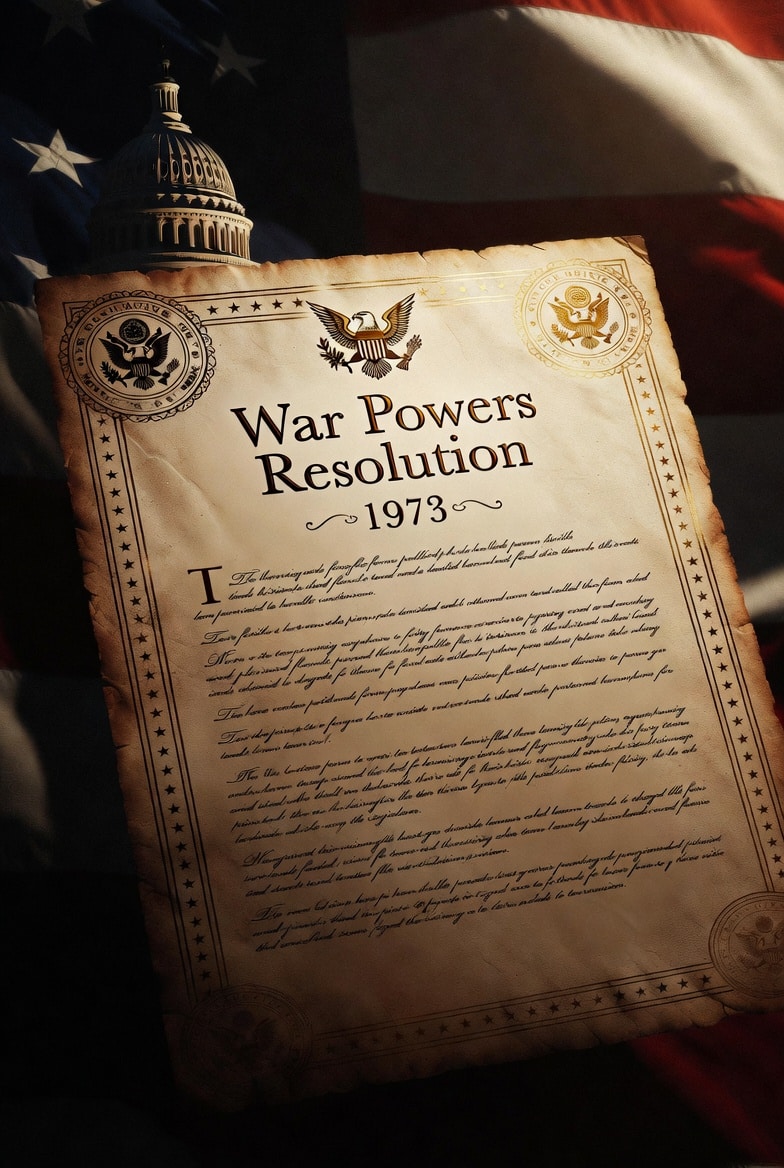
The resolution directed President Trump to withdraw U.S. armed forces from hostilities against Iran unless Congress formally declares war or passes an Authorization for the Use of Military Force. It invoked the War Powers Act, formally known as the War Powers Resolution of 1973, which requires the president to obtain congressional approval within 60 days if U.S. forces are engaged in hostilities. The Trump administration had argued that the ceasefire paused the 60-day clock, making the resolution moot.
The War Powers Act was enacted by Congress in the aftermath of the catastrophic Vietnam War. President Richard Nixon vetoed the act, and Congress responded by crushing his veto with a stunning override. While it is difficult to envision Trump’s Iran War escalating to a Vietnam-level quagmire, simply continuing to pursue the war could be enough to trigger a domestic political reckoning. It would also sink the global economy, something Vietnam never did.
The broader context made the vote all the more significant. The United States and Israel launched coordinated airstrikes against Iran on February 28, 2026—the U.S. operation codenamed “Epic Fury,” Israel’s “Roaring Lion”—killing Supreme Leader Ayatollah Khamenei and targeting nuclear and military facilities. Iran retaliated with missile and drone attacks on U.S. bases in Kuwait, Qatar, Bahrain, Saudi Arabia, and the United Arab Emirates and effectively closed the Strait of Hormuz. A fragile ceasefire took effect on April 8, but the conflict remained deeply unstable. As of the vote, the war had lasted over 90 days with no formal congressional authorization.
The June 3 vote was the fourth attempt to pass such a resolution. Speaker Mike Johnson had sent the House home early for recess around May 21, when it appeared the measure had enough votes to pass, but the delay failed to flip the necessary Republican votes.
The resolution’s path forward faces enormous obstacles. It must pass the Senate, where a similar measure advanced in May with four Republican senators—Rand Paul (KY), Susan Collins (ME), Lisa Murkowski (AK), and Bill Cassidy (LA)—voting to advance it. If passed by both chambers, Trump would almost certainly veto it, and overriding a veto requires a two-thirds majority nowhere near achievable. Secretary of State Marco Rubio warned that passage would tell Iran that Trump’s “hands are going to be tied.”
Sen. Paul has been among Congress’s most consistent voices on this question, introducing the End Endless Wars Act. Rep. Ro Khanna (D-CA) co-led the bipartisan resolution with Massie, declaring that “no president should be able to bypass Congress’s constitutional authority over matters of war.”
No War Powers Resolution has ever successfully survived a presidential veto in U.S. history. The vote is therefore largely symbolic but politically potent as a sign of fracturing GOP unity.
And for Massie, an outgoing congressman with nothing left to lose, it represents a final stand for the constitutional principle he spent his career defending. Massie’s resolution will almost certainly die in the Senate or fall to a presidential veto, not because the constitutional argument is weak but because the bipartisan addiction to executive war-making is stronger than any single congressman’s principles.