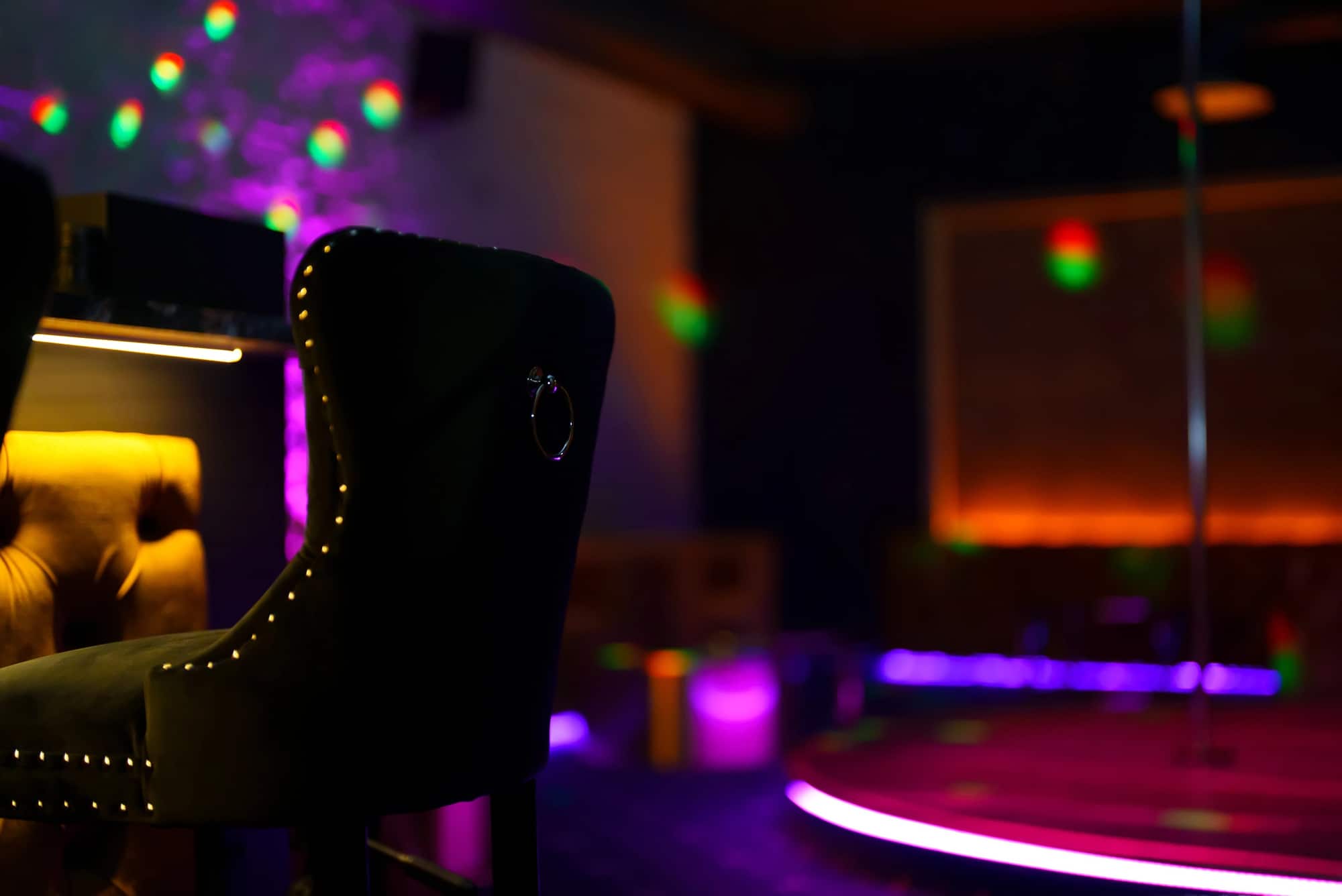
For years, an odd meeting between three men notorious in the Oklahoma City bombing literature has been reported to have taken place at a Tulsa strip club, with one or two Ryder trucks in the parking lot, bragging about an incident that would occur eleven days later, April 19. There is documentary and video evidence suggesting the meeting took place, but it was not clear until recently who may have been alongside McVeigh and Andreas Strassmeir at the club that night.
New documents appear to identify Michael Brescia as the third man in the group, with one man loudly bragging that a big event would make his name famous on April 19. Strassmeir and Brescia were roommates at Elohim City.
McVeigh is said to have rented the truck used in the bombing one week later in Junction City, Kansas.
Strassmeir was allowed to flee the country and returned to Germany via Mexico in early 1996.
Brescia was later sentenced to prison for other bank robberies and served a federal prison term but was never charged with involvement in the Oklahoma City bombing.
The Imperial Motel
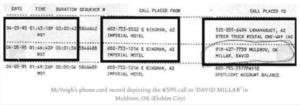
We will examine Timothy McVeigh’s whereabouts on April 8, 1995, as many witnesses identified him in Tulsa that night, yet he claims he was alone in a motel room in Arizona—at the Imperial Motel. A motel registration card can put Timothy McVeigh’s name in Arizona. It isn’t proof he was actually there.
That distinction matters and will be examined here, in the case of Timothy McVeigh, whose extended stay at the Imperial Motel from April 7 to April 11 must be considered alongside reports placing him in Oklahoma City and Tulsa during that time. We’ll examine McVeigh’s motel extension and those sightings in more detail in what follows.
One of the reports we’ll consider concerns a suspicious man seen in the parking garage of the Murrah Building, sometime between 4/10 and 4/12, spotted by bombing victim Delores Watson and identified by her as Tim McVeigh.
The other report concerns an evening at Lady Godiva’s strip club in Tulsa on April 8, 1995. There you find three men, drinks, dancers, and a remark that would become apocalyptically prophetic just eleven days after it was uttered.
Just days earlier, on April 5, McVeigh phoned Andy Strassmeir in Elohim City from his room at the Imperial Motel in Arizona.
Was that call, one of McVeigh’s last to be made before he went radio-silent for days, to arrange for this particular get-together at Lady Godiva’s on the 8?
April 8, 1995: Lady Godiva’s in Tulsa
My reading of the evidence is that the three men at Lady Godiva’s on April 8 were Tim McVeigh, Andreas Strassmeir, and Michael Brescia. That conclusion is drawn from the accounts assembled here, not from an identification established by every individual document, but from a collective analysis of all the evidence. The cumulative details support this conclusion, leading me to reach the same conclusion other investigators did.
The more specific proposition—that they were celebrating completed bombing preparations—is a hypothesis. The distinction is worth noting.
Start with what reportedly happened before anyone had a bombing to explain.
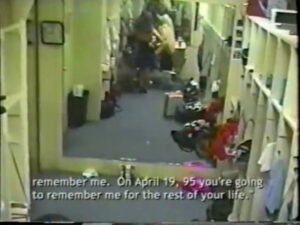
On April 8, 1995, a server at Lady Godiva’s entered the dancers’ preparation room and described to a co-worker an odd conversation she’d just had with a customer. The club’s security system recorded her account. The reported timestamp was 8:37 pm, and “Tara” relates that the man told her:
“I’m a very smart man. And on April 19 ‘95, you’ll remember me for the rest of your life!”
Just another weirdo, or so it seemed at the time.
People often say foolish things in bars, but rarely are their comments linked to the exact date of an impending mass murder.
The fact that this recording exists distinguishes this claim from an ordinary post-bombing memory. The waitress’s account predates the event that made her remark significant. That does not identify the customer, but it does mean the prediction cannot simply be dismissed as some story invented after April 19.
The tape reportedly survived because of a fight between dancers. A group of dancers from a neighboring state’s strip club had come through to perform at Godiva’s, and tensions in the locker room were high, leading to a full-on fistfight and a brawl. At least two were involved, and one dancer was subsequently kicked out of the club for the night.
Owner Floyd Radcliffe retained the security tape to review the altercation and later discovered the earlier conversation between Tara and her co-worker.
According to his account, Radcliffe contacted the FBI so agents could come collect the tape. But not before he made a copy and provided one to reporter J.D. Cash, who had just begun his own investigation of the event.
Cash had begun investigating the incident the very same week one of the club’s dancers who interacted with the trio of strange men, Shawn Tea Farrens, was found dead of an overdose of gamma-hydroxybutyrate (GHB). An FBI document shows that the server brought Farrens over to the men’s table, and that she was the dancer who spent the most time with the men after one made the comment about April 19.
[image10-farrensdeath.jpg]
This adds an element of intrigue to an already unusual death, in that GHB is not a recreational drug; rather, it is a date rape drug, a “knock-out” drug—which strongly suggests foul play.
Was Farrens murdered for what she saw and encountered with those three men at Lady Godiva’s that April evening? We may never know. It was only recently, through the acquisition of the medical examiner’s report by one of a young legion of new researchers (thanks, Trevor), that this fact even became known, thus adding intrigue to an already suspicious thirty-year-old event.
Witnesses Identify McVeigh, Strassmeir, and Third Man
The footage from Lady Godiva’s subsequently reached television audiences through CBC’s The Fifth Estate, which aired on October 22, 1996, under the title “The Company They Keep.” [transcript]
The reporting was a bombshell:
WOOD: “We showed photographs of Andreas Strassmeir and his roommate, Mike Brescia, to five women on shift that night. They were all so frightened, they wanted to protect their identities.
(to unidentified women) OK, so what I’m asking is if any of you people who were here April 8—and you were all here—can identify this man [Strassmeir] as being in the club on that night.
UNIDENTIFIED: Yes.
WOOD: And why do you remember him specifically?
UNIDENTIFIED: Face.
WOOD: And you?
UNIDENTIFIED: Yes, I did.
WOOD: You do remember him?
UNIDENTIFIED: Yes, I do.
WOOD: And you remember him for what reason?
UNIDENTIFIED: His buck teeth.
WOOD: His buck teeth.
UNIDENTIFIED: Yes.
WOOD: What about this man? [Michael Brescia] Was he in here that night?
UNIDENTIFIED: Yes.
WOOD: How sure are you that he was in here that night?
UNIDENTIFIED: Positive.
WOOD: And why are you positive?
UNIDENTIFIED: Because I recognize him and I remember him sitting back in a booth.
WOOD: Brescia wouldn’t talk to us, and Strassmeir denies he was ever at Godiva’s, but a cocktail waitress claims she remembers seeing Strassmeir sitting next to Timothy McVeigh.
One of the dancers also recognized McVeigh’s photo.
WOODS: (to unidentified cocktail waitress) You saw this man [McVeigh] in here?
UNIDENTIFIED: Yes.
WOOD: And how do you remember? What makes you remember seeing him in here that night?
UNIDENTIFIED: From one of the girls. I just heard her say something about a couple of guys, there were a couple of weird guys, she wanted somebody to go sit with them.
WOOD: A couple of weird guys.
UNIDENTIFIED: Yes, uh huh.
WOOD: And did she point this man out as one of the weird guys?
UNIDENTIFIED: She said something about some guy named Terry(sic) McVeigh—that’s all I heard.
WOOD: So she mentioned his name to you?
UNIDENTIFIED: Yes. [Emphasis added]
The CBC investigation fully identified the three men: McVeigh, Strassmeir, and Brescia. The dancers were “positive.”
Meanwhile, investigations into the incident continued, with reporting by J.D. Cash, Ambrose Evans-Pritchard, Peter Carlson of The Washington Post, Jon Ronson, and NBC.
During NBC’s investigation, they showed many photographs to server Pam Neouk—the one depicted in the video named “Tara” and “Terra”—and she declined to identify any photographs. However, Neouk was one of several staffers who interacted with the men that night, including several unnamed dancers interviewed by The Fifth Estate; “Cassie,” who was interviewed by Peter Carlson, and other dancers interviewed individually by Lady Godiva’s owner, Floyd Ratcliffe. So, while Neouk couldn’t identify any photos, we can rely on others to make the identifications.
What Did Other Investigators Discover?
British journalist Ambrose Evans-Pritchard is explicit in his book, The Secret Life of Bill Clinton, that McVeigh was seen with Strassmeir and Brescia eleven days before the bombing. Evans-Pritchard’s assertion should be considered alongside the witnesses behind it who he interviewed. Strassmeir’s reported identification was particularly specific: the dancers recalled a German accent and distinctive teeth.
In an interview quote attributed to Lady Godiva’s co-owner Julie Radcliffe, she told British filmmaker and author Jon Ronson:
“The girls identified Strassmeir. They all did identify that gentleman.”
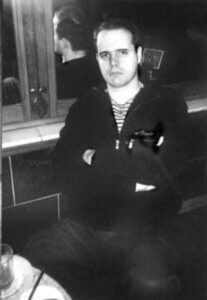
In their interview with CBC’s Trish Wood, the same dancers said they were “positive” it was Strassmeir. An accent and teeth are not fingerprints. But they are concrete features against which an identification can be checked.
As with Strassmeir, we have multiple independent identifications that McVeigh was one of the three men in the group.
Then there is the third man, whom we’ll call “Michael,” based on a recently discovered October 3, 1996 FBI interview with Charmayne Farley. Known at the club as Sydney, Farley’s account supplies a very useful piece of the story.
Farley, like others, remembered the evening so well because of the dressing-room fight. Another dancer and server named “Tara” told her about a customer who appeared wealthy and said he was about to become famous. Farley visited the table. Three men were there, and the server’s attention fell upon one of the three: a man who wore a suit and tie, had dark features, was notably handsome, and was spending freely.
Later, Floyd Radcliffe showed Farley photographs. Farley identified a photo that Floyd had labeled “MICHAEL” as server Tara’s big-spending, handsome customer. The document says what held her attention: he was “good looking” and apparently throwing around some money.
The report does not give Michael’s surname. The identification of that man as Brescia comes from associated, contemporary journalistic accounts—at the time of Ratcliffe’s investigation and the querying of his employees he’d been in contact with J.D. Cash, who both encouraged Floyd to make a duplicate of the tape, and also shared his own lead that the third man was Michael Brescia, then a young, “good looking” and rather flush-with-cash Aryan bank bandit being sought (or unsought?) by the FBI.
It’s notable that just ten days prior to the April 8 encounter at Lady Godiva’s, the Aryan Republican Army (ARA) had robbed a bank in Des Moines, Iowa for nearly $30,0000. At the time, the gang was flush with cash.
Michael, or Mike?
If Floyd got his photo-spread from J.D. Cash, then the one labeled “MICHAEL” was assuredly Michael Brescia, rather than Mike Fortier—who I would add that few dancers would likely describe as “good looking” or handsome, or much less would he have been wearing a suit.
Fortier could have been better described as scraggly—with his unkempt facial hair—probably wearing shorts and a wifebeater, his hair in a ponytail, as seen on national television shortly after the bombing. He was sloppy. Thus, Fortier would never be confused for a handsome man by dancers—they would far more likely have sized up Mike Fortier as a “scrub,” considering his general ratty appearance at the time.
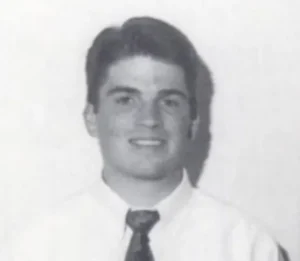
As to the issue of money—with Mike Fortier married and very much in need of cash, it’s unlikely you would find him dropping twenties and hundreds in a strip club, while Michael Brescia, on the other hand, could have been flush with cash depending upon his take from various bank robberies recently carried out by his crew, making a positive impression on the dancers with his confidence and those rolls of $20s and $100s.
With all of this in mind, I believe the “MICHAEL” in the photo was Michael Brescia, shown by Floyd Ratcliffe to dancers, because he had been working with J.D. Cash on this identification.
J.D.’s reporting shows he clearly suspected the third man was Brescia. Indeed, he had photos of Brescia at the ready that he shared with Glenn and Kathy Wilburn for their own investigation in Kansas. Would he have done the same for Floyd Ratcliffe to help with his questions?
Thus, I believe that Ratcliffe and Cash, if they’ve labeled a photograph “MICHAEL,” refer to Michael Brescia, not Mike Fortier.
Wouldn’t you label a Fortier photo “MIKE” anyway?
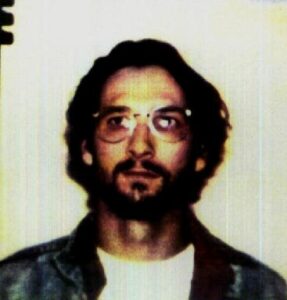
In addition, Fortier’s presence in Tulsa can be ruled out because, unlike Tim McVeigh, Mike’s presence in Arizona at the time did not consist only of a paper record; Mike was home in Arizona with his wife, Lori Fortier, where he was observed by neighbors when Tim made his clandestine journey into Oklahoma, where McVeigh had, apparently, unfinished business in the Murrah Building parking garage and with Andy Strassmeir and Mike Brescia.
Third Man Identified as Neo-Nazi Terrorist and Bank Robber
Charmayne Farley said she could not recall what the other two men sitting with Tara looked like; she was clear that she did not look at them.
Thus, when she nevertheless told investigators she’d never seen McVeigh or Terry Nichols at the club, that doesn’t preclude one of the two men from being McVeigh. If she did not see them, she’d have no memory of them. Indeed, we must rely upon a separate selection of dancers to identify those two men, and they were clearly identified in the CBC broadcast, with one solidly identified as Strassmeir based on accent and appearance, and the other identified positively as Timothy McVeigh.
A witness who cannot describe two men has limited basis to exclude particular identities. Her account is strongest concerning the customer who did catch her attention; thus, with Charmayne, we have a unique and interesting identification of the third man as a “MICHAEL”—and his description as “good looking” and “spending money” matches quite well with what Ambrose Evans-Pritchard wrote concerning the encounter.
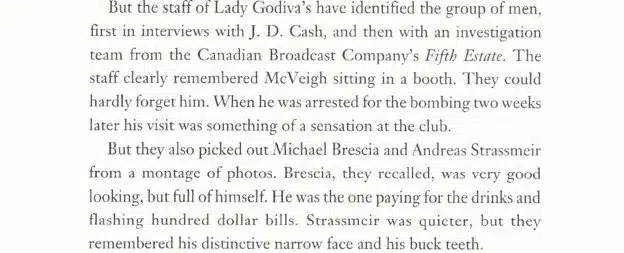
Other reported identifications of the third man round out the case. In an account from Washington Post writer Peter Carlson, a dancer called Cassie identified McVeigh from photographs, and also identified Strassmeir. So, Cassie’s account matches that of those interviewed by The Fifth Estate.
But for the third man—identified as “MICHAEL” by Farley—Cassie recognized that customer as resembling the John Doe #2 sketch; she said that man was the “customer who had been talking with dancers in a back booth.” In other words, the “good-looking” one spending up the money that night.
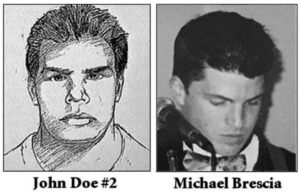
That last identification is not equivalent to selecting Brescia’s photograph. It is a separate observation. Nor does the reported naming of Brescia in bombing victims Glenn and Kathy Wilburn’s civil suit prove his involvement. However, it is notable that at the time the CBC and Carlson investigations were ongoing, the Wilburns were doing their own investigation, traveling personally to Kansas to interview witnesses, and when there, showed witnesses a photo of Michael Brescia, sometimes alongside the John Doe #2 sketch. There, some witnesses reportedly identified Brescia as the sought-after suspect. This must be considered when we have “Cassie” saying this third man at Lady Godiva’s with McVeigh and Strassmeir resembled the John Doe #2 sketch. The Cash/Wilburn investigation in Kansas also has Elliott’s Body Shop mechanic, Tom Kessinger, saying the photos of Michael Brescia resemble the John Doe #2 he saw at the body shop on April 17. Was it him?
Meanwhile, online, Mike Vanderbough of “The John Doe Times” was calling for Brescia’s arrest by the FBI, and putting up “UNWANTED BY THE FBI” posters in Brescia’s hometown. At the time, Brescia was a fugitive wanted by the FBI, yet bloggers, journalists, and investigators knew his location—so why hadn’t the FBI picked him up? It remained a point of contention until the FBI finally did swoop in and arrest Brescia, who was picked up without incident in the parking lot of his employer on January 30, 1997. It seems Brescia was living right out in the open, not hiding, and, for a spell—not exactly sought after either.
Perhaps Brescia’s proposed presence matters most because of his reported relationship to Andy Strassmeir and the Aryan Republican Army. Brescia was Strassmeir’s roommate at Elohim City and a recruit in the neo-Nazi bank-robbing group that hit twenty-two banks.
If the identifications are correct, the gathering puts McVeigh in the company of a bank robber whose connections merit much scrutiny. It is notable to add that the Aryan Republican Army modeled themselves after “The Order,” a white supremacist terrorist group from the mid-1980s who stole over $3 million dollars from banks and armored cars, using the money to advance white supremacist causes, up to and including financing acts of terrorism. Indeed, when he testified at trial, ARA member Kevin McCarthy stated that the group’s bank robberies were a means to an end, with their ultimate goal being to “commit terrorist acts against the United States government.”
In this context, Tim McVeigh once said he received $200 for his help in “planning a bank robbery” and asked his sister, Jennifer McVeigh, to launder the proceeds. Jennifer McVeigh subsequently wrote in an affidavit for the FBI that her brother had obtained funds that were from a bank robbery.
At the time, contemporary news accounts all reported that the FBI was investigating a series of bank robberies that may be connected to the bombing. Those were the ARA robberies, which Brescia was part of. Was McVeigh also a part of some of them? Was Brescia, then, in McVeigh’s company at this time because of McVeigh’s alleged involvement in some of the ARA robberies? Notably, FBI documents described the ARA in one memo as “McVeigh and his associates.”
Recent documents obtained from the FBI by Jesse Trentadue as a result of a FOIA lawsuit were published by this author, as those documents were new and they showed that the FBI began comparing Tim McVeigh’s fingerprints to the ARA bank robbery evidence just seven days after the bombing, and continued those fingerprint comparisons for at least seven months.
These documents, taken together, were published alongside a story detailing how, to the contrary of the FBI’s official position today, they did investigate Timothy McVeigh’s link to this group of neo-Nazi bank robbers and continued doing so for many months after the bombing. What all of this indicates is that Brescia would have been the sort of person that McVeigh could theoretically know and have had business with: he’s the roommate of a radical friend, a member of a terrorist organization who sought to “commit terrorist acts” —and provide funds for same—leaving McVeigh as precisely the sort of person someone in the ARA might lend material support to. Meanwhile, we know McVeigh was evidently the recipient of some money—even if it’s just $200, it’s a start—if we’re to go by Jennifer McVeigh’s statement to the FBI about stolen bank robbery proceeds possessed by Tim McVeigh for his help in planning at least one robbery.
Finally, we have the words of Dennis Mahon, a white supremacist from Tulsa, Oklahoma, and an associate of Andy Strassmeir and Michael Brescia. When interviewed by Jon Ronson in 2000, Mahon said that Brescia and Strassmeir called him on the phone that night from Lady Godiva’s—multiple times—and said firmly that “they were there.”
The Imperial Motel and Clandestine Movements
Did McVeigh put himself “on paper” at the Imperial Motel during a time in which he went to Oklahoma City, Tulsa, and perhaps Elohim City between April 7 and the 11?
Roger Charles raises precisely that possibility in Oklahoma City: What the Investigation Missed and Why It Still Matters. Charles writes that “it is also possible that [McVeigh] made a quick trip to the Midwest between April 7 and April 11. He was checked into the Imperial Motel on those dates, but the owner later said he did not see him, he used no towels, and his bed was undisturbed.”
In Wendy Painting’s book, Aberration in the Heartland of the Real: The Secret Lives of Timothy McVeigh, she takes the matter further. She writes that “[McVeigh’s] defense team noted that while the handwriting on the original registration form at the Imperial resembled McVeigh’s, the registration extension form dated April 7, had very obviously been filled out by someone other than McVeigh.”
I strongly believe that McVeigh’s associates, the Fortiers, paid for and signed the room extension for him at the Imperial Motel. While an unused towel cannot tell us where a man traveled, neither can a registration form signed by someone else prove that he stayed put. These details make the proposed absence plausible; the reported sightings must then establish McVeigh’s clandestine destinations.
One such account comes from Delores Watson, whose son PJ was injured in the bombing and was one of six children from the day care to survive. He wore a tracheotomy until age 11 to assist him with breathing and later became an aviation technician at Tinker Air Force Base.
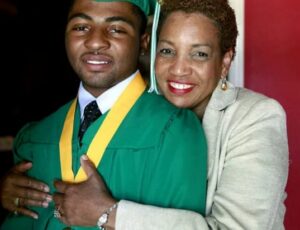
An FBI document summarizing Watson’s interview, supplied with Defense team attorney analysis, places her encounter sometime between April 10 and April 12. She saw a man walking in the basement tunnel from the Federal Building, initially mistook him for someone else, and spoke to him.
The man did not answer.
She reportedly looked directly at him for approximately ten seconds.
The form says she subsequently recognized McVeigh in television footage from Perry:
“That’s the guy I saw in the Federal Building.”
This is a reported identification preserved in a summary, not independently verified proof that McVeigh entered the building; however, it stands as damn-near convincing evidence, to a reasonable person, that the man Watson saw was very likely who she said he was: Timothy McVeigh.
Thus, it belongs in the chronology. A registered motel room is insufficient grounds for throwing it out. The eyewitness identification is stronger; indeed, the evidence that suggests McVeigh was not present at the Imperial Motel between April 8 and 11 is stronger still.
The Two Ryder Trucks at Lady Godiva’s
There is also the reported Ryder truck—no, truck(s), plural—spotted outside Lady Godiva’s on April 8 when McVeigh, Strassmeir, and Brescia visited. Indeed, other essays on the subject have demonstrated that the bombing’s conspirators did seem to use a second Ryder truck in the attack; see the essay “Tim McVeigh and the Second Ryder Truck” for more details on this truck and the innumerable sightings of the smaller, older, faded-yellow vehicle for days at Geary Lake between April 10 and 13, long before the large twenty-foot bomb truck was rented at Elliott’s body shop.
Meanwhile, FBI documents from the investigation describe a Lady Godiva’s security employee seeing the two yellow Ryder trucks in the parking lot on April 8. Curious. The same documents also reveal that “Tara” was joined at the men’s table by dancer Shawn Tea Farrens—whose presence in this case remains a mystery, the one dancer whose interview we need most, and the only one whose life was cut short just a week before anyone began investigating.
The documents detail that a dancer, ejected after an altercation, later urinated beside the wheel well of a Ryder truck, one of two in the parking lot. An undignified incident can be a useful memory anchor. Its value depends on the underlying documents and interviews, each of which establishes important dates, details, and descriptions.
Two Ryder trucks? Indeed. This document was featured in the appendix of the recent bestseller Blowback by Margaret Roberts, excerpted below, reveals that “Tara” asked Shawn Tea Farrens to join the group. Farrens would later be found dead of a GHB overdose one week before the Godiva’s investigation began.
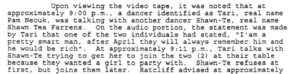

The sighting predates the later rental of the known bombing truck, which was on Monday, April 17, 1995. That prevents an easy identification of the two vehicles. Reports of an older, faded yellow Ryder truck elsewhere, between April 10 and 16 raise further questions, but they do not answer any.
Yellow rental trucks require more than matching paint to become the same truck, but that said, just how many Ryder truck sightings at conspicuous locations, sometimes with Tim McVeigh and sometimes not, must one collect before it is no longer coincidence?
Back to Lady Godiva’s, With Identifications In-Hand
My attention is drawn to the combination of factors. McVeigh called Strassmeir on April 5. Three days later, a trio of men reportedly spent several hours drinking and conversing with dancers at Lady Godiva’s, with one conspicuously doing so.
A dancer recounted one man’s talk about achieving fame and wealth. Another account documented a customer’s prediction that April 19 would make him unforgettable.
The records show that dancer Shawn Tea Farrens joined the group. (She was later found dead.)
Multiple witnesses identified the men as McVeigh, Strassmeir, and Brescia. The motel records suggest a journey, and Delores Watson’s report adds another Oklahoma encounter around the same period of time.
These pieces differ in quality. Some are visible in the supplied records. Others depend on published accounts, interview quotations, or footage that must be examined in full. We should weigh them together without pretending they are interchangeable.
I believe the identifications describe the trio who were there.
I also think an evening of celebration after preparations is a plausible explanation for the spending—and perhaps a few drinks are responsible for the alleged boast.
However, no one in the known evidence overheard a planning session or a declaration that the bomb was ready. Describing the evening as a celebration of completed plans exceeds what the witnesses directly confirm. The question is whether that interpretation best explains all of the evidence once the context is analyzed and the travel chronology is tested. It tracks: McVeigh puts himself “on paper” at the Imperial Motel from April 7 to 11, paid for by the Fortiers, because he has sensitive unfinished business in Oklahoma.
For me, the reported April 19 remark at Lady Godiva’s is the hardest detail to put aside. It joins an otherwise ordinary night in a Tulsa club to a date that had not yet become infamous. Someone was already talking about that date eleven days before the explosion.
I believe that someone was Timothy McVeigh.
The unfinished work is to establish, with equal precision, what Andy Strassmeir and Michael Brescia were doing there, and what they knew.