
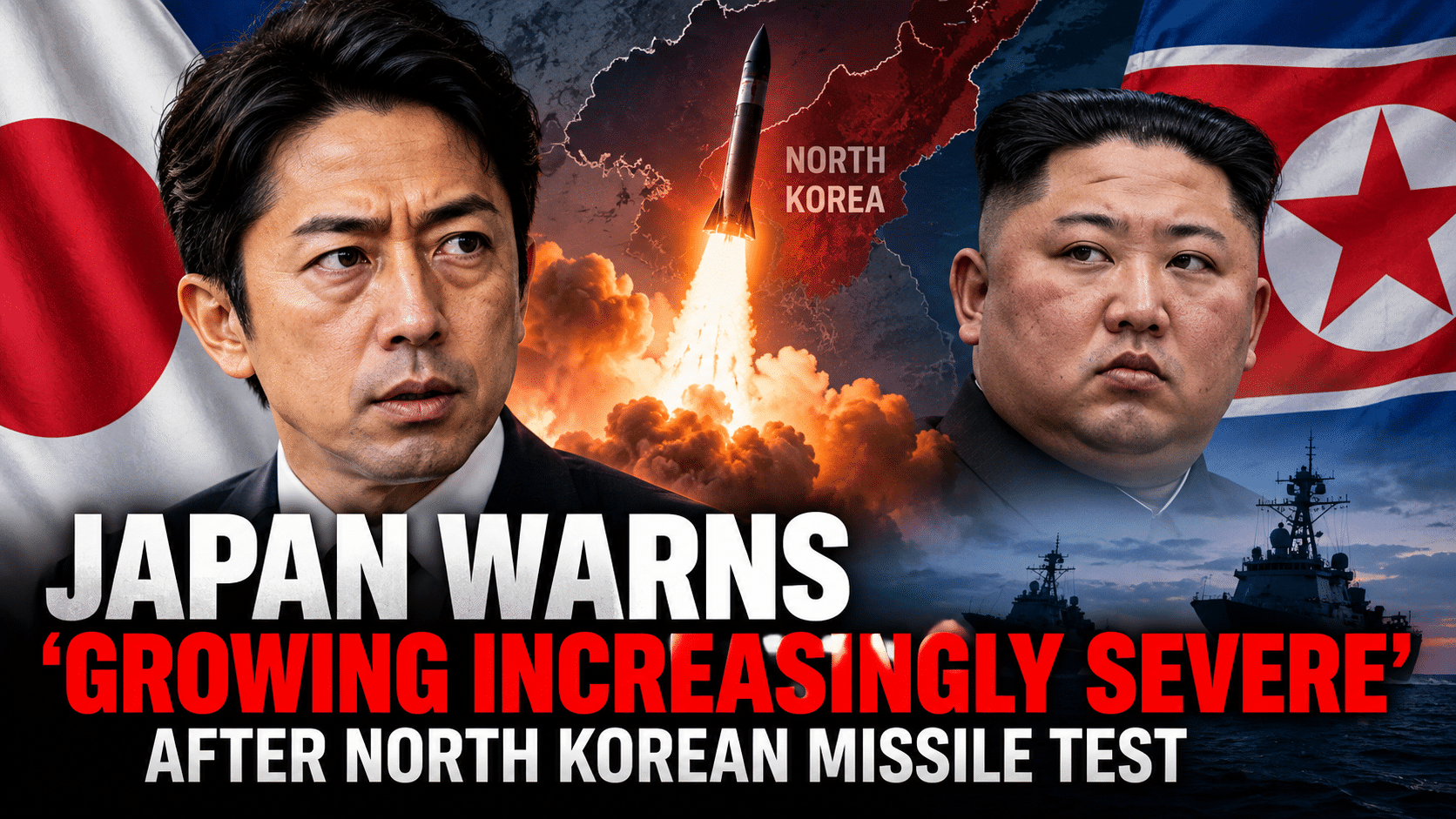
North Korea conducted another missile test on Sunday, prompting Japan to warn that the regional security situation is “growing increasingly severe.”
Japanese Defense Minister Shinjiro Koizumi told reporters that North Korea test-fired two ballistic missiles and went on to warn about the increasing instability in the region. “Last year, there were four instances and at least five missiles, so the number of instances has doubled, and the number of missiles has increased to at least three times as many,” Koizumi said, describing the regional security situation as “growing increasingly severe.”
South Korea said it strengthened its surveillance and alert posture in response to the missile test. “Our military has strengthened surveillance and alert posture in preparation for additional launches,” a statement by the South Korean Joint Chiefs of Staff said. “Korea, the United States, and Japan are closely sharing information related to the ‘North Korean ballistic missile’ and maintaining a full state of readiness.”
Over the past two months, the US has led two rounds of war games in the region. In August, the US and South Korea held bilateral Ulchi Freedom Shield (UFS) war games. Trump scaled back the drills, arguing they were unnecessarily hostile against North Korea. Earlier this month, the US, South Korea and Japan held the trilateral Freedom Edge war games.
While Trump cut the UFS drills in half, the Freedom Edge war games have gone forward as planned. North Korea has conducted multiple missile tests amid the exercises, including several short-range ballistic missile launches immediately after Freedom Edge concluded.
Trump scaled back the war games as he offered to meet with Supreme Leader Kim Jong Un and predicted the two would meet later this year. However, Kim’s sister, Kim Yo Jong, rebuked the overture, saying that merely scaling back the war games did not change the hostile US policy towards North Korea.
Adding to the tensions in the region are moves by South Korea and Japan toward acquiring nuclear-powered submarines. Washington has approved Seoul’s plan to build nuclear-powered attack submarines, while the possibility of Japan acquiring similar vessels has also drawn support from a US Navy official.
In a commentary published by KCNA, international affairs analyst Choe Ju Hyon accused the US of instigating South Korea and Japan to acquire nuclear submarines. “The reality goes to prove that Washington’s plan for ‘AUKUS 2.0,’ which allows the transfer of nuclear technology for munitions to non-nuclear allies, has entered the phase of full-scale expansion,” he wrote.
AUKUS is a trilateral pact between the US, the UK, and Australia. Under the deal, the US and UK agreed to help Australia build a fleet of nuclear submarines. China has also criticized the transfer of nuclear-propulsion technology under AUKUS. The Chinese Foreign Ministry said AUKUS “undermine[s] strategic stability and provoke[s] an arms race in the region.”
In his article, Choe argued that North Korea must increase its nuclear deterrent in response to South Korea and Japan acquiring nuclear submarines. North Korea must “bolster up its nuclear war deterrent means both in quality and quantity without the slightest stagnation and stalemate.”