


Money supply growth slowed in February, falling to the lowest rate recorded since February of last year. Overall, money-supply growth remains well below the growth rates experienced from 2009 to 2016, and has fluctuated little since March of last year
In February, year-over-year growth in the money supply was at 3.1 percent. That was down from January’s growth rate of 3.3 percent, but was up from February 2018’s rate of 3.0 percent.
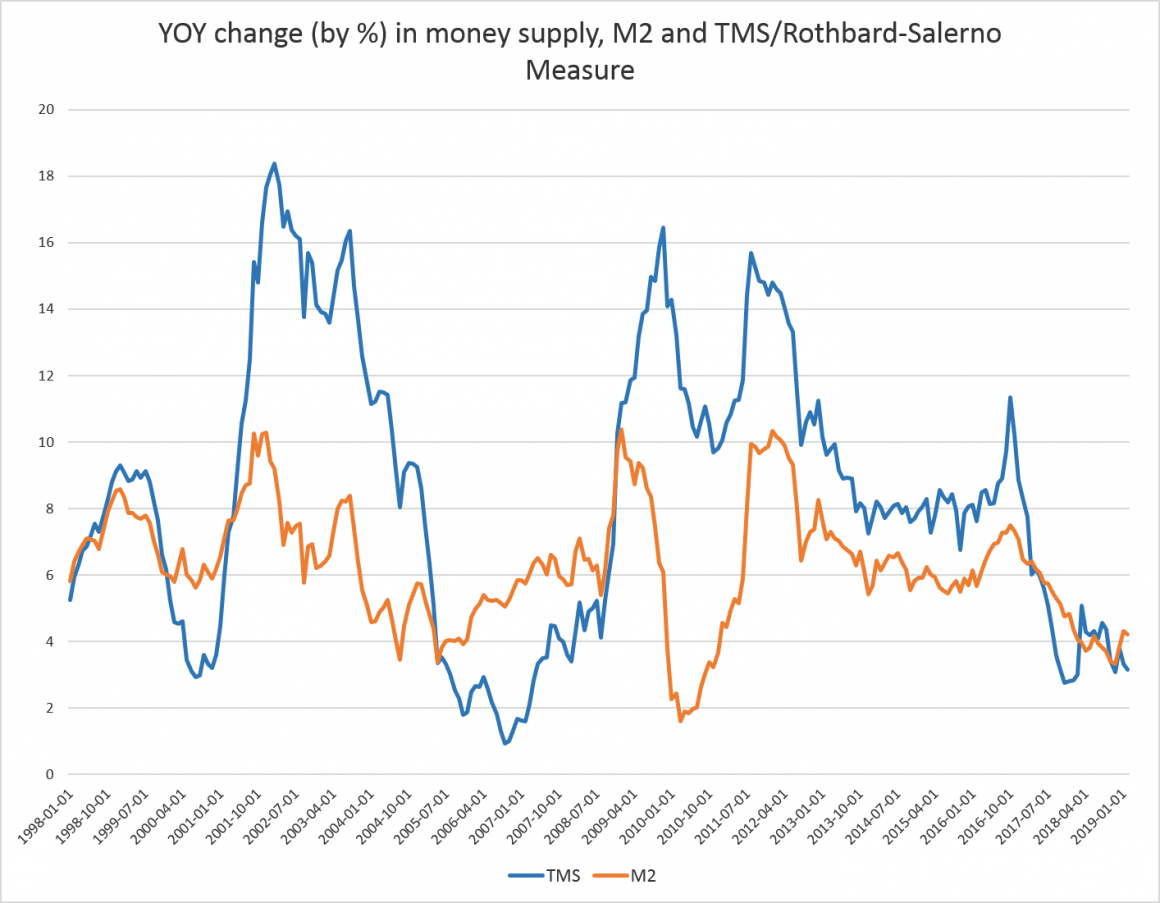
The money-supply metric used here — the “true” or Rothbard-Salerno money supply measure (TMS) — is the metric developed by Murray Rothbard and Joseph Salerno, and is designed to provide a better measure of money supply fluctuations than M2. The Mises Institute now offers regular updates on this metric and its growth.
This measure of the money supply differs from M2 in that it includes treasury deposits at the Fed (and excludes short-time deposits, traveler’s checks, and retail money funds).
M2 growth fell in February, growing 4.2 percent, compared to January’s growth rate of 4.3 percent. M2 grew 4.1 percent in February of last year. Like the TMS measure, the M2 growth rate has fallen considerably since late 2016, but has varied little in recent months.
Money supply growth can often be a helpful measure of economic activity. During periods of economic boom, money supply tends to grow quickly as banks make more loans. Recessions, on the other hand, tend to be preceded by periods of falling money-supply growth.

Many factors contribute to these trends. In recent months, money supply growth — in both M2 and TMS — has likely been impacted by falling growth rates in real estate loans at commercial banks. In February, real estate loans grew 2.9 percent, year over year, which was a 51-month low. The demand for mortgage loans has softened as mortgage rates have risen. In February, the 30-year, fixed average mortgage rate reached 4.4 percent, which was down from November’s recent high of 4.87. February 2018’s average mortgage rate was much lower, however, coming in at 4.33 percent. However, the Fed has recently signaled it plans to half increases in the target rate, and this may lead to more real-estate loan activity.