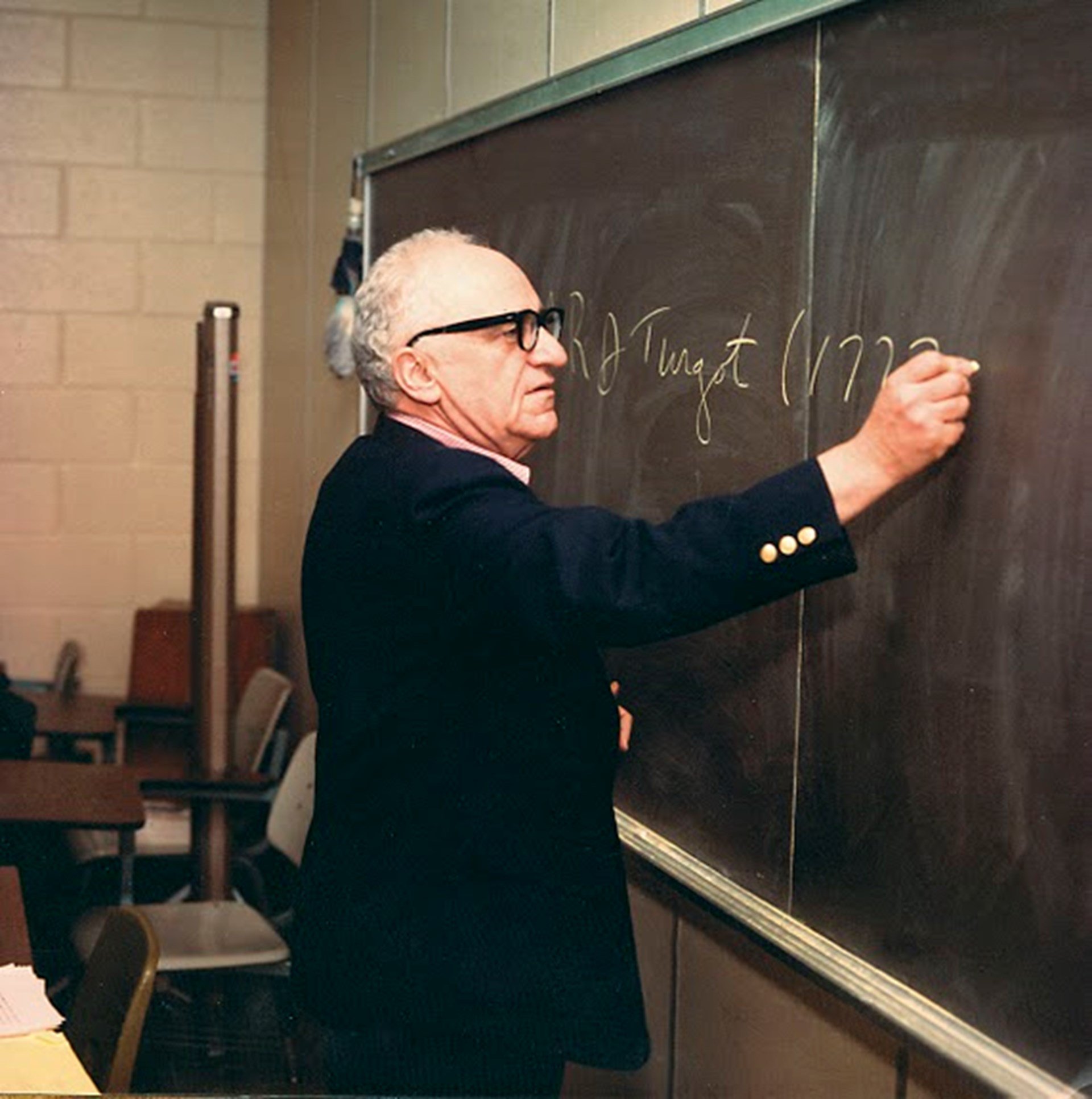
On March 2, 1926, Murray Rothbard was born in the Bronx, New York, an only child of immigrant parents. His father worked as a chemist and his mother encouraged his voracious reading. Early interests in history and logic foreshadowed a career in which he relentlessly scrutinized economic models, historical narratives and political myths.
Rothbard enrolled at Columbia University at sixteen and earned a B.A. in mathematics and economics, graduating Phi Beta Kappa. He completed a Ph.D. under Joseph Dorfman with a dissertation on The Panic of 1819, showing how an early U.S. central bank triggered a depression. Although Columbia exposed him to Keynesian ideas, his decisive intellectual turning point came when he attended Ludwig von Mises’s seminar at the Foundation for Economic Education. There he encountered Austrian praxeology and laissez‑faire economics. The seminar transformed him into a disciple of Misesian economics and natural‑rights philosophy.
He emerged from the FEE library convinced that liberty required abolition of state coercion rather than mere reform. In his twenties he coined the term “anarcho‑capitalism” to describe a stateless society based on voluntary exchange. Hans‑Hermann Hoppe later observed that “the anarcho‑capitalist movement…would not exist were it not for Rothbard’s work.”
In the 1950s, Mises asked Rothbard to write a textbook explaining Human Action for a broad audience. The result, after ten years of labor, was Man, Economy, and State (1962), a monumental treatise of more than 1,000 pages. The book restored praxeology—the logic of human action—to the center of economics and systematically deduced micro‑ and macroeconomic laws from the axiom that individuals act purposefully. In the process Rothbard extended and refined Austrian theory. He argued that monopoly could not exist in a free market because prices and profits were governed by consumer preferences; monopolies arose only when government granted exclusive privileges. He integrated Frank Fetter’s theory of rent and developed a pure time‑preference theory of interest that aligned with Eugen von Böhm‑Bawerk’s capital theory. He also criticized the Keynesian emphasis on aggregate demand and asserted that business cycles result from central bank–induced credit expansion; genuine prosperity, he argued, required a gold standard and 100 percent reserve banking.
The response to Man, Economy, and State was extraordinary. Ludwig von Mises praised it as “the result of many years of sagacious and discerning meditation,” and Henry Hazlitt described it as “the most important general treatise on economic principles since Ludwig von Mises’s Human Action.” The book’s success marked the revival of Austrian economics at a time when mainstream economists dismissed it as archaic. Power and Market, written as an addendum but later published separately, extended the analysis by categorizing all forms of state intervention into “autistic,” “binary,” and “triangular” interventions. Rothbard argued that every intervention—whether it be taxation, price controls, or conscription—reduces voluntary exchanges and therefore diminishes social welfare.
Rothbard’s talents were not confined to economics. He held a lifelong fascination with American history and believed, following his mentor’s advice, that to understand current politics one must investigate history “as a detective investigating a crime.” His historical writing reflects this revisionist zeal and skepticism toward official narratives. America’s Great Depression (1963) applied Austrian business cycle theory to the 1930s, demonstrating with extensive data that the Federal Reserve’s credit expansion caused the late‑1920s boom and that Herbert Hoover’s interventions—wage rigidities, tariffs, and public works—prolonged and deepened the downturn. The book showed that the New Deal accelerated rather than corrected interventionism. Historian Paul Johnson later acknowledged that Rothbard’s thesis had become the “official view” in his own Modern Times.
He continued this project in Conceived in Liberty, a multi‑volume history of colonial America and the Revolutionary War. Rejecting nationalist hagiography, he argued that the Revolution was fundamentally libertarian—an uprising against imperial privilege and mercantilist monopolies. He emphasized overlooked radicals and showed how the centralizing impulse in the Constitution betrayed that spirit. His later histories traced the lineage of laissez‑faire ideas and exposed recurring collusion between political elites and banks, showing that crises, from early panics to the Progressive Era, were failures of privilege rather than markets.
Rothbard regarded economics as value‑free but believed political philosophy must rest on a moral axiom. He championed natural rights grounded in self‑ownership and property homesteading. In The Ethics of Liberty (1982), he argued that because individuals own themselves, any initiation of force is unjust; legitimate force arises only in defense or restitution. From this he deduced the non‑aggression principle and the illegitimacy of the state. The book systematically derived libertarian law from first principles, including property rights in land, children, and animals, and offered a stateless legal order based on private arbitration and insurance. David Gordon notes that the work integrated property theory and economics into “the first fully integrated science of liberty.”
For a New Liberty (1973), subtitled “The Libertarian Manifesto,” served as Rothbard’s outreach to the general public. In a tone both scholarly and combative, he unveiled the state as the great predator. “War is mass murder,” he wrote; “conscription is slavery; and taxation is robbery.” Governments, he argued, are “criminal gangs” that cloak plunder in patriotic rhetoric. Every service claimed by the state—from police to schools—could be better provided through voluntary association and free markets. Lew Rockwell, his collaborator and later chairman of the Mises Institute, called Rothbard the “creator of modern libertarianism,” noting that he wove together classical liberalism, Austrian economics, American anti‑war tradition, and natural‑rights theory into a coherent ideological system. According to Rockwell, once someone has absorbed Rothbard’s arguments, “the vision of liberty will never leave him.”
He was as prolific as he was influential, writing dozens of monographs, thousands of articles, and co-founding the Journal of Libertarian Studies and the Review of Austrian Economics. He served as S.J. Hall Distinguished Professor at the University of Nevada, Las Vegas until his death in 1995. His New York Times obituary called him “an economist and social philosopher who fiercely defended individual freedom against government intervention.” Hoppe recalled moving to New York because he regarded Rothbard as “the greatest of all social theorists, certainly of the 20th century and possibly of all times,” noting that since then “there has been no second Mises or Rothbard” and that without Rothbard there would be no Ron Paul movement or “popular libertarian agenda.”
Rothbard’s activism matched his scholarship. He believed that real‑world political change was vital to libertarianism and, after initially judging the United States premature for a new party, he joined the fledgling Libertarian Party in the mid‑1970s. He wrote position papers and helped shape its platform, and his alliance with Charles Koch led to the establishment of educational and advocacy institutions such as the Cato Institute and the Center for Libertarian Studies. He also served as founding editor of the latter’s Journal of Libertarian Studies. Later, as vice president for academic affairs at the Mises Institute, he created the Review of Austrian Economics. Sheldon Richman notes that Rothbard’s “passion nonpareil” forged a “self‑conscious libertarian movement,” built through his activism and charisma as much as through his writings, and the editors of his Festschrift described him as a “joyous libertarian” and “champion of liberty” whose integrity and optimism made him a leader in the battle for freedom. By the late 1980s he broke with the Libertarian Party and, together with Lew Rockwell, sought to create a paleolibertarian alliance combining libertarianism with cultural conservatism and reviving Old Right anti‑war politics.
Ron Paul, the physician‑turned‑congressman who inspired a new generation of libertarians, credited Rothbard as his principal economic influence. In End the Fed, Paul recalled discovering the writings of Mises, Hayek, Rothbard and Sennholz and says that of these authors he came to know Rothbard best, urging Washington insiders to read America’s Great Depression. Joseph Stromberg wrote that Rothbard “put the ‘anarcho’ in anarcho‑capitalism” and that his writings “massively influenced three generations of libertarians and conservatives.”
Academic assessments have echoed these tributes. The introduction to the Festschrift Man, Economy, and Liberty called him “the founder of the first fully‑integrated science of liberty,” praised his economic treatises for integrating monetary theory, capital theory, and praxeology, and noted that he is “no less than the father of libertarianism.” Hans‑Hermann Hoppe and Lew Rockwell have maintained that there would be no anarcho‑capitalist movement, no coherent libertarian philosophy, and no vibrant movement of anti‑state intellectuals without Rothbard’s pioneering work.
Rothbard’s influence persists because he combined theoretical rigor with moral passion. As an Austrian economist, he reconstructed economic science around human action and demolished the myth that markets breed monopolies or crises. As a historian, he exposed the government’s complicity in economic and political disasters. As a political philosopher, he defended self‑ownership and non‑aggression with penetrating logic. In each domain he punctured fashionable fallacies with the kind of sardonic clarity. His critics call him utopian, but Rothbard knew that the state’s utopian promise is far more dangerous than the voluntary arrangements he envisioned. He recognized that “it is easy to be conspicuously ‘compassionate’ if others are being forced to pay the cost.”
Rothbard died on January 7, 1995, but his intellectual heirs continue to debate, refine, and apply his ideas. Modern scholars working in law and economics routinely cite his analyses of monopoly, utility, and welfare. Historians inspired by his revisionism re‑examine the motives behind wars and economic crises. Activists campaigning against war and central banking wave signs demanding to “End the Fed” and “Audit the Pentagon,” slogans that originate in his work. For these students of liberty, Rothbard is not merely a historical figure but a living provocateur whose arguments challenge them to rethink the relationship between coercion and cooperation.
On this anniversary of his birth, it is fitting to remember Murray Rothbard not only as “Mr. Libertarian” but as a polymath whose scholarship helped forge modern libertarianism. He taught that liberty is indivisible, that economics is inseparable from ethics, and that history must be stripped of statist mythology. That synthesis—iconoclastic, rigorous and uncompromising—continues to inspire those who seek a society based on voluntary association rather than the iron fist of the state.