
In mid-September 2026, former Green Beret Tim Kennedy was shot multiple times in the leg during an ambush in the Minembwe Highlands of South Kivu, in the eastern Democratic Republic of Congo (DRC). He was part of a small Vectus Global team, one of Blackwater founder Erik Prince’s private security companies, accompanying Congolese forces. The event prompted, for a moment, a degree of American media coverage of the Congo. To be sure, the coverage was as shallow as it was fleeting, mostly focused on Kennedy’s own story; but make no mistake, there is much more here than just a seemingly random firefight involving private contractors in some remote African hinterland.
Eastern Congo has been a conflict economy for decades. North and South Kivu sit atop deposits of coltan, gold, tin, and other minerals that move through informal and violent channels funding paramilitary operations.
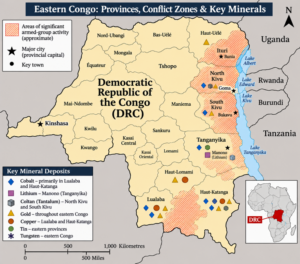 This trade has for years been dominated by the March 23 Movement (M23)—a Rwandan-backed Congolese rebel group. M23 and affiliated groups control or tax significant territory and artisanal mining sites, using these funds to support their operations. Until recently, these aimed at maintaining and expanding the group’s control, ostensibly in defense of the Tutsi of eastern DRC, both from hostile local armed groups and foreign militias operating in the DRC, most notably the Democratic Forces for the Liberation of Rwanda (FDLR), a Hutu rebel group formed by perpetrators of the 1994 Rwandan genocide. It should be noted that this is why Kigali, under the rule of Paul Kagame and his Rwanda Patriotic Front (RPF), supports the group—framing the issue as one of national security and ethnic solidarity, providing strategic depth against both the DRC and Hutu armed groups, while protecting the Tutsi community of eastern DRC.
Just last month, in October, things escalated as the resources and person of former DRC leader Joseph Kabila were added to this proxy war and rebellion.
The difficulties of this situation from Kinshasa’s perspective—which sees hundreds of millions of dollars in tax revenue annually siphoned away by these groups, to say nothing of broader questions of sovereignty and control—were precisely what led to Kennedy and the rest of the Vectus team being in eastern DRC.
Three years ago, Erik Prince’s Vectus Global (and related entities) signed a multi-year contract with the Congolese Finance Ministry focused on protecting mining revenue, reducing smuggling, and improving tax collection. It was to be a so-called “tax brigade.” The arrangement is classic capacity substitution. Kinshasa lacks reliable, well-paid, well-led forces capable of securing revenue streams or holding contested ground, so it brings in contractors to supply expertise. In a classic case of mission creep, however, as fighting in the east of the country intensified, the role expanded: drone support and operational planning commenced, while contractors began working alongside the Armed Forces of the Democratic Republic of Congo (FARDC), especially units in South Kivu, including efforts around Uvira and the highlands.
With fighting looks set to intensify in coming months, we should not be surprised to hear of more Americans being wounded or even killed working for the DRC—Americans should also, therefore, be on the lookout for creeping official involvement.
For Washington does have its sights set on the DRC—though not, for the present, in the troubled east.
Further south, in the developed industrial belt, the picture is much different. For one thing, the security environment is much less critical, with most trouble there—from violence to smuggling—being the result of four much smaller, less capable local groups.
For another thing, the overwhelmingly dominant foreign presence is Chinese. Companies such as CMOC and Zijin dominate large-scale copper and cobalt production. This position was built patiently after the mid-2000s commodity boom through minerals-for-infrastructure deals and a willingness to operate in higher-risk environments.
Having belatedly realized their critical reliance on Beijing for such critical minerals, part of Washington’s variety of efforts to create new sources of supply and refining of such minerals has been to work hard to carve out a place for themselves in the DRC. This began last year with the December 2025 U.S.–DRC Strategic Partnership Agreement. The deal creates a Strategic Asset Reserve giving American entities right of first offer on designated critical mineral projects, preferential access for American buyers on certain offtake, and joint work on infrastructure such as the Lobito Corridor. The early commercial flagship is Virtus Minerals, a firm of military vets and ex-CIA spooks, which partnered with India’s Lloyds Metals to acquire the troubled copper-cobalt producer Chemaf in March. It was the first significant American operating-mine deal under the new framework. But it won’t be the last. Already, other vehicles, including Orion-linked consortia and Development Finance Corporation tools, are pursuing additional stakes and other arrangements.
While Washington’s explicit goal is reduced dependence on Chinese-controlled refining and processing, full displacement of Chinese production in the near term is not on the horizon. With the Sahel to the northwest of the DRC a wreck, and Sudan and the Horn of Africa to the northeast not much better and trending negative, we can only hope that conflict in the DRC will not expand and produce the horror of a Third Congo War.
Perhaps its centrality to the economic plans of both Beijing and Washington will help?
To be sure, on its face the prospect of great power competition augurs ill. But given their mutual interest in maintaining secure access to minerals, and the enormous attendant difficulties of working in the region, there exists an opportunity for cooperation between Washington and Beijing. Indeed, for while important, the DRC is not a core national security interest for either power, and there is therefore better reason than usual to hope that commercial pragmatism might prevail over geopolitical rivalry. Both Washington and Beijing have an interest in a Congo sufficiently stable to produce, process, and export its mineral wealth, and neither stands to benefit from another regional conflagration that makes investment prohibitively dangerous. A coincidence of interests exists, presenting an opportunity for the two powers to recognize that they have more to gain from a stable and commercially accessible Congo than from turning it into another theater of strategic competition.
Whether the policymakers and decisionmakers in both capitals possess the restraint and diplomatic imagination to seize that opportunity remains an open question. For the Congolese, one can only hope they do.