The absolute state of America in its late-stage empire era is perfectly illustrated by the weekly, sometimes daily, cultural event of checking social media to see what unhinged post the president has left for us this time. This week’s installment, as the latest deadline issued to the Iranians for total capitulation to American and Israeli demands, reads like an open confession to international courts of war crimes.
Thankfully, like a number of deadlines before, it passed without further escalation. On the contrary, Donald Trump announced yet another delay to potential attacks on Iranian energy to accompany a two-week ceasefire. While a potential end to hostilities is welcome news, it isn’t clear that the Iranians have accepted the ceasefire, especially considering the conditions Washington has demanded, such as opening the Strait of Hormuz.
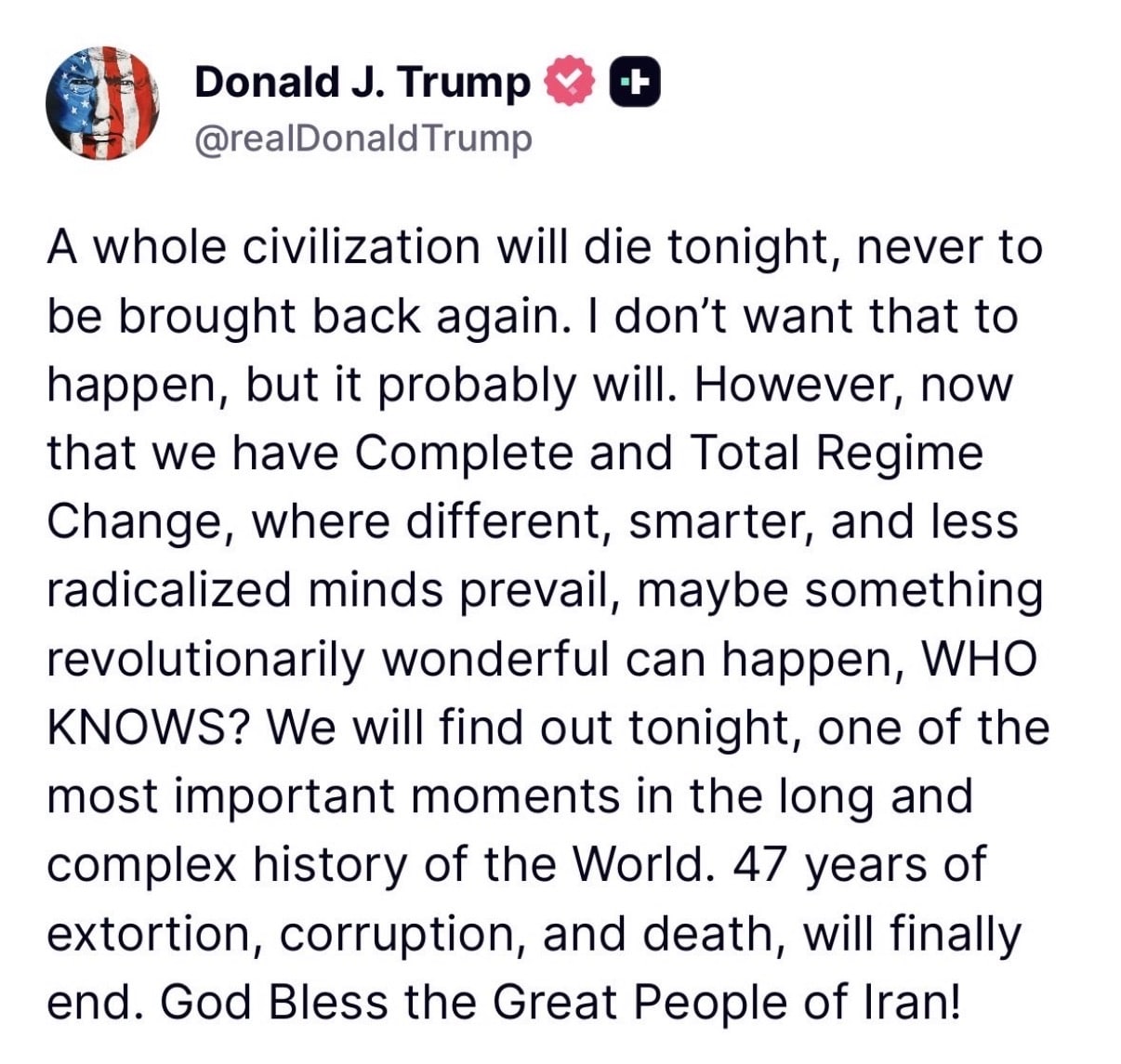
President Trump posted:
“A whole civilization will die tonight, never to be brought back again. I don’t want that to happen, but it probably will. However, now that we have Complete and Total Regime Change, where different, smarter, and less radicalized minds prevail, maybe something revolutionarily wonderful can happen, WHO KNOWS? We will find out tonight, one of the most important moments in the long and complex history of the World. 47 years of extortion, corruption, and death, will finally end. God Bless the Great People of Iran!”
If your initial reaction was, “The United States Government has engaged in extortion, corruption, and death for a lot longer than 47 years,” you would be correct, but the president was talking about Iran. This post was only the latest statement in a whirlwind month which saw claims of total victory, threats of continued escalation, alleged peace negotiations, and genocidal ultimatums. Key among those varied positions during the war with Iran is the dubious balance between bombs and bargaining, but lacking a demarcation between the two that diplomacy requires to suspend disbelief.
The initial attack on Iran launched by the United States and Israel on February 28 was, by the latter’s own admission, “pre-emptive,” after indirect nuclear talks failed to produce an agreement. That failure may have been more to do with outrageous demands from an unwilling participant than from a genuine breakdown of diplomacy, but regardless, Washington also defended its actions as “self-defense” under Article 51 of the United Nations Charter.
This method of engagement is not a novel phenomenon. In June of last year, during the Israel-Iran “12 Day War,” the U.S. conducted strikes on Iran’s uranium-enrichment facilities. A preliminary U.S. intelligence report assessment concluded that the strikes did not destroy Iran’s nuclear capability and only set it back “by a few months,” despite Trump’s boasting that the program had been “obliterated.” Just days before those strikes, Washington and Tehran were preparing another round of nuclear talks, even as Trump acknowledged an Israeli strike “could very well happen,” leading critics to wonder exactly who is leading American foreign policy: Washington or Tel Aviv? A less generous alternative for “pre-emptive” when describing major attacks that coincide with peace negotiations is “sneak attack.” Such attacks make diplomacy look more like cover than constraint, to both adversaries and allies alike.
The official casus belli presented by the Trump administration emphasized Iran’s nuclear and ballistic missile programs and repeated the Article 51 self-defense claim in United Nations communications. The U.S. Article 51 letter itself characterizes combat operations as “necessary and proportionate” self-defense and links them to protecting U.S. forces, allies, and maritime commerce. These are the kinds of claims governments make when justifying the use of force, though one can’t help but contend that the items listed were far more secure before the war started than they are now. Never mind, of course, that a letter to the U.N. means less than nothing to the U.S. Constitution. Article I, Section 8 delegates war powers to Congress, not to the president, and certainly not to a foreign body.
Against the official Trump administration narrative stands a lack of credible evidence to the public. Despite repeated claims, there was “no evidence” of an imminent nuclear or missile threat justifying the February 28 attack. Furthermore, the fact that the attack was conducted under the cover of talks drives home the accusation that the administration failed to exhaust diplomatic options or negotiate in good faith. This is not a minor dispute among a larger conflict. It strains credulity to believe that foreign governments, firms, and individuals could rationally trust U.S. explanations of events.
By April, the credibility problem was being openly acknowledged. The Associated Press reported an Iranian diplomat saying Iran “no longer trusts” the Trump administration after the United States bombed Iran twice during prior rounds of talks, and that guarantees against renewed attack were now required for ending hostilities. When one or both sides expect deception, peace is no longer negotiated; it is wagered.
Economist Robert Higgs coined “regime uncertainty” to explain why private investment can remain weak when the basic boundaries of government action appear unstable. He defined being “uncertain about the regime” as being distressed that investors’ property rights and returns may be “attenuated further by government action,” ranging from tax increases and regulation to confiscation. In other words, if rules can shift abruptly, long-term commitments become bets on politics rather than on markets. Higher stock-price volatility, reduced investment, and unemployment are all consequences of businesses being exposed to government action. There is no greater instance of this than when wars are waged.
Applied to the current U.S. regime, regime uncertainty is not a partisan insult. It is the consequence of unstable constraints on the executive branch, and the reality that the powers of the presidency have expanded for generations under both Democratic and Republican leadership. Economic performance depends on credible political commitments, because private actors hold back without confidence that agreements, contracts, and ownership rights will be respected over time. In foreign policy, the same logic governs treaties, shipping routes, sanctions relief, and any promise that must be believed after the diplomatic shaking of hands.
The Iran War has supplied a number of examples. In his April 1 prime-time address, Trump declared that U.S. goals were nearly achieved but offered no concrete plan to end the war. Shortly after, he threatened to expand attacks to electricity generation and oil infrastructure if negotiations were unsatisfactory. All the while, representatives of Tehran were adamant that no such negotiations were taking place, or even welcome in light of the attacks Iran sustained while engaging in peace talks. This is regime uncertainty in real time: uncertainty not merely about what will happen, but about what difference it makes even if good-faith diplomatic overtures are made.
It’s one thing for President Trump to threaten a belligerent regime’s military capabilities as a means to re-establish international commerce, in this case the demand that Iran reopen the Strait of Hormuz. But it’s quite another to point missiles at “a whole civilization,” including the specific targeting of civilian infrastructure should this latest ultimatum fail. These threats have included power plants, bridges, and a complete dismissal that any of it amounts to war crimes. Whether these statements are credible threats or “The Art of the Deal,” they communicate a willingness to treat the lives of Iranian civilians as leverage. That message is received not only by Tehran, but also by every other nation on Earth that must decide if future negotiations with the United States will be governed by law or by the impulses of the currently-elected tyrant.
Regime uncertainty has immediate costs, with markets hesitating each week in anticipation of the latest ultimatums, whether executed, delayed, or withdrawn. Why does it matter beyond the (hopefully) short-term price inflation? Uncertainty is associated with reduced investment and employment, and it propagates through rational delay as firms and financiers wait for clarity. In trade and investment, uncertainty discourages entry when costs are sunk, which is another way of saying that uncertainty taxes exchange.
Even if this war ends soon, the damage to national reputation lingers. Stanford Professor Michael Tomz argues that sovereign reputations sustain cooperation by shaping expectations about whether a government will honor commitments when it is tempted to defect. A bargaining style that pairs public talks with surprise force, and pairs peace language with threats to disable civilian life, supplies information that counterparties cannot unlearn. In practice, that means more collateral, more third-party enforcement, and shorter horizons, because trust has been replaced by verification. This has consequences not only in diplomacy, but also in shipping insurance, cross-border finance, and the willingness of allies to align their diplomacy and commerce with Washington’s stated aims.
Higgs’ concept of regime uncertainty is about rational fear that the rules are not rules, but instruments, and that governments may change them without warning. The Trump administration’s conduct of the Iran war has illustrated that problem within foreign policy. Even if this period passes without further escalation beyond what is already on the record, it has already imposed lasting damage on America’s image as a predictable negotiating partner and on the outlook for future trade and diplomacy, because credibility, once spent, cannot be instantly repurchased. The fallout of that reputational disaster is measured in years, not in news cycles.