What happens to a republic when its government lies so often that lying becomes less a scandal than a method of administration?
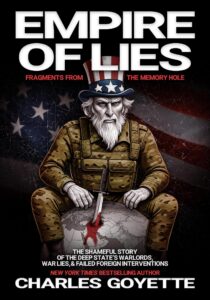
Charles Goyette’s answer is that the republic becomes an empire, and the empire eventually becomes unable to distinguish its propaganda from the world outside. It spends money it does not have. It starts wars it cannot finish. It creates enemies faster than its diplomats can name them. When the consequences arrive, its officials announce that nobody could have foreseen them. The newspapers publish the announcement. A congressional committee expresses concern. Then everybody gets ready to do it again.
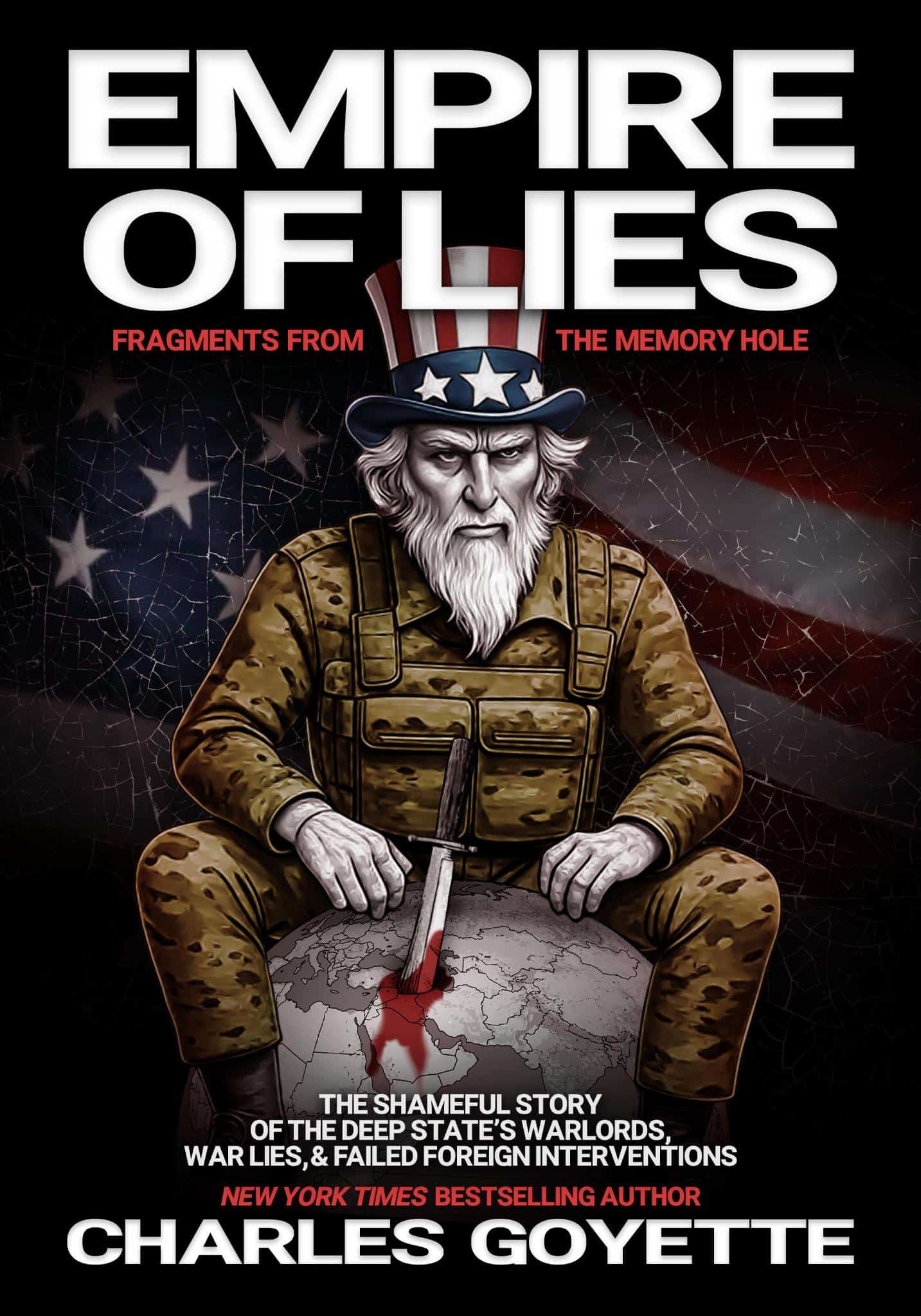
Empire of Lies: Fragments from the Memory Hole is an effort to prevent that cycle from disappearing into what George Orwell called the memory hole. It is not a conventional chronological history of American foreign policy. Goyette instead gathers revealing episodes and arranges them around a central proposition: deception is not an accidental blemish on an otherwise benevolent American empire. “Systemic dishonesty,” as he puts it in his introduction, belongs to the nature of empire itself.
That judgment will sound extreme only to readers who have forgotten nearly everything that happened during their own lifetimes. Goyette has not forgotten. His subjects include the destruction of TWA Flight 800, the murder of John F. Kennedy, the CIA’s regime-change operations, Russiagate, the incestuous foreign-policy establishment, the press’s appetite for war, the fraud used to invade Iraq, Obama’s record of intervention, the engineered confrontation with Russia, and the fiscal exhaustion of the United States. These are not separate scandals. They are fragments of one history.
Goyette opens with TWA Flight 800, the Boeing 747 that exploded off Long Island in July 1996, killing all 230 people aboard. The official investigation blamed an ignition in the center fuel tank, although the source of the spark was never determined. Hundreds of witnesses described seeing a rising streak of light. Explosive residue was found on recovered wreckage. The CIA then produced an animated video instructing Americans that the witnesses had misunderstood what they saw.
Goyette does not pretend to prove conclusively that a missile destroyed the aircraft. He calls the chapter a thought experiment and asks what the government would have done if a missile had brought it down at a politically inconvenient moment. Would officials have told the truth if the truth damaged the Clinton administration or threatened a wider war? The record of state behavior supplies the answer. Governments will “subvert the truth for their own ends,” especially when foreign policy is involved.
The treatment of TWA Flight 800 is arresting, though it is also a risky way to begin the book. Readers who know only the official account may decide in the first chapter that they have wandered into a collection of conspiracy theories. They should keep reading. Goyette’s larger case does not depend on resolving Flight 800. It depends on showing that American officials have repeatedly contemplated staged incidents and have lied about real ones.
The documentary evidence for that proposition is abundant. Operation Northwoods proposed manufactured attacks as a pretext for invading Cuba. President Kennedy refused it. Before the Iraq invasion, George W. Bush discussed disguising a surveillance plane in United Nations colors in the hope that Saddam Hussein would shoot at it. General Hugh Shelton recalled a Clinton cabinet official suggesting that an American aircraft be deliberately exposed to Iraqi fire to manufacture grounds for war. These were not Internet rumors. They were proposals entertained at the highest level of government.
The chapter on coups moves from Iran and Guatemala to Cuba, France, South Vietnam, and the Kennedy assassination. Goyette is particularly good on the 1953 overthrow of Iranian Prime Minister Mohammad Mossadegh. The public explanation was resistance to communism. The material interest lay in oil. Mossadegh’s government had challenged the arrangements that allowed Western companies to extract Iran’s resources on favorable terms. The CIA and British intelligence answered with bribery, hired mobs, propaganda, and a restored Shah whose security apparatus was trained with Western help.
Washington has spent the succeeding generations blaming Iranians for remembering what Washington prefers to forget. The hostage crisis is remembered; the coup that shaped the regime against which the hostages rebelled is pushed down the hole. Iranian hostility is treated as a strange cultural affliction requiring sanctions, covert action, and occasional bombardment. This is how an empire converts blowback into a fresh mandate for intervention.
Goyette’s account of Kennedy is more assertive. He assembles the familiar but still formidable record: Kennedy refused to rescue the Bay of Pigs invasion, rejected Operation Northwoods, resisted demands for preventive nuclear war, pursued a test-ban treaty, and intended to withdraw from Vietnam. The intelligence establishment had motive, means, and opportunity. Long-withheld files exposed additional CIA falsehoods concerning Lee Harvey Oswald. Former President Harry Truman warned only a month after the assassination that the CIA had become an operational and policymaking arm of government.
Does this prove in a courtroom sense that the CIA killed Kennedy? No. Goyette sometimes moves from a strong accumulation of motive and concealment to a firmer conclusion than the surviving evidence permits. Yet the official lone-gunman story has not earned the reverence still demanded for it. An agency that concealed material evidence, lied under oath, and spent decades resisting disclosure has forfeited any presumption of innocence. The burden is not on ordinary Americans to have faith in a file kept locked for sixty years.
The chapters on the Deep State and the establishment supply the book’s conceptual center. Goyette does not describe a secret committee whose members meet every Tuesday to run the world. The establishment is a network held together by shared interests, social advancement, official secrecy, and an imperial creed. Its personnel circulate between the national-security agencies, congressional offices, defense corporations, think tanks, banks, and television studios. They disagree about elections while accepting the permanence of American global domination.
The system’s reaction to Trump’s first election illustrates this machinery. Goyette treats Russiagate as a Deep State campaign intended to disable any attempt at better relations with Moscow. The Steele material was unreliable, exculpatory evidence was suppressed, and intelligence veterans became television personalities while the press repeated their claims. The same newspapers that had transmitted Dick Cheney’s Iraq fabrications discovered no embarrassment in transmitting another set of claims from the same institutional world.
Goyette is right about Russiagate. The campaign against Trump was not invented by Trump, and acknowledging its abuses does not require admiring him. Intelligence agencies should not be permitted to interfere in elections merely because their target is vulgar or unfit. A republic in which unelected officials may secretly veto the electorate is already far gone.
The distinction matters because Trump later demonstrated that persecution by one part of the ruling class does not make a politician independent of the rest. Trump threatened portions of the imperial consensus during his first term, particularly on NATO and Russia. He also filled his administration with establishment figures, bombed Syria, assassinated Qasem Soleimani, and surrendered to the Israel lobby whenever resistance required more than a speech.
Goyette sees this inconsistency. His introduction condemns Trump’s 2025 fantasies about turning Gaza into a resort and recognizes that the joint American-Israeli attack on Iran had not settled anything. Even so, a faint hope remains that Trump might understand the danger of nuclear confrontation or end the Ukraine war. After the events of 2026, there is no longer any “perhaps” about him.
Trump has revealed himself as the worst of the bought-and-paid-for lackeys of the ruling class. The supposed opponent of forever wars launched Operation Epic Fury with Israel in February 2026. The White House advertised “overwhelming force” and promised to eliminate the Iranian threat “once and for all.” Six months later, the war was still producing strikes and retaliation, while oil moved above $100 a barrel. The administration had requested additional funding for an operation it had already proclaimed a success. White House announcement, Associated Press report
This development does not refute Goyette. It confirms him with almost indecent speed. Near the end of the book, he reproduces the post-9/11 plan described to General Wesley Clark: Iraq, Syria, Lebanon, Libya, Somalia, Sudan, and finally Iran. Goyette notes that the empire had been checking countries off the list and that Iran remained unfinished business. His book was completed in December 2025. Within three months, the final unchecked box had become an American war.
The chapters on the press are among the book’s best. Goyette understands that state propaganda usually arrives wearing the clothes of independent journalism. Officials provide an allegation to favored reporters. The report is then cited on television by the same officials as independent confirmation. Anonymous intelligence sources acquire more authority than named skeptics. When the story collapses years later, the correction is placed somewhere near an advertisement for replacement windows.
The Iraq war is the great modern specimen. Claims about aluminum tubes, nuclear programs, mobile biological laboratories, al-Qaeda connections, and stockpiles of unconventional weapons moved from the administration to the press and back again. The establishment did not merely get the intelligence wrong. It selected doubtful fragments, suppressed contrary judgments, and presented uncertainty as fact. Torture was then used partly to extract the Iraq–al-Qaeda connection that the interrogators had been unable to find because it did not exist.
Goyette gives special attention to the social character of the lapdog press. War brings anchors drama, audiences, and the reflected glamour of men with medals. Brian Williams embellished his supposed exposure to combat and was later restored to broadcasting. When Trump fired missiles at Syria in 2017, Williams repeatedly described the weapons as beautiful. George W. Bush joked before reporters about his missing weapons of mass destruction while Americans were still dying in the war those weapons had been used to justify. The press laughed.
This behavior cannot be explained by Democratic bias or Republican bias. The common denominator is reverence for state power. Fox News may prefer a Republican commander in chief, while MSNBC wants a Democratic one. Both networks accept the commander in chief. Both turn to the same retired generals. The permitted dispute concerns who should control the imperial machine, not whether the machine should exist.
The chapter on Barack Obama is correspondingly severe. The Nobel Peace Prize president bombed seven countries and helped destroy Libya. His administration armed rebels in Syria even when its own analysts warned that jihadists dominated the opposition. Washington fought al-Qaeda in one place while supporting forces intertwined with it elsewhere. At one point CIA-armed groups were fighting Pentagon-armed groups inside Syria. This was called policy because admitting madness would have endangered too many careers.
Goyette does not sentimentalize Bashar al-Assad. He makes the harder point that Assad’s authoritarian government was no worse than regimes Washington supported and that secular Syria offered shelter to Christians fleeing the catastrophe in Iraq. The relevant question was never whether Assad met the standards of a New England town meeting. It was what would replace him. Iraq and Libya had already supplied the answer, but the governing class had trained itself not to look backward.
The sections on Russia and Ukraine are similarly valuable. Goyette traces NATO expansion, the American role in the overthrow of Ukraine’s elected government in 2014, the consolidation of a hostile state on Russia’s border, and the CIA’s construction of forward operating bases in Ukraine. None of that makes Russia liberal or renders every Russian action legitimate. It does establish that the war did not fall from a clear sky in February 2022.
The demonization of Vladimir Putin performed the same function once performed by the demonization of Saddam Hussein. Personal evil replaced history. Anyone who mentioned NATO expansion was accused of repeating Russian propaganda. Anyone who asked what Washington would do if Russian intelligence constructed bases along the Mexican border was deemed morally suspect. The discussion had to remain childish because an adult account of cause and effect would have interfered with weapons appropriations.
Goyette’s chapter on missile defense explains why this irresponsibility is more dangerous than the earlier misadventures. Iraq could not destroy the United States. Russia can. Washington’s withdrawal from arms-control agreements, its placement of missile systems near Russia, and its use of Ukraine for strikes on Russian territory have weakened the barriers against nuclear war. Political leaders boast of crossing red lines as though history awards prizes for making a cornered nuclear power more nervous.
The book’s final chapters widen the lens from war crimes to imperial decline. Foreign bases and weapons programs have opportunity costs. Money spent on Afghanistan was unavailable for bridges, flood control, or productive investment. National Guard personnel and equipment deployed abroad were missing when Hurricane Katrina struck. Goyette’s discussion of disaster response makes the imperial bill physical. It appears in missing high-water vehicles, delayed helicopters, and equipment sitting thousands of miles from the Americans who paid for it.
Between the beginning of the post-9/11 wars and Trump’s second term, federal debt rose from $5.8 trillion to about $37 trillion. The empire calls this strength because the Treasury can still sell bonds. A motel owner learns a different definition of solvency. If I borrow to repair a roof, I have a roof. If Washington borrows to turn Libya into a militia bazaar, it has interest payments and a fresh supply of enemies.
Here the case could be strengthened. Goyette recognizes that China passed the United States in manufacturing while Washington consumed its capital in war. But the scale of this is beyond precedent. China invested in industrial production, technical education, energy, transportation, and physical infrastructure. The United States invested in financial manipulation, asset inflation, and global coercion. China built the productive base from which military power ultimately grows. America retained the military expenditure while allowing much of the productive base to leave. This is not an argument that China is free or that Americans should imitate its political system. It is an argument that factories exist and PowerPoint slides do not. A carrier fleet cannot be maintained indefinitely by an economy specializing in compliance departments, insurance billing, and leveraged acquisitions. Sanctions are less frightening when the sanctioned world manufactures the goods and the sanctioning power manufactures derivatives.
Goyette ends with the rule that no empire has escaped. Britain won two world wars and lost its empire. The Soviet Union survived the German invasion but could not afford its military burden. Germany and imperial Japan pursued domination until their domestic economies were consumed by it. Asked whether the American empire will prove the exception, Goyette answers, “The day is young.”
The historical comparison is persuasive, though the American decline may be slower and less theatrical than many expect. There need not be a final collapse broadcast from the Capitol. The government may keep its flags, bases, and nuclear weapons while living standards fall and public services deteriorate. The empire can survive as an expensive shell long after the republic inside has died.
There are weaknesses in Empire of Lies. Goyette occasionally presents a cumulative inference with more certainty than the record warrants. The state is not always as unified as the word “Empire” makes it appear; competing agencies and donor networks sometimes obstruct one another. More space could have been given to monetary debasement, deindustrialization, and the mechanics by which military spending feeds domestic financialization. These reservations do not diminish the book’s importance. Goyette has written a literate, well-documented, morally serious indictment of the American imperial system. His humor keeps a grim subject readable, while the breadth of his evidence prevents the familiar escape into partisan blame. Kennedy and Johnson matter. So do Bush, Obama, Biden, and Trump. The names change. The official appetite for power remains.
The book’s subtitle, Fragments from the Memory Hole, is exact. Our rulers depend less on persuading us that the last war was wise than on making us forget how it was sold. They need the Tonkin deception detached from Iraq’s weapons, Iraq detached from Libya, and Libya detached from Ukraine. Above all, they need Iran to look new.
Goyette puts the pieces back together. The picture they form is not flattering, but it is recognizably ours. An empire lies because consent would otherwise be withheld. It forgets because memory would make the next lie harder to sell. It falls because reality eventually collects the debts that propaganda concealed.
The alternative is not national humiliation. Goyette makes a crucial distinction between imperial decline and American renewal. Bringing the empire home would release productive resources and reduce the enemies manufactured for ordinary Americans. We might recover the republic once Washington is no longer trying to supervise mankind.
That will require more than electing another loud man who promises to drain the swamp before handing its foreign policy to the same donors and war planners. It begins with memory. It continues with refusal. Goyette’s final demand is that the empire end and “America [be] allowed to come home.” After the lies, the graves, and the bill that keeps arriving, coming home would be a very good beginning.
This article was originally featured at the Libertarian Alliance and is republished with permission.