
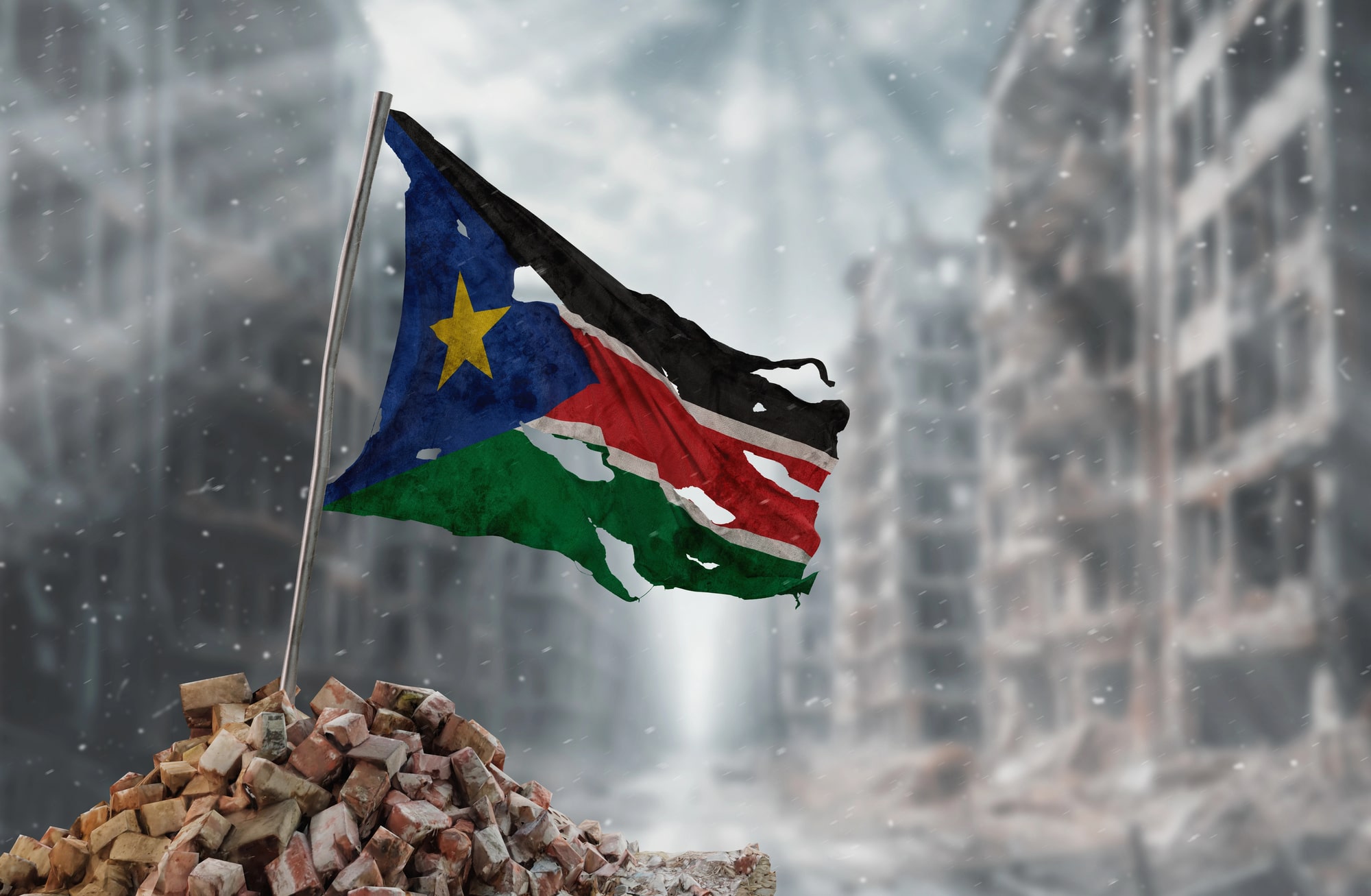
Located in Northeast Africa, Sudan receives relatively little attention in discussions of global geopolitics.
This is despite the country being embroiled in a devastating civil war between Sudan’s army and the Rapid Support Forces (RSF) since 2023. With potentially over 150,000 deaths, and both sides accused of committing war crimes, the situation is bleak.
The RSF notably has been accused of significant atrocities in Darfur, including mass killings and ethnic targeting during its capture of El Fasher.
Amid the ongoing conflict, allegations of chemical-weapons use by Sudan’s military have added another troubling layer to the war.
An exclusive France 24 report identified two separate alleged attacks on September 5 and September 13, 2024, near Khartoum, Sudan’s capital. Through open-source intelligence and assessments from five experts, the investigation concluded that the images were “consistent with” aerial drops of chlorine-filled barrels.
France 24 concluded that the Sudanese Armed Forces were most likely responsible for the attacks as they were described as the only side having the aerial capability for such an operation.
In April 2025, the United States determined under the Chemical and Biological Weapons Control and Warfare Elimination Act of 1991 that the Sudanese government had used chemical weapons in 2024, placing it “in violation of international law.”
Shortly after Washington’s determination, a video posted by what Human Rights Watch described as a pro-RSF account appeared to show a yellow-green cloud near the Barri military base—an image HRW said was consistent with chlorine exposure.
In response to its determination, the U.S. government imposed an initial round of sanctions in June 2025, followed by additional measures in July 2026.
The July measures included restrictions on aviation by Sudanese government-owned or government-controlled carriers, export restrictions covering “all other goods and technology,” and limits on certain forms of financial assistance to Sudan. The measures included waivers for assistance serving basic human needs, as well as for food and agricultural commodities and products.
Even before the sanctions were imposed, Sudan’s economy was near collapse. The IMF estimated unemployment at a staggering 61.3% in 2026, while the World Bank estimated that 71% of the population lived in extreme poverty in 2024, surviving on an average of $2.15 per day.
Since the start of the war, Sudanese banks have lost nearly half of their capital, while as many as 70% of bank branches have closed.
The chemical-weapons allegations have re-emerged after a secret dossier was shared with The New York Times and The Washington Post by an unidentified “Middle Eastern intelligence agency.” In an unconfirmed report, Le Monde—using two security sources—attributed the material to Israeli intelligence.
The dossier itself has not been released publicly in full, but the newspapers reported on its contents extensively. According to the Times, the material allegedly included communications indicating that General Abdel Fattah al-Burhan knew about the chemical-weapons program and reportedly told others to “remove all traces” of its activities.
The reports also claimed that as many as 290 chemical munitions had been stockpiled by October 2024, 106 of which were allegedly used. Most of the weapons were reportedly stored at Merowe Air Base.
Sudan has strongly denied the allegations, claiming its chlorine stocks were used for water purification, civilian industry, and energy, while offering inspections by an international body.
Sudan also claimed that it invited U.S. officials twice to send a technical team to investigate the allegations, but that Washington declined. The government also accused the unidentified Middle Eastern country behind the dossier of attempting to divert attention from its own involvement in the war.
Former chemical-weapons investigators have called for independent verification. Lennie Phillips, a former OPCW investigator, said investigators would need to interview witnesses and establish what they “felt, smelt and saw.”
Colonel Hamish de Bretton-Gordon, a former British Army chemical-weapons specialist, said the evidence reviewed by The National indicated that chlorine had been weaponized and that the SAF had likely decided to use it.
A separate investigation led by former senior OPCW officials also examined witness testimony and other evidence about alleged attacks in 2024 and 2025. While they found credible evidence of possible chemical-weapons use, the investigators said they could not conclusively determine what happened and called for an official OPCW investigation.
The Sudan case recalls similar controversies surrounding chemical-weapons allegations in Syria. As discussed by journalists Seymour Hersh, Aaron Maté, Gareth Porter, and Robert Fisk, MIT physicist Theodore Postol, and even British intelligence, attribution was a disputed issue in the chemical-weapons cases involving Ghouta in 2013, Khan Shaykhun in 2017, and Douma in 2018.
The 2017 and 2018 incidents led to direct U.S. military action. In April 2017, President Donald Trump launched 59 Tomahawk missiles at a Syrian airfield. In April 2018, the United States, Britain, and France coordinated strikes against Syrian government targets.
The 2017 strikes also produced celebratory coverage from MSNBC anchor Brian Williams, who described the launch footage as “beautiful.”
As ret. U.S. Army Colonel Lawrence Wilkerson later concluded about the 2013 Ghouta attack, “even if the map is only half accurate, this was truly a heinous use of chemical weapons.”
If chemical weapons were used in Sudan, that would likewise be monstrous. Chlorine can severely damage the eyes, nose, throat, and lungs when inhaled, which is why it is classified as a choking agent. At high concentrations, exposure can also cause death.
With Sudan already impacted by the devastating war, additional sanctions may place further strain on an already vulnerable population.
Former chemical-weapons investigators have described the evidence as “troubling” and worthy of further investigation. While the evidence that chlorine was weaponized has continued to grow, questions remain over exactly what happened and who was responsible, particularly without an independent OPCW investigation.
Until further analysis can be conducted and these questions are answered, additional sanctions and intervention should be avoided.