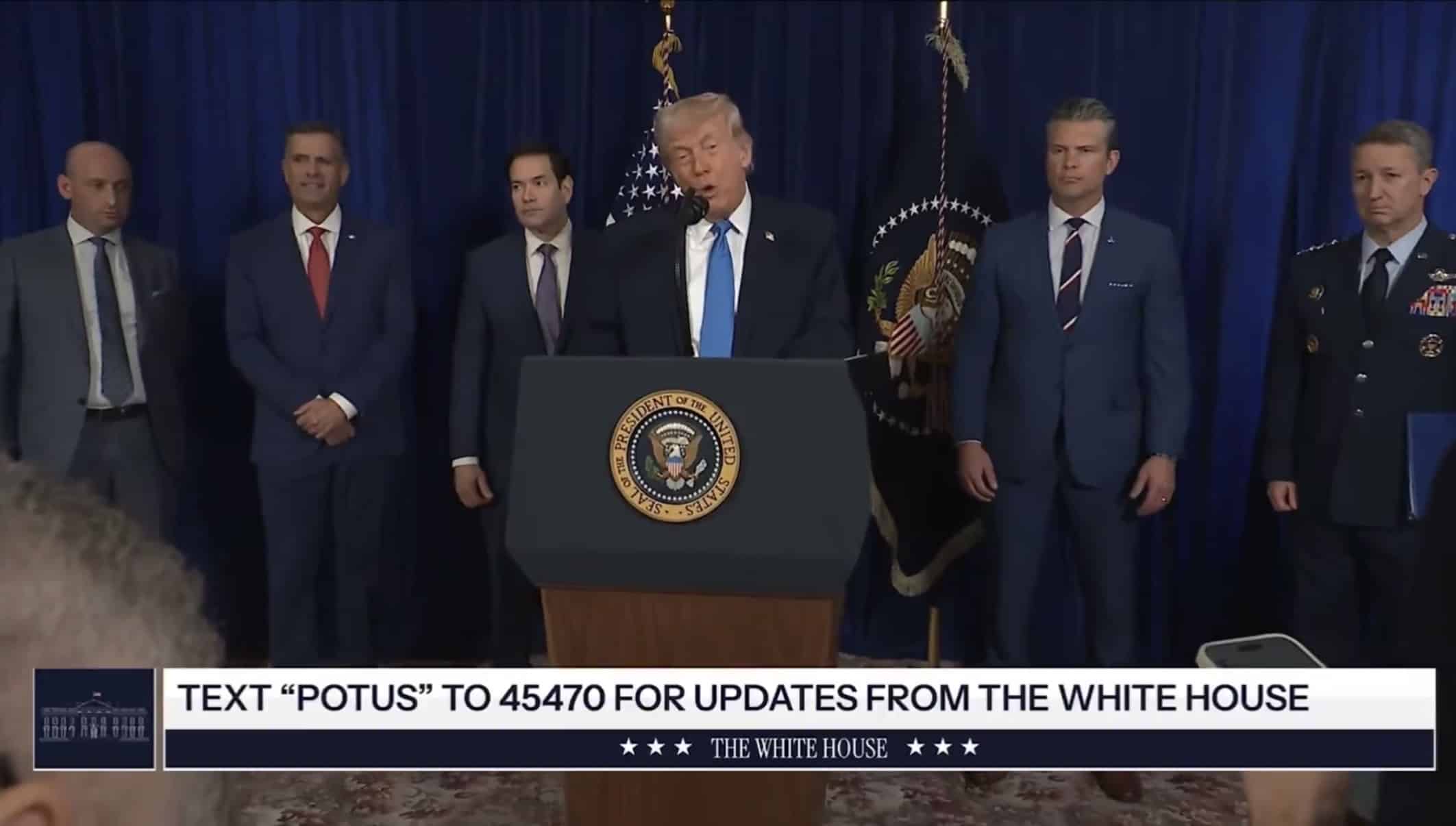
At 4:21 in the morning of January 3, U.S. President Donald Trump posted, “The United States of America has successfully carried out a large scale strike against Venezuela and its leader, President Nicolas Maduro, who has been, along with his wife, captured and flown out of the Country.”
No one had anticipated such a military operation prior to the announcement, and no one anticipated the comments Trump would make later that morning in his press conference.
The press conference, and the comments that followed shortly after, contained several shocking statements.
The first was the announcement of the military operation itself. Once cloaked purely in the language of preventing drugs from flowing into the United States, the Trump administration had recently clarified its intention for regime change. In late November, Trump told Venezuelan President Nicolás Maduro to resign and leave the country. In December, Secretary of State Marco Rubio said, “It is clear that the current status quo with the Venezuelan regime is intolerable for the United States. So, yes, our goal is to change that dynamic.”
Asked if his goal was to force Maduro to give up power, Trump said, “Well, I think it probably would…That’s up to him what he wants to do. I think it’d be smart for him to do that. But again, we’re gonna find out. If he wants to do something, if he plays tough, it’ll be the last time he’s ever able to play tough.” White House Chief of Staff Susie Wiles says that Trump’s Venezuela strategy is “to keep on blowing boats up until Maduro cries uncle.”
Maduro did not cry uncle. He continued to defy the United States and to call for Washington to abandon ambitions for its “crazy war.” So, the soft coup turned into a hard coup, and the U.S. launched a military attack on Venezuela, capturing Maduro and bringing him back to the U.S. to face drug charges.
But perhaps the most shocking moment in Trump’s press conference was his unexpected announcement that “We’re going to run the country until such time as we can do a safe, proper, and judicious transition. So we don’t want to be involved with, uh, having somebody else get in and we have the same situation that we had for the last long period of years.” During the Q&A, Trump added that “Venezuela has a lot of bad people in there, a lot of bad people that shouldn’t be leading. We’re not gonna take a chance that one of those people take over for Maduro.”
As a person to take over from Maduro, at least temporarily, the Trump administration has settled on Venezuela’s Vice President Delcy Rodríguez. In the press conference, Trump said that Rubio “just had a conversation with her, and she’s essentially willing to do what we think is necessary to make Venezuela great again. Very simple.”
That, too, was a stunning and unexpected move. The Trump administration had long argued that Maduro was an illegitimate leader who had lost Venezuela’s last election to the María Corina Machado led opposition. Rubio had nominated opposition Machado for her Nobel Prize, and she dedicated her prize to Trump. Following the coup, Machado declared that “Today we are prepared to assert our mandate and seize power.”
But Trump spurned Machado during the press conference, saying “it would be very tough for her to be the leader if she doesn’t have the support within, or the respect within the country. She’s a very nice woman, but she doesn’t have the respect within [Venezuela].”
It was stunning that Trump turned his back on democracy and on the election the United States had leaned so heavily on in its case against the legitimacy of the Maduro administration and on the opposition that they claim won that vote and settled on working with the vice president whom they claim is not legitimately elected. In the days following the coup, Maduro’s government appears to still be in power.
But despite Trump’s claim that Rodríguez is willing to do whatever Washington tells her to do, Rodríguez appeared to remain loyal to Maduro and defiant. She maintained that “There is only one president in Venezuela, and his name is Nicolas Maduro.” She called America’s actions “barbarity.” Though she said that Venezuela is willing to “have respectful relations” with the United States, she insisted that they “will never return to being the colony of another empire.”
Prior to Rodríguez’ defiance, Trump had already declared in his press conference that the U.S. is “ready to stage a second and much larger attack if we need to do so.” He warned that “[a]ll political and military figures in Venezuela should understand what happened to Maduro can happen to them” and pointed out that Rodríguez will have to do whatever she’s told because “she really doesn’t have a choice.”
After her defiance, Trump warned that “if she doesn’t do what’s right, she is going to pay a very big price, probably bigger than Maduro.”
On January 5, Delcy Rodríguez issued a statement that sounded more conciliatory but preserved her main points. She continued to say, as both she and Maduro previously had, that Venezuela “consider[s] it a priority to move toward a balanced and respectful international relationship between the United States and Venezuela” and “to work together on a cooperation agenda aimed at shared development” but that that had to be done “within the framework of international law” and “based on sovereign equality and non-interference.” She insisted that there can be no “external threats,” and she continued to refer to Maduro as “President Nicolás Maduro.”
Though Rubio attempted to nuance Trump’s statement into a more palatable formulation, saying the United States would not be “running” Venezuela but would “running policy” in Venezuela—a difference so fine it is difficult to detect—Trump stuck to his harsher formula. Asked the next day who was in charge in Venezuela, Trump said that the U.S. would be “dealing with the people that just got sworn in.” But then he said, “Don’t ask me who’s in charge, because I’ll give you an answer, and it’ll be very controversial…We’re in charge.”
The press conference was shocking, not only for its dismissal of Venezuelan democracy, but for its dismissal of American democracy and the people’s representatives. When asked if Congress was notified about the military operation, Trump deferred to Rubio who said that “[t]his was not the kind of mission that you can do congressional notification on.” Trump then dismissed Congress, adding that it “has a tendency to leak…Congress will leak, and we don’t want leakers.” Despite the undemocratic precaution, news of the military action did leak: both “The New York Times and Washington Post learned of a secret US raid on Venezuela soon before it was scheduled to begin Friday night — but held off publishing what they knew to avoid endangering US troops.”
The press conference was also incredible for the legal justification it attempted to provide. Trump provided none. But Rubio and Chairman of the Joint Chiefs of Staff Dan Caine did. Caine said that the military operation was conducted “in support of a request from the Department of Justice,” that it was “an apprehension mission…to bring to justice two indicted persons.”
Rubio said the operation was “largely a law enforcement function. Remember, at the end of the day, at, at its core, this was an arrest of two indicted fugitives of American justice, and the Department of War supported the Department of Justice in that job.”
But there are two problems with that legal defense. The first is that, according to many international law experts, the argument doesn’t hold water. The American act was a crime of aggression that violated United Nations charter article 2(4) that prohibits states from using military force against another country or violating their sovereignty. Contrary to the UN charter, the U.S. attacked Venezuela without a resolution from the Security Council and without a necessity dictated by self-defense.
But even if the act of seizing and arresting Maduro was legitimized by the law enforcement defense, that would not legitimize the further acts of ruling Venezuela or seizing its oil.
And finally, the press conference, and the remarks that followed, were shocking for their scope and application beyond Venezuela.
Secretary of War Pete Hegseth said that America’s “adversaries remain on notice. America can project our will anywhere, anytime.” Asked if Colombian President Gustavo Petro had to “watch his ass” as Trump warned earlier, Trump replied, “He’s making cocaine, they’re sending it into the United States, so he does have to watch his.” On January 4, Trump said that Colombia’s Gustavo Petro is “making cocaine and selling it to the United States.” He then warned that “He’s not going to be doing it for very long.” Asked if the U.S. would conduct an operation against Colombia, he said “it sounds good to me.”
Trump also said that “Cuba is gonna be something we’ll end up talking about…we wanna help the people in Cuba.”
On Cuba, Rubio added, “when the president speaks, you should [Laughs] take him seriously. So, uh, suffice it to say, you know, Cuba is a disaster. It’s, it’s run by incompetent, senile men…So yeah, look, if I lived in Havana and I was in the government, I’d be concerned at least, a little bit.”
Trump further warned that “Mexico has to get their act together, because [drugs are] pouring through Mexico, and we’re going to have to do something” and that “we do need Greenland, absolutely. We need it for defense.”