
Political movements often begin as revolts against entrenched power, only to be absorbed by the very institutions they sought to challenge. The pattern is familiar in American political history. Grassroots insurgencies ignite public enthusiasm, mobilize voters around neglected issues, and briefly threaten the ruling consensus. Yet over time they are either neutralized or transformed into instruments of the existing political order.
Two movements defined the political awakening of many Americans in the early twenty-first century: the Tea Party and the MAGA movement. Both promised a revolt against Washington. Both claimed to represent ordinary Americans against an unaccountable ruling class. Both attracted millions of supporters who believed they were witnessing the birth of something genuinely transformative.
Yet both ultimately failed. The Tea Party quietly evaporated. MAGA, far larger and louder, appears to be collapsing in far more dramatic fashion.
Understanding why requires examining how each movement began, how it was captured, and how it ultimately betrayed the expectations of those who built it.
The origins of the Tea Party are frequently misrepresented. Many commentators date the movement to the protests that followed the financial crisis of 2008, or to the televised outburst by Rick Santelli on CNBC criticizing mortgage bailouts in February 2009. Those events certainly accelerated the phenomenon, but they were not its true beginning.
The intellectual spark occurred earlier during the 2007 presidential campaign of then-Congressman Ron Paul (R-TX).
Paul’s candidacy introduced a generation of younger voters to ideas that had largely disappeared from modern political discourse: sound money, constitutional limits on federal power, opposition to foreign wars, and skepticism toward the Federal Reserve. His campaign also revived the symbolism of the Boston Tea Party, culminating in a massive online fundraising event on December 16, 2007 that raised more than $6 million in one day. Political scientist Rachel M. Blum notes that Paul’s campaign “provided a libertarian framework that later Tea Party activists would adapt and expand.”
Paul’s message resonated because it spoke directly to growing dissatisfaction with both political parties. The George W. Bush administration had overseen two major wars, the creation of the Department of Homeland Security, the Patriot Act, and massive deficit spending. Meanwhile Democrats were preparing to expand government even further in response to the financial crisis.
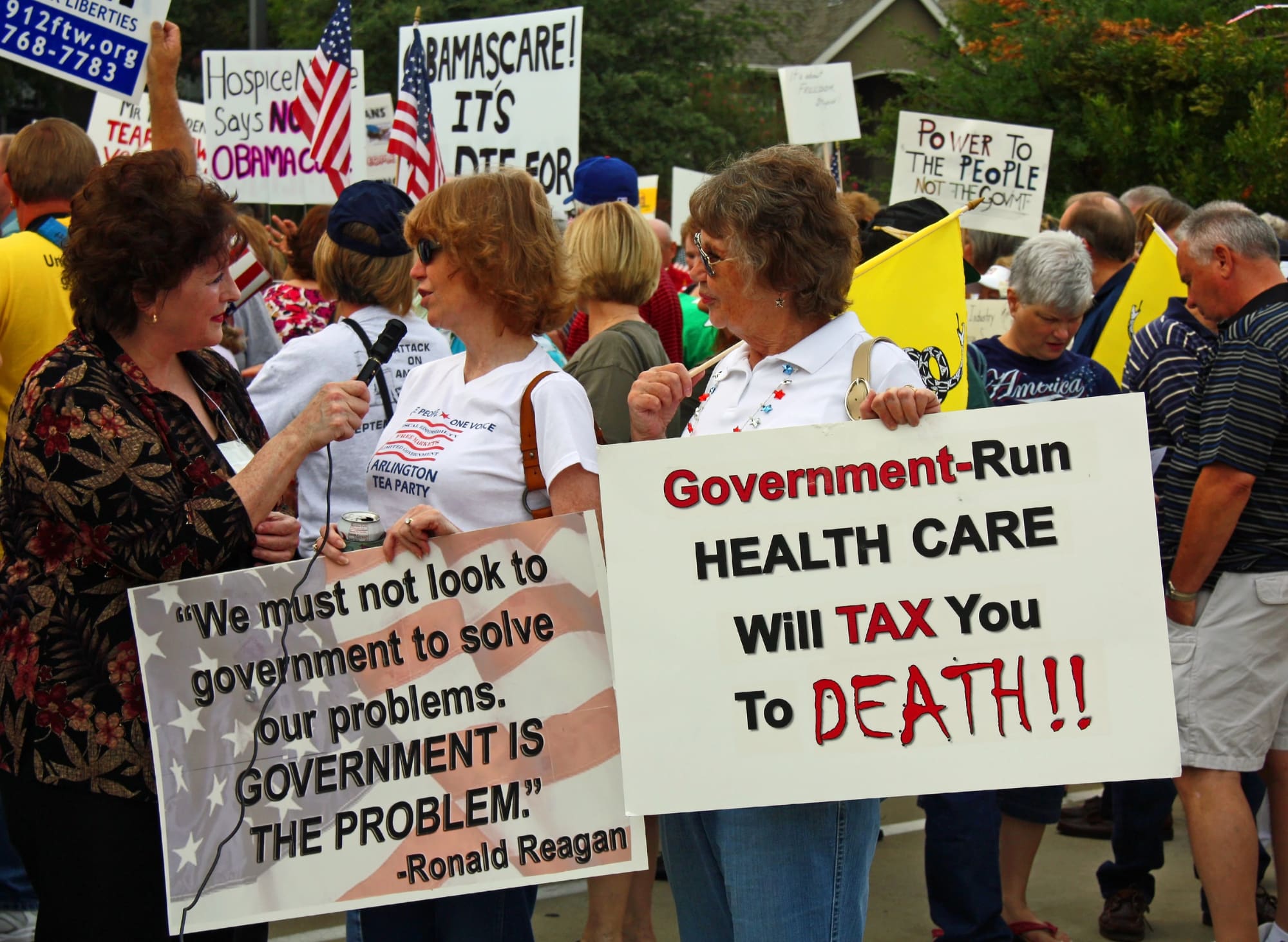
The Tea Party therefore emerged as a protest against bipartisan expansion of state power. Its central themes were fiscal restraint, limited government, and constitutionalism. Tea Party activists were motivated by “concerns about federal spending, taxation, and perceived violations of constitutional principles.”
At its height the movement displayed genuine grassroots energy. Protests erupted across the country. Primary challenges toppled long entrenched incumbents. Candidates running under the Tea Party banner won seats in Congress during the 2010 midterm elections.
For a moment it appeared that the Republican Party might actually be forced to confront its own contradictions.
That moment did not last.
Movements that threaten entrenched political structures rarely remain independent for long. Parties, consultants, and political donors have powerful incentives to co-opt insurgent energy rather than allow it to remain outside institutional control.
The Tea Party was no exception.
By 2010 large political organizations began integrating Tea Party rhetoric into the Republican Party’s existing electoral apparatus. Advocacy groups funded by major donors began branding themselves as Tea Party organizations. Meanwhile Republican politicians who had previously supported bailouts, deficits, and foreign interventions suddenly adopted the language of fiscal conservatism.
Free the People’s Matt Kibbe later observed that “the establishment didn’t defeat the Tea Party, it absorbed it.”
The consequences were predictable. Once integrated into the party structure, the movement’s core demands were gradually diluted. Campaign rhetoric about spending cuts and limited government gave way to the usual legislative compromises. The federal budget continued to expand. The national debt continued to grow. Foreign interventions continued.
Even some of the candidates initially elected with Tea Party support eventually voted for policies that contradicted the movement’s original message. The rebellion that had once targeted Washington’s bipartisan consensus increasingly became just another faction within the Republican coalition.
By the middle of the decade the Tea Party label had largely disappeared. The movement did not collapse in dramatic fashion. Instead it faded quietly into the machinery of partisan politics.
The insurgency had itself been infiltrated.
The decline of the Tea Party created a political vacuum. The underlying frustrations that fueled it, spending, war, and overreach, had not disappeared.
Into that environment stepped Donald Trump.
Trump’s 2016 presidential campaign channeled much of the same anger that had animated the Tea Party, but in a more populist and nationalist form. His slogan, “Make America Great Again,” promised a dramatic break with the existing political order.
Many of his campaign promises addressed precisely the issues that had driven earlier grassroots revolts. He pledged to reduce foreign military commitments and end what he called “endless wars.” Trump declared that the Iraq War had been a mistake and that the United States should “stop trying to nation build.”
He promised strict immigration enforcement, including large-scale deportations of illegal immigrants. He criticized government spending and trade policies that he argued harmed American workers. Above all, he portrayed himself as an outsider willing to confront entrenched political interests.
The phrase “America First” became the ideological shorthand for this agenda. For many supporters, MAGA and America First were essentially synonymous.
The scale of the movement dwarfed the Tea Party. Trump won the presidency, reshaped the Republican Party, and maintained an intensely loyal base of supporters.
Yet the survival of a political movement ultimately depends not on slogans, but on results.
Over time the gap between MAGA rhetoric and governing reality widened.
One area of disappointment involved accountability for government officials associated with the COVID era. Many on the right frequently criticized figures such as Dr. Anthony Fauci during the pandemic, and many supporters expected investigations or legal consequences after the crisis subsided. Those expectations were not fulfilled. Fauci retired from government service without facing criminal charges or meaningful institutional accountability. If anything, Trump has held Fauci up as a notable public servant, due in no small part for himself having turned policy over to Fauci in the height of the pandemic.
Immigration policy provided another test. During the campaign Trump had promised mass deportations and sweeping changes to immigration enforcement. According to data from the Department of Homeland Security, however, the number of deportations during his first administration never approached the scale often discussed during campaign speeches. Later statements suggesting that large scale deportations were unrealistic further alienated supporters who had viewed immigration enforcement as central to the MAGA platform. While the activities of ICE have made for many front-page news headlines in his second term, the results still fall far short of campaign promises. Worse still is President Trump’s own walking back, openly capitulating with comments signaling a reluctance to target all manner of industries and locations rife with illegal immigrants.
Fiscal policy produced similar contradictions. Despite campaign rhetoric about reducing spending, federal expenditures rose significantly during Trump’s presidency. The Congressional Budget Office reported that the national debt increased by nearly $7.8 trillion between 2017 and 2021. His second term has thus far yielded the same results, despite the campaign rhetoric. Just over the first fourteen months, the national debt has increased by over $2 trillion.
Each of these developments eroded confidence among those who had believed that MAGA represented a fundamental break with Washington’s habits.
Yet the most consequential rupture involved foreign policy.
The promise to end America’s “forever wars” had been one of Trump’s most distinctive campaign themes. It also resonated strongly with voters weary of two decades of military interventions.
When the United States initiated military action against Iran, many supporters saw it as a direct betrayal of that promise.
Military confrontation with Iran had long been advocated by hawkish factions in Washington. Critics across the political spectrum warned that such a conflict could destabilize the entire Middle East and risk escalation with other major powers. Historian Andrew J. Bacevich has repeatedly argued that American attempts to dominate the region have produced “a pattern of intervention without victory.”
For supporters who had embraced the America First vision of restraint, the war represented the opposite of what they had been promised. A campaign built around ending foreign entanglements had instead produced another one.
The contradiction was not merely strategic. It was philosophical. America First had implied a foreign policy focused on national defense rather than global policing. A new Middle Eastern war suggested that the old interventionist consensus remained intact.
The gulf between “MAGA” and “America First” has never been more vast.
The Tea Party’s demise was quiet. It dissipated through gradual absorption into the existing political structure.
The unraveling of MAGA appears far more dramatic.
Because the movement was so closely identified with one individual, its credibility depended heavily on that individual’s ability to deliver on the promises that mobilized millions of supporters. When those promises were abandoned or contradicted, the resulting disillusionment was correspondingly intense.
The irony is striking. Trump was the figure who created the movement, but also the one whose decisions ultimately undermined it.
A slogan that once symbolized rebellion against the political establishment increasingly functions as a brand detached from any coherent policy program. The phrase MAGA continues to circulate in political rhetoric, yet the policies associated with it increasingly resemble the same government expansion, foreign intervention, and fiscal excess that earlier insurgent movements opposed.
In that sense the transformation mirrors what happened to the Tea Party, but on a larger scale.
The earlier movement dissolved as it was absorbed by the system. The later one appears to be collapsing under the weight of its own contradictions.
Grassroots energy can mobilize voters, raise money, and even reshape party coalitions. Yet translating that energy into lasting policy change requires confronting entrenched institutional incentives that resist meaningful reform.
Political parties, bureaucracies, and interest groups possess enormous capacity to neutralize insurgent movements. Sometimes they absorb them. Sometimes they redirect them. In either case the end result is frequently the same: the original demands are diluted or abandoned.
For supporters who believed that either the Tea Party or MAGA represented a fundamental break with the status quo, the disappointment has been profound.
The Tea Party was consumed before it could transform the system it challenged.
MAGA, born from many of the same frustrations, now appears to be collapsing under the contradictions of its own leadership.
Perhaps it was nostalgia for the excitement of the Tea Party days that helped birth MAGA, and the former’s quick and unceremonious end left the latter’s faithful blind to the political pattern.
The Tea Party stumbled so that MAGA could fall.