
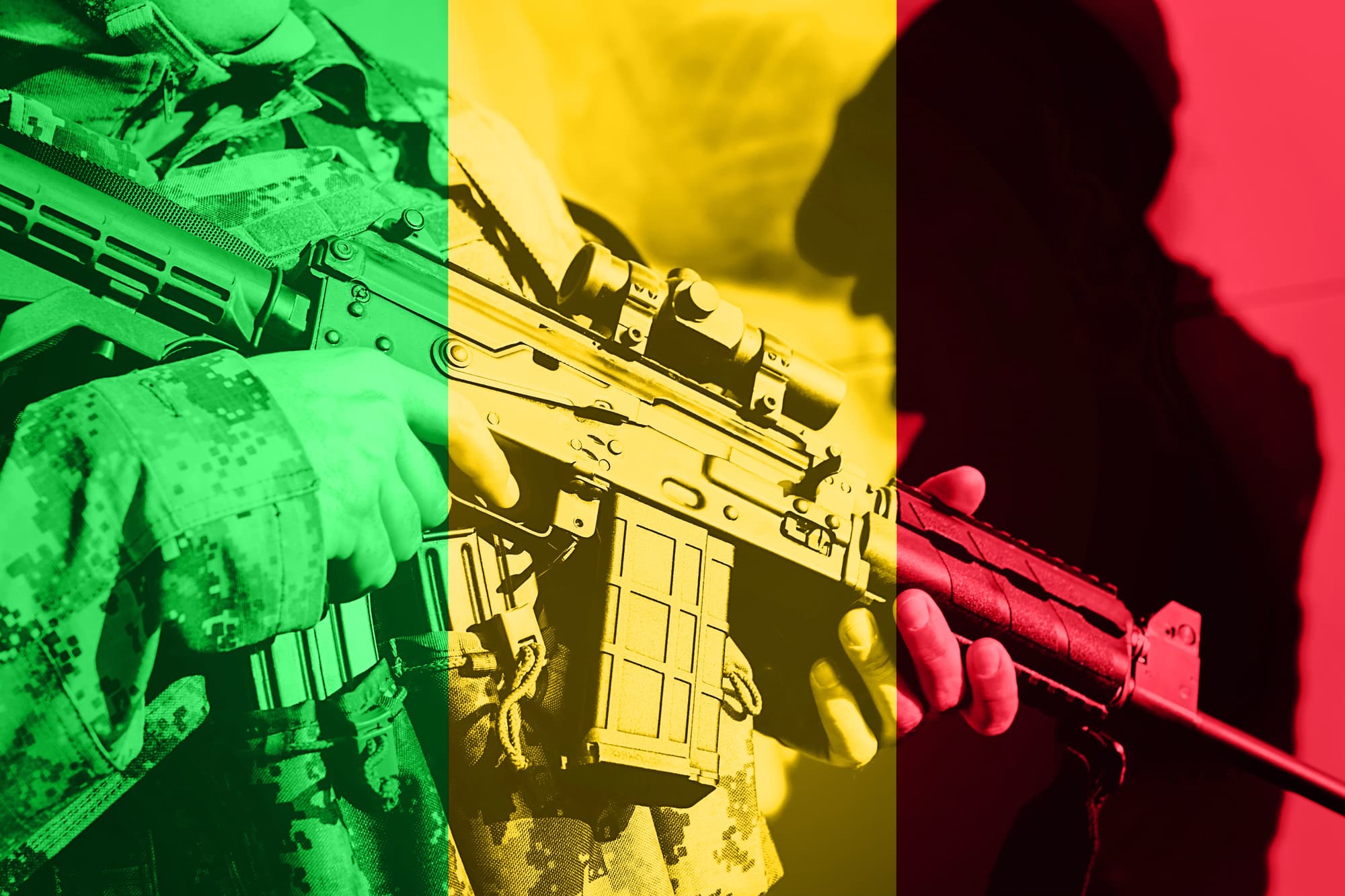
Mali remains in chaos.
Al-Qaeda-linked militants and Tuareg separatists have recently demonstrated an ability to coordinate attacks against the Malian military, while the country’s Russian-backed junta struggles to maintain control over territory far beyond the capital. Violence has spread across the Sahel, and Mali remains one of the epicenters of the region’s seemingly endless war against jihadist insurgencies.
Washington’s answer, as usual, is to ask what more it can do.
That is the wrong question.
The more important question is what Washington has already done.
For all the attention devoted to Mali’s military coups, Tuareg separatism, Islamist extremism, French colonialism, Russian mercenaries, and the failures of successive governments in Bamako, one fact deserves considerably more attention: the crisis that exploded in Mali in 2012 was in large part the downstream consequence of Washington’s decision to destroy the Libyan state the year before.
The Tuareg rebellion was real. The grievances were real. The Malian state had long struggled to govern its enormous and sparsely populated northern territories. Tuareg rebellions had occurred repeatedly, including in 1963, 1990, and 2006. Libya’s Muammar Gaddafi had also spent decades cultivating relationships with Tuareg fighters and other communities across the Sahara.
None of this, however, absolves Washington of responsibility for what happened next.
Indeed, it makes the consequences of the Libyan intervention all the more important.
The 2011 NATO campaign did not merely remove Gaddafi. It destroyed a government that had, however imperfectly and brutally, exercised control over Libya’s territory and stockpiled enormous quantities of weapons. When that state collapsed, those weapons did not disappear. They spilled across borders into some of the weakest and most poorly governed territory on earth.
The result was a security vacuum stretching across the Sahara.
A 2013 analysis by the Council on Foreign Relations described the violence that engulfed Mali as a direct function of NATO’s intervention, noting that the alliance’s “light footprint” approach helped create the security vacuum through which Libyan weapons flowed south. United Nations reporting documented the uncontrolled circulation of enormous quantities of military materiel after the collapse of the Libyan government.
Among those who returned south were Tuareg fighters who had served in Gaddafi’s forces. They came home not merely with grievances but with weapons.
That distinction matters.
The Tuareg did not suddenly become disaffected because NATO bombed Libya. Their conflict with Bamako was decades old. But Washington’s intervention radically altered the balance of power between the Malian government and its northern opponents.
A longstanding political dispute became an armed rebellion with access to sophisticated weaponry.
The counterfactual is therefore important. Absent the collapse of Libya, Mali would not necessarily have been peaceful or democratic, and the Tuareg rebellion would not necessarily have been avoided. But the rebellion would have confronted a different regional security environment. Fighters returning from Libya would not have benefited from the same post-collapse proliferation of weapons and the disappearance of Libyan state control. Bamako would still have faced deep grievances in the north, but the scale, speed, and military effectiveness of the 2012 rebellion could plausibly have been substantially different.
That distinction is essential because it separates an explanation from an excuse. Mali’s internal problems were sufficient to produce conflict. They were not necessarily sufficient to produce the particular regional conflagration that followed the destruction of Libya.
In early 2012, the National Movement for the Liberation of Azawad (MNLA) launched its rebellion. Malian government forces were driven from large portions of the north. The resulting military humiliation contributed directly to the March 2012 coup in Bamako. The central government then lost still more control, and jihadist organizations—including al-Qaeda in the Islamic Maghreb and Ansar Dine—exploited the resulting vacuum.
This is the crucial distinction that tends to disappear in conventional accounts of Mali.
The Tuareg rebellion and the jihadist insurgency were not the same thing.
The former had deep indigenous roots. The latter was able to exploit circumstances created by the collapse of state authority.
The MNLA initially sought an independent or autonomous Azawad. Islamist factions subsequently turned against their former allies, drove the secular separatists from several major northern cities, and imposed their own brutal interpretation of Islamic law. By the end of 2012, jihadists controlled much of northern Mali and were threatening to advance south.
Encouraged and then supported by Washington, France intervened in January 2013.
And so the cycle began again.
Years passed. The insurgency continued.
Then came the coups.
Western policymakers have often treated Mali’s military takeovers as proof that Africans need more democratic tutelage from abroad. There is certainly nothing admirable about military rule. But the question is why the Malian military became sufficiently powerful and sufficiently frustrated with civilian government to seize power in the first place.
With regard to the latter, corruption, weak institutions, ethnic tensions, poor governance, and the persistent failure to reconcile northern communities with Bamako all mattered. While with regard to the former, Washington’s role deserves scrutiny precisely because the United States spent years trying to strengthen the Malian security state.
The irony is difficult to miss: Washington trained soldiers to defend a government that was increasingly incapable of defending itself, then expressed astonishment when soldiers concluded that they could do a better job running the government (the same thing happened in neighboring Niger, in three times in Burkina Faso, in Chad, Guinea, and Gambia—though this last coup attempt failed).
This is the recurring paradox of American security assistance in Africa. Washington strengthens coercive institutions because they are the institutions most immediately capable of fighting insurgents. But in countries where civilian institutions are weak, strengthening the military can strengthen the very institution most capable of overthrowing civilian rule.
And once the coups came, Washington responded with sanctions, diplomatic pressure, and condemnation.
Mali responded by turning elsewhere.
France was expelled. Western troops departed. Bamako deepened its relationship with Russia and eventually became a leading member of the Alliance of Sahel States alongside Burkina Faso and Niger. Today, Goïta’s junta has indefinitely postponed the promised return to democracy and suppressed any opposition in the territory it controls—which is, itself, increasingly shrinking, as the coordinated attacks of Jama’at Nusrat al-Islam wal-Muslimin (JNIM) and the Tuareg-dominated Azawad Liberation Front (FLA) have seen them push further south and west, including in April attacks around Bamako.
Washington can reasonably dislike that outcome. What it cannot reasonably do is pretend it appeared from nowhere.
For years, Western governments insisted that Mali’s security depended upon their continued presence. Yet after more than a decade of foreign military assistance and intervention, the insurgency remained alive. It is unsurprising, that the situation has largely remained the same despite this change: today jihadist groups control or contest substantial portions of territory, while the Malian government relies increasingly upon Russian support.
The obvious lesson should be restraint.
Instead, Washington risks drawing the opposite conclusion, that the problem was simply insufficient intervention. President Donald Trump has recently suggested Washington was again “weighing strikes.”
Mali is not “an American security interest” worth any American blood and treasure. Its political future belongs to Malians. Its security problems belong primarily to Malians and their African neighbors.
That does not mean Americans should be indifferent to Malian suffering. Quite the opposite. It means recognizing the difference between caring about a problem and possessing the ability to solve it.
Washington possesses enormous military power.
It does not possess the local knowledge necessary to engineer a durable political settlement among Mali’s ethnic groups, determine which factions deserve legitimacy, or reconstruct institutions capable of governing a territory larger than Texas with a fraction of the population.
Bombs cannot accomplish those things.
Neither can military trainers.
And neither can another generation of American counterterrorism spending.
The tragedy of Mali is therefore not simply that Washington failed.
It is that Washington intervened in Libya, helped create the conditions under which Mali’s existing problems exploded into a regional security crisis, and then spent the next decade attempting to manage the consequences of the instability its own intervention helped unleash.
We should hope Washington stays out.