
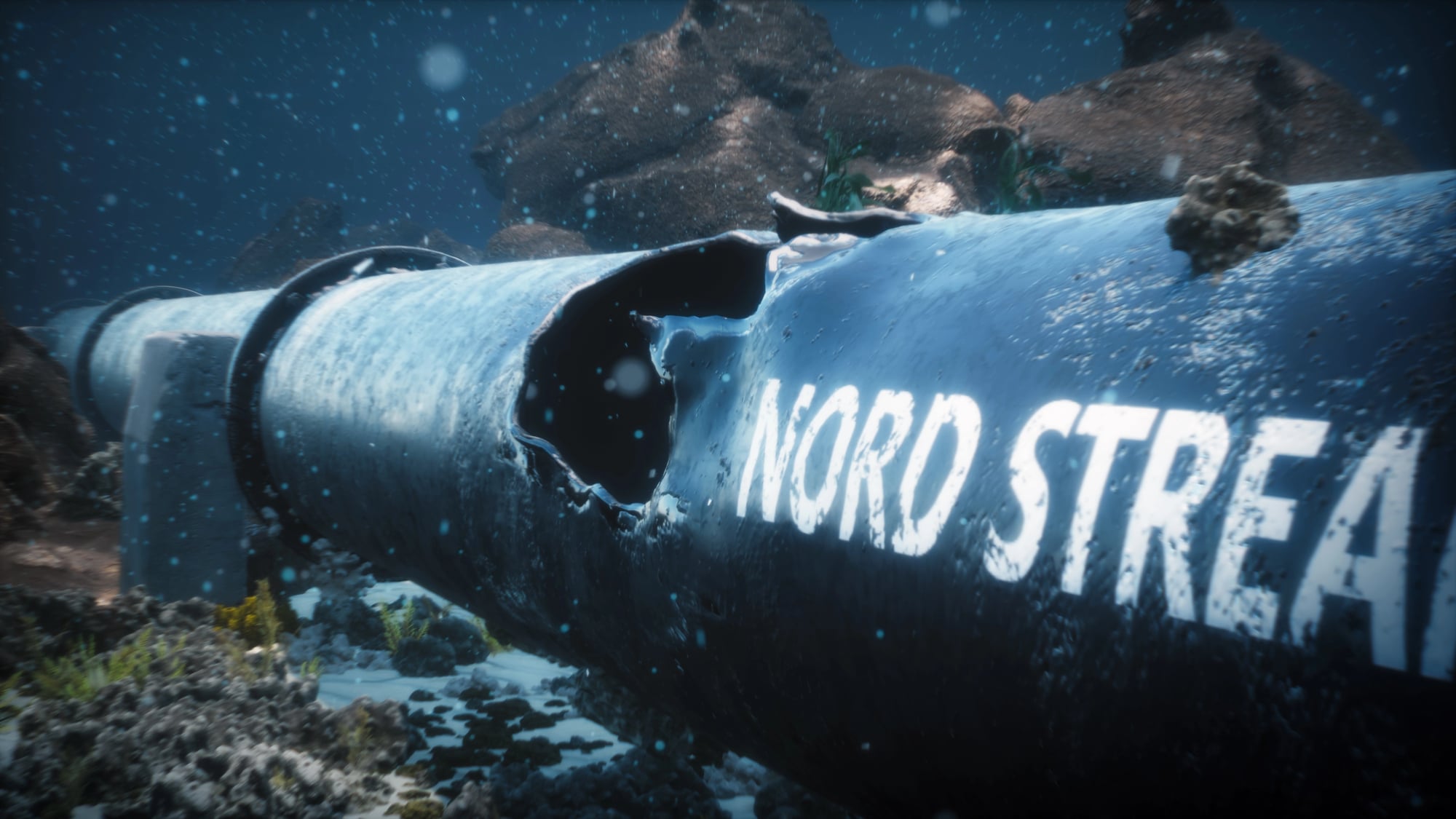
On September 26, 2022, explosions damaged three of the four strands of the Nord Stream pipelines, which ran beneath the Baltic Sea from Russia to Germany.
Four years later, we still have no definitive answer as to who carried out the attack, but we may be getting closer to that answer through a trial that recently began in Hamburg, Germany, on October 14.
When Nord Stream blew up, it was an environmental disaster of epic proportions. Researchers estimated that between 445,000 and 485,000 metric tonnes of methane escaped into the atmosphere, nearly five times the record previously held by California’s Aliso Canyon gas leak.
It has also led to speculation over who was responsible for the attack.
Journalist Seymour Hersh launched his Substack with a bombshell report accusing Washington of orchestrating the destruction. This included allegations that the Biden administration spent months planning the destruction of Nord Stream with U.S. Navy divers planting explosives during NATO’s BALTOPS 22 exercise, along with Norwegian assistance.
In his report, Hersh implicated senior officials, including National Security Advisor Jake Sullivan and CIA Director William Burns, while pointing to President Joe Biden’s and Under Secretary of State Victoria Nuland’s public threats against Nord Stream 2 as evidence of Washington’s intentions. The White House denied his allegations.
A few months later, investigative journalist James Bamford pointed to Ukraine and Poland as the most likely perpetrators, arguing that both possessed the motive, means, and opportunity to carry out the attack. Bamford dismissed the ideas of Russian involvement and Seymour Hersh’s allegations against Washington.
Still, Bamford maintained that “the United States would certainly have 80% of the answer, if not a hundred percent of the answer, at this point.”
Meanwhile, Jeremy Scahill, then with The Intercept, highlighted an investigation by Swedish engineer Erik Andersson, whose findings suggested that a small team of divers using explosive charges could have carried out the attack, rather than the underwater drones discussed by Bamford.
Although Andersson initially supported Hersh’s account, his investigation raised doubts about its details while leaving open the possibility of American involvement.
It wasn’t until August 2025 that Ukrainian national Serhii Kuznetsov was arrested by Italian police at the request of German authorities. Charges were filed in June 2026, with the trial officially beginning on October 14 in Hamburg.
According to German prosecutors, Kuznetsov along with members of the Ukrainian military allegedly developed plans for the operation “on the orders of state authorities in Ukraine.” Investigators claim the group used the yacht Andromeda, with divers placing explosive devices on three of the four pipeline strands.
Ukrainian President Volodymyr Zelensky, however, has repeatedly denied his country’s involvement in the attack.
Among the evidence cited in the indictment were intercepted telephone conversations between Kuznetsov and his wife while he was detained in Italy. During these conversations, Kuznetsov reportedly described feeling “abandoned” by Zelensky, while insisting that he had not left his military unit to “do something independently.”
Kuznetsov’s defense has called for the proceedings against him to be dropped as he has not received authorization to speak due to serving as an officer in the Ukrainian military. His lawyers argue that he is forced to defend himself “with his hands tied,” while also portraying him as a political scapegoat.
Kuznetsov’s Italian lawyer also accused German authorities of misleading Italian courts, arguing that his client had been extradited on sabotage charges through a European Arrest Warrant, only to later face war crime accusations. The defense has also argued that Nord Stream was a legitimate military target as a “Russian weapon” to finance the war.
His lawyers also state that he had spent around eleven months in solitary confinement while awaiting trial.
Statements from German politicians have also shed light on the political ramifications of the incident. This includes Christian Democratic Union politician Roderich Kiesewetter who stated “it’s a good thing that this pipeline no longer exists,” while also claiming the operation could have taken place without Ukrainian leaders being aware of its planning.
Meanwhile, the Alliance for Social Justice and Economic Reason party has called for an investigation into the demolitions with signs calling to “establish a parliamentary inquiry committee now!” Others like German Foreign Minister Johann Wadephul have declined to comment on the investigation.
On October 27, the court rejected Kuznetsov’s motion to dismiss the case. That same day, a German Federal Criminal Police Office (BKA) expert testified that six explosions occurred along the pipelines, with one section being ripped open for almost 300 meters.
The case against Kuznetsov has become more complicated, however, as the BKA testified that hair, clothing, and fingerprints recovered from the Andromeda were linked to two suspected Ukrainian crew members, but no physical evidence directly connected Kuznetsov to the yacht. The BKA also noted that investigators discovered traces of explosives aboard the yacht—including on the deck and in the cabins, bathrooms, and seating area.
BKA experts have since testified that the residues primarily contained RDX, along with smaller quantities of HMX—two powerful explosives more commonly associated with military applications than civilian use.
During the sixth day of the trial, a German Navy officer with eighteen years of experience in mine-clearance diving stated that “two divers could easily manage to place explosives at six damaged sites at a depth of 80 meters over 12 days.”
When questioned by the judge about his use of the word “easily,” the officer reaffirmed, “Yes, easily.”
The hearing also included testimony that the Andromeda could have accommodated the operation despite cramped conditions, photographs of ropes found aboard the yacht that the officer suggested could have been used during the dives, and discussion of prosecutors’ allegations that Kuznetsov was the mastermind behind the operation rather than one of the divers.
The next trial date brought further intrigue. Polish border police records revealed a Ukrainian passport bearing Kuznetsov’s photograph, but with a different surname and an age four years older than his own. Meanwhile, an employee of the company that chartered the Andromeda was unable to identify Kuznetsov despite having been shown numerous photographs by investigators.
On the eighth day of the trial, November 17, a harbor master testified that the Andromeda stopped in Wiek, Germany, on September 7–8 before returning to refuel on September 22. The yacht then returned to the seaside town of Warnemünde the following day, just three days before the explosions.
Four years after the Nord Stream explosions, the question of who ultimately authorized the destruction remains unanswered.
With eight hearings completed, whether the proceedings in Hamburg will provide that final answer remains to be seen.