
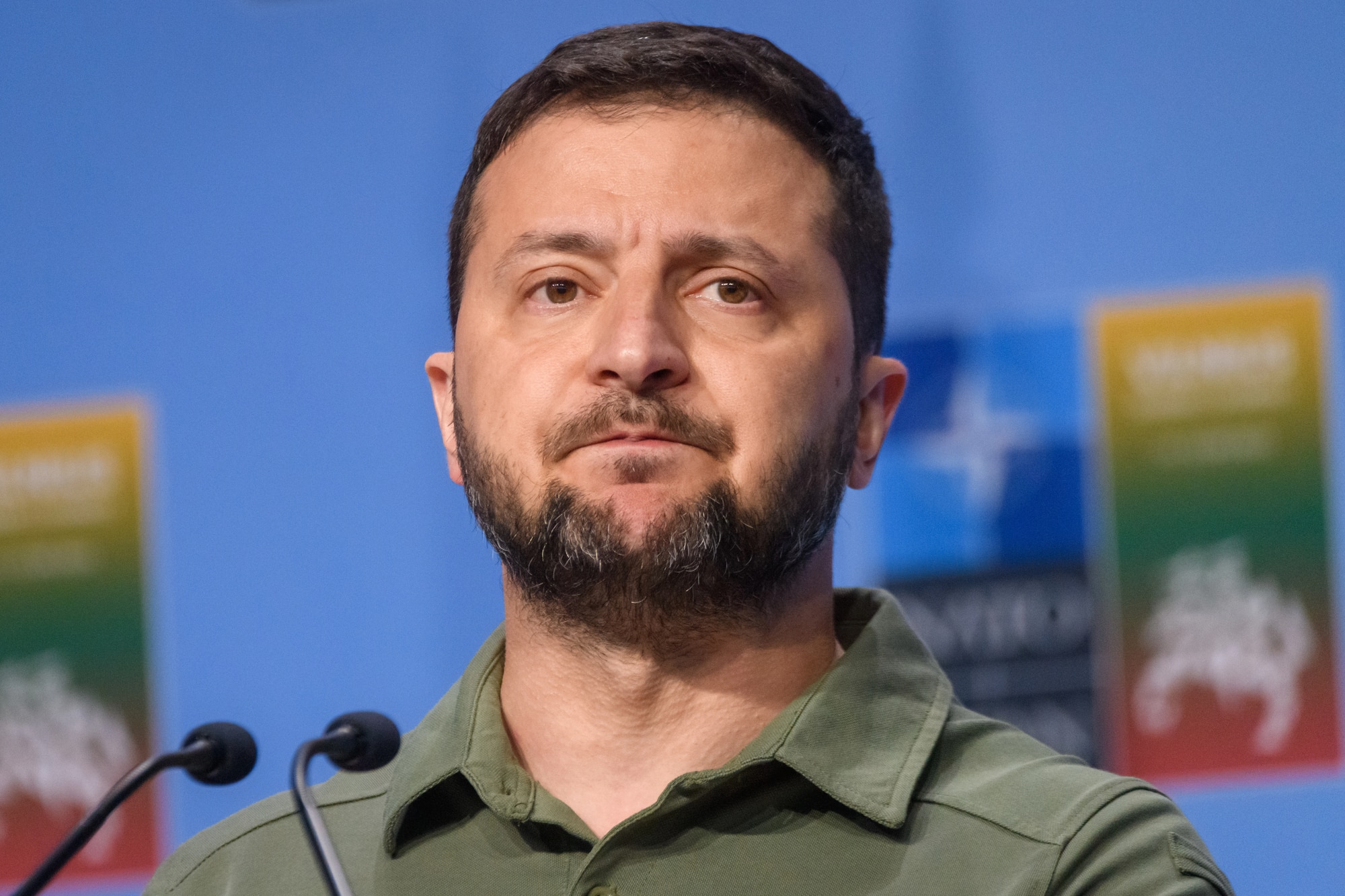
Last week, on the sidelines of the NATO summit, Volodymyr Zelensky repeated his demand that Ukraine be invited to join NATO, which was bold, considering that Ukraine’s president wasn’t even invited to the NATO summit. Zelensky attended a leaders dinner but was not invited to speak at, or even attend, the summit’s meetings.
This year, Zelensky’s argument for NATO membership took a new direction. While the Ankara Summit Declaration, released at the end of the summit, renewed NATO’s “unwavering support for Ukraine in defending its freedom, sovereignty, and territorial integrity,” it did not repeat the pledge made at earlier summits that Ukraine would become a member of NATO.
Zelensky argued, this time, not that Ukraine needs to be in NATO, but that NATO needs Ukraine to be in it. Speaking on the sidelines of the summit, Zelensky asked, “I have a question for you. Do you really believe it? Do you really believe it would be right to leave outside Nato, a country and a people with this level of defensive capability?” Then, he answered his own question, “If we already have these capabilities, if Ukrainians already know how to fight like this, then it does make sense for these capabilities to become a part of the alliance’s collective defence that would make all of us stronger.”
Zelensky argued that Ukraine should be admitted into NATO because Ukraine would make NATO stronger. This is an important shift in the argument for two reasons. The first is that the first form of the argument, that Ukraine has the right to choose to join the alliance, didn’t work. The second is that the NATO treaty specifies that NATO can invite a European state to join if it is “in a position to further the principles of this Treaty and to contribute to the security of the North Atlantic area.”
But advancing that argument was very bold of Zelensky too. Expanding NATO to Ukraine is only necessary to make NATO stronger because the promise of expanding NATO to Ukraine crossed Russia’s security red line and created the need to make NATO stronger. The most effective way to make NATO stronger is a written, binding commitment to keep NATO out of Ukraine.
Despite the absence of an invitation and the absence of a membership promise, the Western media consistently portrayed Zelensky as the big winner of the summit because he walked away with two gifts from U.S. President Donald Trump.
But this too is strange. When both gifts are unwrapped, they are not what they seem, and neither is likely to help Ukraine win the war.
The first was Trump’s granting of “his tacit approval” for Ukraine’s recent campaign of deep drone strikes into Russian territory. “It’s an escalation, but it’s also an escalation that could help lead to an end,” Trump said.
The quotation makes good headlines. But it is not news. American approval of the deep strikes is entailed by America’s essential participation in them. Senior Ukrainian officials recently told The Financial Times that “American intelligence assistance has also played a role, aiding Kyiv in charting the best paths for its drones and helping to skirt air defences.”
The second, and biggest, was Trump’s seemingly impromptu announcement that the United States would allow Ukraine to manufacture Patriot interceptors, a right the U.S. has, until now granted only to Germany and Japan. “We’re going to give a license to you to make Patriots. That’s pretty cool, right? This way you can’t complain that we’re not giving them enough,” Trump told Zelensky.
That sounds great for Ukraine, since they no longer seem to be able to intercept any of Russia’s ballistic missiles. But there are two serious caveats.
The first is that Ukraine is unlikely to produce a single Patriot interceptor on time to affect the war. “The only problem,” Ukrainian Defense Ministry adviser Serhii Beskrestnov said, is that “All of this could take a year or more.” It may take even longer. The New York Times reports that it could take “years.” Ukraine does not have years.
Even once the U.S. contractor that produces Patriots is selected and informed, there is still the process of setting up production, securing subcontractors for limited components and meeting security requirements. Even then, the process is complex, and producing a single missile can take years more.
Then there is the further problem that, as soon as Ukraine started building the facility, Russia would target it with airstrikes, as many media outlets have pointed out. That is part of the reason why Ukraine has been forced to move much of its drone production out of Ukraine into European countries.
Like Trump granting approval for Ukraine’s deep drone strikes, the impromptu promise to allow Ukraine to produce its own Patriot missiles, if it ever happens, is more optics than Trump coming to Ukraine’s rescue.
Ukraine’s rescue will not come on the battlefield. Russia can produce many more ballistic and hypersonic missiles than Ukraine could produce Patriot interceptors, and deep strikes inside Russia will not prevent the fall of Donbas where the real war is being fought. Rescue for Ukraine will come from where it always should have, and could have, come: the negotiating table. It is time to stop making deceptive promises about the next wonder weapon and start negotiating the settlement that was always inevitable and that will establish an inclusive security architecture that respects the legitimate security concerns of Ukraine and Russia so that lasting peace can finally come to Europe.