
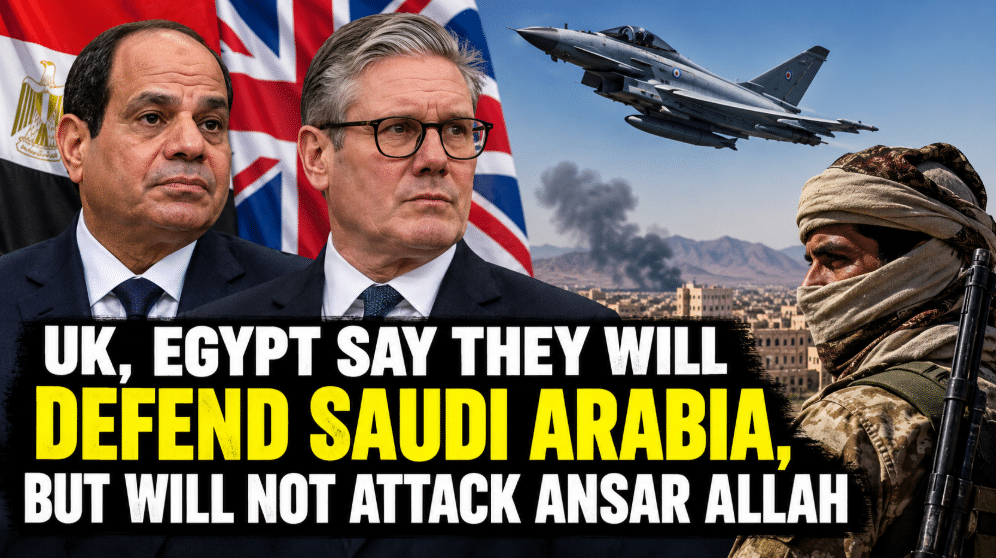
The UK and Egypt have pledged defensive support for Saudi Arabia amid its war against Ansar Allah in Yemen. However, both countries said they would not conduct offensive operations against the group, which controls Yemen’s most populous regions.
On Wednesday, Egyptian President Abdel Fattah al-Sisi said that Egypt’s military support for Saudi Arabia would be limited to defense, and Cairo would not authorize strikes inside Yemen. Sisi’s remarks followed the Egyptian National Defense Council’s pledge to provide “all possible forms of support” to Saudi Arabia as the kingdom battles Ansar Allah, or the Houthis, in Yemen.
Egypt is “extending all necessary and possible forms of support to the sisterly Kingdom of Saudi Arabia to defend its security and stability, and to safeguard its resources, territorial integrity, and Islamic holy sites,” the statement from the National Defense Council chaired by President Sisi said.
On Tuesday, the UK announced it would deploy Typhoon fighter jets to defend Saudi Arabia against missiles and drones fired by Ansar Allah. British officials said the aircraft would not conduct offensive operations in Yemen.
Saudi Arabia has received pledges of military support from Turkey and Pakistan, its partners in the Mecca Accords, as well as assistance from France and the US. However, President Donald Trump has refused multiple requests from Saudi Crown Prince Mohammed bin Salman for the US to begin direct attacks on Yemen. Trump has provided Saudi Arabia with intelligence and targeting support.
In 2014, Ansar Allah seized the capital city and took control over most populated regions in Yemen. Initially, the US worked with Ansar Allah to target al-Qaeda in the Arabian Peninsula. However, Saudi Arabia viewed Ansar Allah’s control of Yemen as problematic. Riyadh backed a government-in-exile, which it attempted to install in power with a massive bombing campaign, a blockade, and by backing militias opposed to Ansar Allah.
The Barack Obama administration elected to support Saudi’s war to alleviate Riyadh’s concerns over the Iran Nuclear Deal. The war killed hundreds of thousands of people, caused a cholera epidemic, and the blockade resulted in widespread malnutrition among children.
During the war, Ansar Allah developed missile and drone capabilities that were able to cause significant damage to Saudi Arabia’s energy infrastructure. While Riyadh and Sanaa agreed to a ceasefire in 2022, they have not reached an agreement to end the war. The fighting between Ansar Allah and Saudi Arabia reignited after the Saudis hit the Sanaa airport twice in July.