America’s Counter-Revolution Reviewed

by | Aug 15, 2016

America’s Counter-Revolution Reviewed

by | Aug 15, 2016

[vc_row][vc_column][vc_column_text]Independent historian (and old friend) Joseph R. Stromberg reviewed America’s Counter-Revolution: The Constitution Revisited at The American Conservative magazine website. He opens “The Federalists’ Revenge” with:[/vc_column_text][vc_column_text]

America’s Counter-Revolution, dedicated “To the constitutionalists of all parties,” gives new meaning to the word pithy. In 20 short chapters (most of which were previously columns in the Freeman and elsewhere) Sheldon Richman achieves a remarkable thematic coherence, giving the reader a nice window into American constitutional argument and thus into American history.

[/vc_column_text][vc_column_text]

Building on Arthur E. Ekirch’s Decline of American Liberalism (1955), Richman concludes that the Federalists gave America a vague constitution having the appearance of limited powers but marred by implied ones: a “living constitution” for conservative nationalists. The Federalists, recall, set imperial greatness above liberty and thought real limits on power “impossible”; so-called Anti-Federalists opposed the rule of self-nominated aristocrats and believed in dispersed power.

[/vc_column_text][/vc_column][/vc_row]

Sheldon Richman

Sheldon Richman

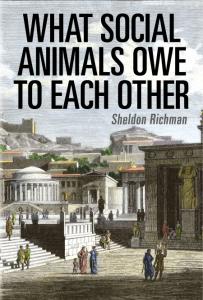
Sheldon Richman is the former executive editor of The Libertarian Institute and a contributing editor at Antiwar.com. He is the former senior editor at the Cato Institute and Institute for Humane Studies; former editor of The Freeman, published by the Foundation for Economic Education; and former vice president at the Future of Freedom Foundation. His latest books are Coming to Palestine and What Social Animals Owe to Each Other.

View all posts

Our Books

Recent Articles

Recent

Mousetrapped: Trump Takes the Bait

Mousetrapped: Trump Takes the Bait

The mousetrap motif plays a major role in tales and literature, from Shakespeare’s Hamlet who set one to find his father’s murderer, to Agatha Cristie’s famous play, The Mousetrap, that opened in London’s West End in 1952 and is still running today 30,000 performances...

read more
Copernicus at 500

Copernicus at 500

Famed for his contributions to the hard sciences—most notably his theory of heliocentricity—the sixteenth-century astronomer Nicolaus Copernicus was also an acute analyst of monetary policy. To that end, Ralph Benko has done us all a great service with this new...

read more
‘Terror’ as Technique in American Policymaking

‘Terror’ as Technique in American Policymaking

In a speech delivered in the autumn of 2002, as the United States moved inexorably toward war with Iraq, the late Joan Didion delivered an offhand remark that effectively summed up the flaw at the heart of the logic behind that coming war, and of the logic of a number...

read more

Pin It on Pinterest

Share This