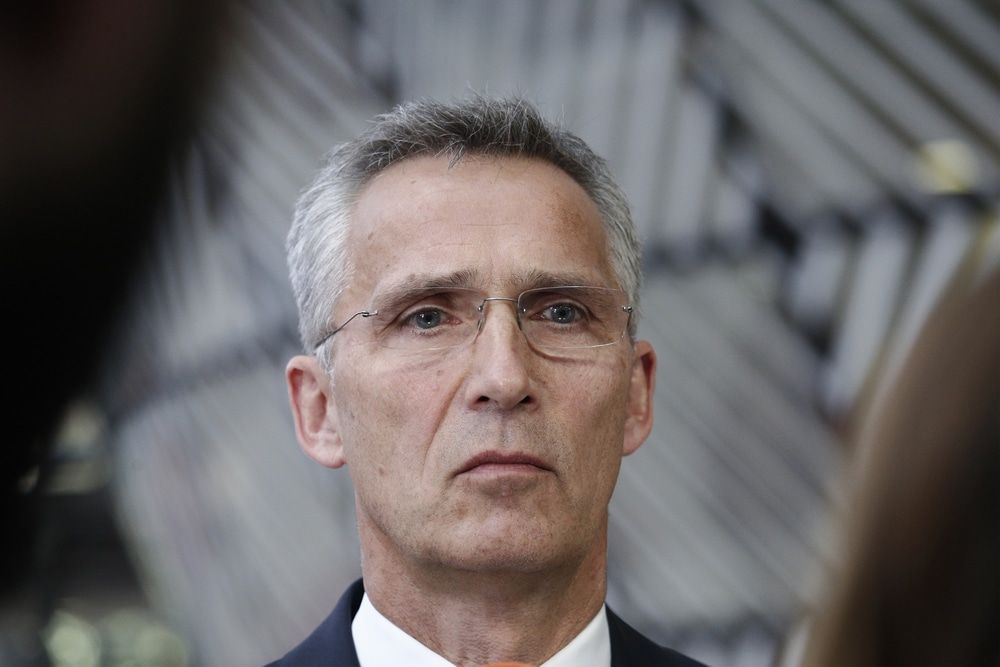
NATO Secretary General Jens Stoltenberg likely surprised both factions in the ongoing debate about NATO expansion and its role in triggering the Russia-Ukraine War. He also undermined (perhaps fatally) the official cover story about the reasons for the Ukraine war. Since Russia’s February 2022 invasion, Western officials and their allies in the corporate media have insisted vehemently that the alliance’s addition of Eastern European nations after the Cold War and giving a pledge to Ukraine that it would become a member someday had nothing to do with Vladimir Putin’s decision to attack his neighbor. Indeed, anyone who argued otherwise risked being accused of echoing Russian propaganda and being “Putin’s puppet.”
Both the official explanation and the pervasive narrative regarding the war were unequivocal. Putin was power-hungry and unwilling to tolerate an independent, pro-Western Ukraine on Russia’s border. Brookings Institution Senior Fellow Steven Pifer’s interpretation was typical; “For the Kremlin, a democratic, Western-oriented, economically successful Ukraine poses a nightmare, because that Ukraine would cause Russians to question why they cannot have the same political voice and democratic rights that Ukrainians do.” Even when Pifer published his piece in July 2022, that explanation was extremely weak, given Ukraine’s own corruption and authoritarianism. Volodymyr Zelensky’s subsequent systematic assault on civil liberties makes the notion that Putin felt threatened by Ukraine as an irresistible democratic magnet patently absurd. Ukraine is not a democratic country by any reasonable definition of the term.
Nevertheless, other analysts made arguments similar to Pifer’s thesis. That Russian grievances over NATO helped spark the war “makes no sense,” wrote Rutgers professor Alexander Motyl. “NATO cannot have been the issue,” historian Timothy Snyder insists; Putin “simply wants to conquer Ukraine, and a reference to NATO was one form of rhetorical cover for his colonial venture.” Such comments matched the official positions that the U.S. and other NATO governments adopted. Interventionist opponent Caitlin Johnstone was accurate that “arguably the single most egregious display of war propaganda in the 21st century occurred last year, when the entire western political/media class began uniformly bleating the word ‘unprovoked’ in reference to Russia’s invasion of Ukraine.”
In a September 6, 2023 speech to the European Union Parliament, Secretary General Stoltenberg contradicted the entrenched official narrative, most likely inadvertently. “President Putin declared in the autumn of 2021, and actually sent a draft treaty that they wanted NATO to sign, to promise no more NATO enlargement. That was what he sent us. And was a pre-condition for not invade (sic) Ukraine. Of course we didn’t sign that.”
Stoltenberg emphasized, “He wanted us to sign that promise, never to enlarge NATO. He wanted us to remove our military infrastructure in all Allies that have joined NATO since 1997, meaning half of NATO, all the Central and Eastern Europe, we should remove NATO from that part of our Alliance, introducing some kind of B, or second class membership. We rejected that.” Consequently, “he went to war to prevent NATO, more NATO, close to his borders.” [Emphasis added]
Several scholars and former officials had warned for years that NATO’s expansion to Russia’s border would end badly, and the Russian invasion of Ukraine confirmed those predictions. George Kennan, the intellectual father of America’s containment policy during the Cold War, perceptively warned in a May 1998 New York Times interview about what the Senate’s ratification of NATO’s first round of expansion would set in motion. “I think it is the beginning of a new cold war,” Kennan stated. ”I think the Russians will gradually react quite adversely and it will affect their policies. I think it is a tragic mistake.”
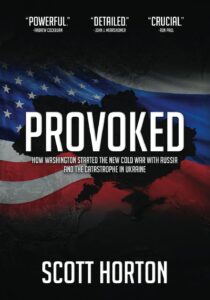
NATO’s attempt to make Ukraine a full-fledged military asset was especially provocative. Kremlin leaders regarded Ukraine as not only being in Moscow’s rightful sphere of influence, but in Russia’s core security zone. Putin made that point clear on numerous occasions at least as far back as his speech to the Munich Security Conference in 2007. Instead of taking those warnings seriously, Western leaders blew through one red light after another. NATO’s leader, the United States, especially worked to forge ever-closer military ties with Ukraine. In essence, the Trump and Biden administrations began to treat Ukraine as a NATO member in all but name.
Extensive arms shipments to Kiev along with U.S. and NATO joint military exercises constituted the centerpiece of that policy. But that was not the extent of Washington’s provocations. Shortly after Russia annexed Crimea in 2014, the CIA initiated secret paramilitary training programs for Ukrainian special operations personnel in the United States and in Ukraine. Yahoo national security correspondent Zach Dorfman noted that “U.S. and Ukrainian intelligence have even participated in joint offensive cyber operations against Russian government targets, according to former officials.”
Such actions make a mockery of the argument that Russia’s invasion of Ukraine was unprovoked. That assertion is convenient propaganda, but it was always devoid of both facts and logic. Stoltenberg’s comments merely confirm what should have been obvious to both the foreign policy community and the news media from the beginning.