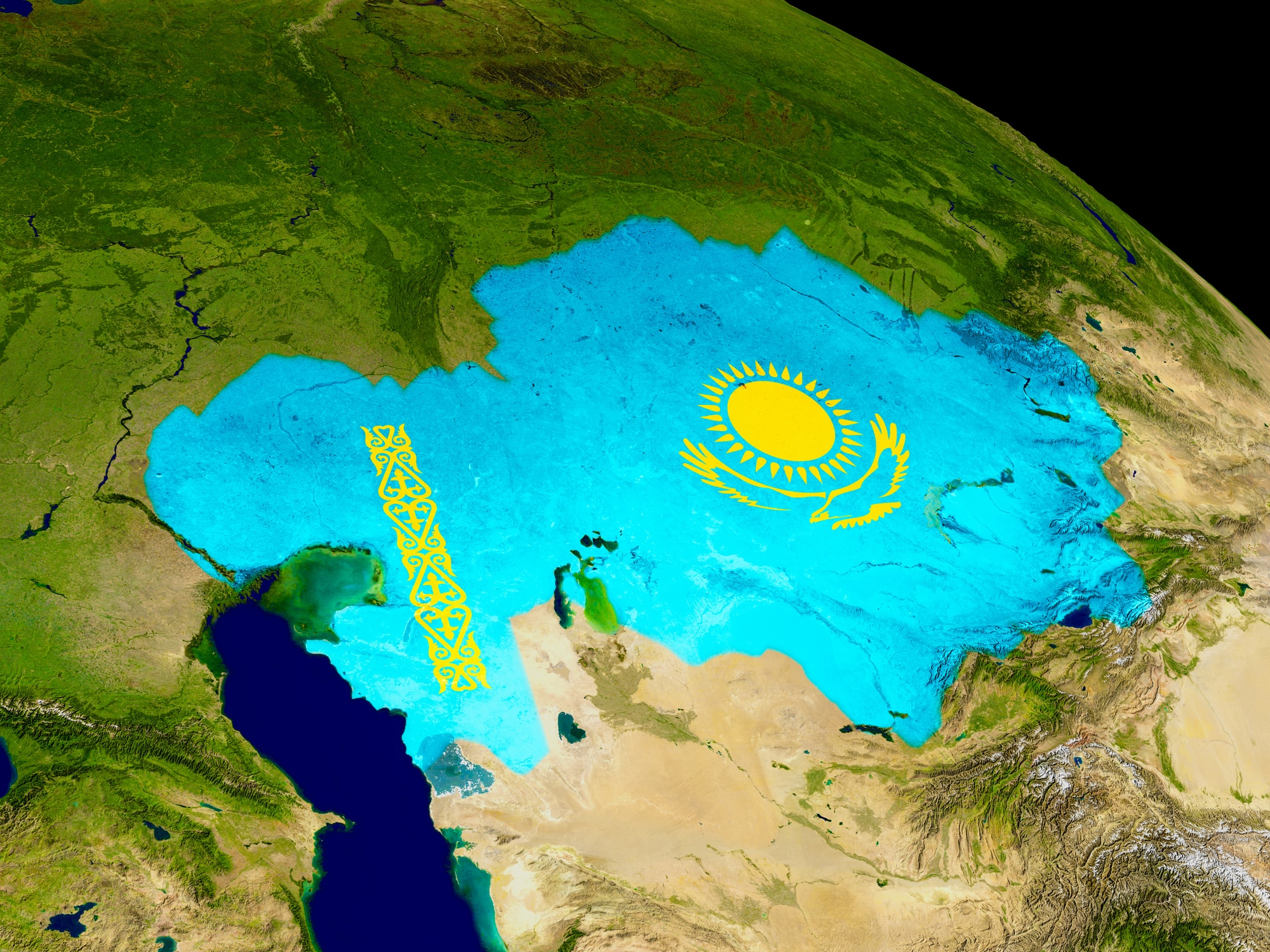
When President Donald Trump celebrated Kazakhstan’s decision to join the Abraham Accords, he spoke of peace and partnership in the familiar language of statesmen. The announcement sounded like a diplomatic victory in a region marked by instability. In reality, it looked more like one more step in a slow and deliberate effort to turn Central Asia into a forward operating base against Russia, China, and Iran.
Kazakhstan sits at the heart of that emerging contest. American strategists began to speak of a unified space that they call “Greater Central Asia” years before Trump returned to the White House. At the American Foreign Policy Council, S. Frederick Starr urged Washington to adopt an ambitious regional strategy. He described a zone that stretches from the Caspian Sea to western China and argued that the United States must compete there if it wants to shape the future of the Russia-China relationship, the broader Asian balance, and the flow of critical resources such as uranium, oil, and natural gas.
Starr carried that message to Congress. In 2018 he testified before the House Committee on Foreign Affairs on the emergence of Central Asia and described a region that can either serve as a bridge for Chinese and Russian influence or as a barrier to it. He encouraged lawmakers to support deeper economic, security, and political engagement.
The State Department translated that thinking into an official U S Strategy for Central Asia 2019-2025. The document promised support for Afghanistan, democracy initiatives, and regional trade. Russian analysts who examined the strategy saw something more pointed. One study in a Russian academic journal described an obvious anti-Russian and anti-Chinese orientation and noted that Washington treated Kazakhstan and Uzbekistan as primary partners. The authors identified three main lines of effort. They saw a geopolitical thrust that challenged Moscow and Beijing, an economic agenda that promoted alternative corridors and markets, and an ideological campaign that pushed Western political models.
Think tanks around Washington refined the playbook. The Atlantic Council urged policymakers to partner with Central Asian states in a way that reduces their dependence on both Russia and China. Its analysts recommended trade and investment schemes that counterbalance the Belt and Road Initiative, support for Kazakh oil exports to Western markets, and infrastructure financing that loosens Chinese control. They also called for expanded border security programs, counterterrorism training, and intelligence exchanges that would allow Central Asian governments to lean less on the Russian led Collective Security Treaty Organization (CSTO).
The Hudson Institute stressed a different theme. Its work on the C5 plus 1 framework highlighted Kazakhstan’s role in global uranium supply chains and emphasized nonproliferation partnerships. Hudson analysts argued that Washington can use cooperation on nuclear safety and fuel management to deepen ties and to constrain countries such as Iran that continue nuclear development.
Trade and transit routes gave this strategy a physical backbone. American and European planners looked at the map of Eurasia and saw one obvious path for commerce that does not run through Russia or Iran. They called it the Middle Corridor, or more formally the Trans Caspian International Transport Route. This corridor begins in Central Asia, crosses the Caspian Sea, passes through the South Caucasus, and enters Europe. It offers a way to move goods and energy between East Asia and Western markets while sanctions constrain Russian and Iranian routes.
Trump and his advisers did not ignore this emerging blueprint. At the November 2025 C5 plus 1 summit, Secretary of State Marco Rubio spoke to Central Asian foreign ministers about the wealth beneath their soil. He told them, in comments reported by Responsible Statecraft, that they should take the resources that God placed in their lands and use them to diversify their economies. Trump called Central Asia an extremely wealthy region and described critical minerals as one of the key items on the agenda.
Chinese officials and commentators watched those moves with concern. Beijing views Central Asia as a natural extension of its own economic and security space. The American Foreign Policy Council captured that anxiety bluntly when it noted that China’s pathway to Europe and the Middle East runs through Greater Central Asia. Beijing has invested heavily to secure that pathway. In September 2025, Chinese leaders signed seventy trade agreements worth nearly fifteen billion dollars with Kazakhstan alone, according to Al Jazeera.
The new Abraham Accord between Kazakhstan and Israel unfolds on this contested ground. Kazakhstan has carried on a complex relationship with Iran for decades. Reports in The Diplomat described allegations that Kazakhstan transferred nuclear warheads to Iran in the early 1990s. Those claims never received clear public confirmation, but they alarmed Israeli officials. In 2009, then-Israeli President Shimon Peres traveled to Astana to press the Kazakh government to halt uranium ore sales to Iran. During the long negotiations over the Iranian nuclear deal, Israeli diplomats objected when Kazakhstan tried to soften Tehran’s image in international forums.
Now Israel and the United States can present Kazakhstan’s entry into the accords as a sign that the Central Asian state aligns more closely with their camp and less with Iran’s. The formal document does not mention uranium or warheads. Yet in strategic terms it helps tighten a network that stretches from the eastern Mediterranean to the Kazakh steppe and that can pressure Tehran from another angle, this time from the north.
Turkey’s role as a member of NATO adds another layer of tension. Ankara has promoted a vision of pan-Turkic integration for years and revived it with new intensity under President Recep Tayyip Erdogan. The Organization of Turkic States grew out of periodic summits of Turkic speaking countries and now includes Turkey, Azerbaijan, Kazakhstan, Kyrgyzstan, and Uzbekistan as full members.
Erdogan did not hide his ambitions. At one early summit he told assembled leaders that they formed “six countries and one nation,” a remark recorded by Special Eurasia. Turkish officials repeated that phrase as they pushed for tighter economic and political coordination. The Diplomat later observed that Azerbaijan’s victory in the Second Karabakh War, achieved with significant Turkish military support, expanded the idea of pan-Turkic unity.
China views this activism through a dark lens. Chinese officials accuse Ankara of providing shelter to Uyghur separatist groups that Beijing labels terrorists. The Jamestown Foundation documented repeated Chinese claims that Turkey hosts militants from the East Turkestan Islamic Movement and related organizations. Academic research published through the University of Hawaii noted that Beijing sometimes accuses Turkey of harboring the East Turkestan Liberation Organization and other groups that advocate independence for Xinjiang.
Chinese analysts also complain that Turkish diplomats run an illegal passport scheme. Chinese media argue that Turkish embassies in China and Southeast Asia have issued passports to Uyghurs who then travel onward to Turkey, Syria, and other countries.
Iran and Russia express their own worries. Iranian officials openly fret about Turkish influence in the South Caucasus and Central Asia. The Armenian Weekly reported on Iranian concerns that Turkey uses its economic presence in Azerbaijan and Georgia and its activism in the Organization of Turkic States to knit together a bloc of Turkic nations that might encircle Iran and erode its role in regional trade.
These concerns do not bother Washington. They intrigue it. Policymakers in the United States now speak of Turkey’s regional activism as a useful complement to American efforts. An Atlantic Council report on Turkey’s presence in Central Asia noted that Turkish activities often align with U.S. interests and urged closer coordination. The authors suggested that partnership with Turkey and other allied states in the region can advance American goals at limited political and economic cost.
Turkey provides NATO compliant arms to Central Asian states and helps them modernize their forces. Analysts such as Syed Fazl-e-Haider of Central Asia-Caucasus Analysis observed that “through this framework, Turkey has assumed a leading role in diminishing Russia’s influence over the military development of these states.”
Kazakhstan’s Abraham Accord with Israel fits neatly into this emerging lattice. It ties a Central Asian state that already participates in the Organization of Turkic States more closely to Israel, which enjoys tight security and intelligence links with Washington.
Officials in Washington and Jerusalem will continue to describe this agreement as a peace achievement. They will speak of regional stability and interfaith understanding. In practice, the accord sharpens a contest over the future of Eurasia. The United States and its allies seek to reshape supply chains, security agreements, and cultural ties across the heartland that stretches from Anatolia to western China. They hope to weaken Russian and Chinese leverage and to hem in Iran.
The Abraham Accord with Kazakhstan does not bring real peace. It brings a new layer of legitimizing rhetoric to a slow encirclement of rival powers along the Eurasian frontier, a frontier that now serves as the civilizational center of gravity for an increasingly multipolar world.