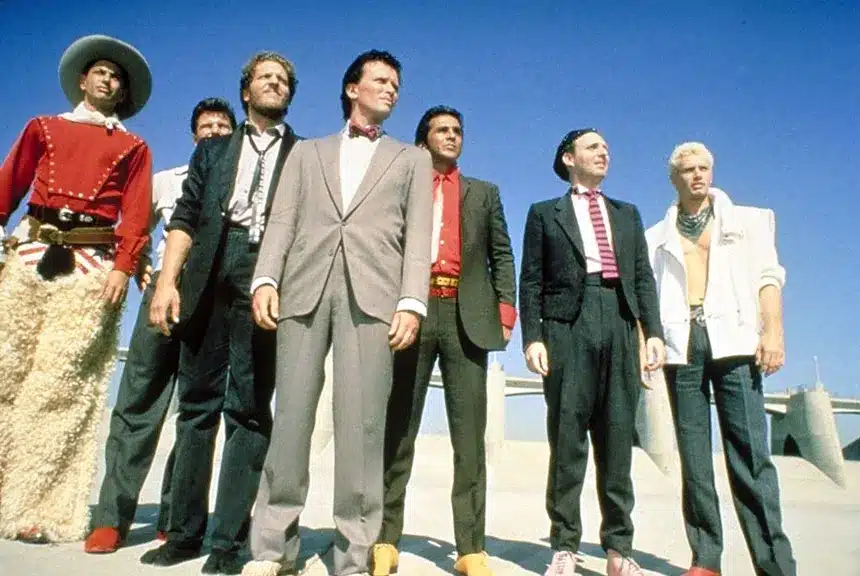
“Don’t be mean, we don’t have to be mean, coz remember, no matter where you go, there you are,” said Buckaroo Banzai as he stood on stage with his band of as multi-faceted men. The Hong Kong Cavaliers. Buckaroo, the scientist, surgeon, rock star, comic book character among other things, above all else, a hero. Champion for the human race, even as two rival alien empires battle one another. Earth a weak proxy in such a struggle, the ‘ally’ aliens are not good, rather less evil and see us humans as useful, a malleable race to manipulate and threaten into helping them with their war. Despite this, Buckaroo Banzai and The Hong Kong Cavaliers are competent, poised and do good despite a strange world setting around them.
It’s still our world, 1980s America at least, peak Cold War, where the petty squabbles between human nation states are insignificant in scale to whatever the aliens are fighting over. Buckaroo understands this and heroically saves the day, without compromise to his principles. Not the aliens, not the governments, his and the Cavaliers. Buckaroo’s principles also has a tendency of aligning with the audiences. The story telling and audience align morally.
There was a time when story telling invoked morality which was understood by the reader or viewer. Compromise and pragmatism could tar a character into moral ambivalence and see them residing in a grey area. A lesser evil status. Noir and the 1970s cinema and pulp writings gave us such complicated characters, anti-heroes or simply protagonists who we could journey with as the plot takes shape. Not entirely good people. We knew this.
Whether Parker from the Richard Stark novels and subsequent books or The Man With No Name as portrayed by Eastwood in the Leone trilogy of Dollar films. Both had a code of sorts even if it the code revolved around them making money, for themselves. These characters at times do good, at least can be framed mostly in such a manner. Travis Bickle from Taxi Driver, Lolita’s Humbert Humbert or Tony Montana from Scarface, are not good men even if some men fantasy about being them. Or, in some way romance and fetishise them and their victims in a manner which is not universally moral. Revealing instead the intuition and instincts of those drawn to such aesthetics or entitlements over others.
Bales portrayal of Patrick Bateman in American Psycho, has become a meme with a serious reflection on boys and males who fixate on aesthetics and corporately entwined yuppy capitalism. The sociopath appeal and…charm? By which Bale portrays Batemen over rides the critical thinking of some in the audience. Perhaps, it’s that some viewers forget we can watch and read fiction with unreliable narrators and bad protagonists, unfortunately in an age of ‘looks-maxing’, narcissism affirmation and main player syndrome the appeal of such a character transcends any understood morality and instead validates the worse qualities in an individual.
For the anarchist brained, Snake Plissken is the anti-establishment arch type who with patched eye, occasional limp and scowl disregards authority regardless of how they captured him and convinced him into serving them. In doing so, he is able to do it his way, overcome adversity and still push his middle finger into the face of the tyrants. In the Escape universe it’s not that life is cheap, it was traded for order and authority. We don’t see the suburbia and cities away from the prison of LA and New York. They may as well be Demolition Man’s San Angeles, a utopia where facades and gentrification reduce life into insincere platitudes and meaningless slop. For those in the sewers, they are the filthy human rodents who would find themselves in the prison cities of Carpenter’s Escape movies. Not because they are violent criminals, rather they rejected authority and the homogenised tyranny of a San Angeles.
The world does not suddenly become such realisations, it deceives and fattens itself up in the mean time. With promises of stability, a law, ban and restriction here and there until choice is limited to no choices, only what is allowed or mandated. The whims of the State or in case of cyberpunk, corporate monopolies determines that people no longer have any individual agency, if they do it’s stolen in fragments or exists like a weed in the cement. Sex is safe to the point it’s a bland disconnected ritual of non-contact hygiene, music empty jigs, or put simply a vibe. Food limited slop of the corporate victor in the fast food wars, Taco Bell or Pizza Hut depending on where you watched the movie. But people are wealthy, they have comfort. Entertainment so long that’s it not challenging, degenerate or violent. Disney-adults.
The Running Man, both film incarnations, exists in a less extreme manner. The balance between grime and violence to the clean corporate and government comforts of the suburbs and apartments is less segregated or hidden. The proletariat still work and pollute the streets with the stench of their working class existence while their betters live in perfumed deceptions and technologically enriched laziness. Not quite an Elysium, where trusted old technology remains because it’s reliable and doesn’t not betray the user. Smart devices and modern technology is anti-proletariat and just another aspect of surveillance and censorship. The affluent watch the violence with deceived excitement, a breads and circus sort of dimension. The criminals and the dirty must run and try to survive those who hunt them, whether trained killers or pro-wrestling like figures of violence.
The districts and cities of the Hunger Games was more a dystopian apartheid sate, though anyone who is the victim of apartheid like conditions already consider their reality a dystopia. Unlike The Running Man this cities inhabitants enjoy a ritualistic orgy of violence where the youth kill and die for their delights. Those in the city wrap flabby and sickly bodies with fashion, morally bankrupt self interested creatures who see the world as a pantry and screen by which to gorge themselves on or watch with voyeuristic sadism. There is no empathy, no morality, no dignity, just lavish comfort for themselves and death and starvation for those beyond. All extractive societies convince themselves it’s done for a greater good.
We the viewer understand the antagonists in The Running Man, Hunger Games and Escape from New York/LA films as being evil, or bad. Even if we watch them with more in common with the audiences of their worlds, Yet, here we are in a world that aspires to live out such hubris and lack of moral dignity. A world where smart devices spy and censor, and soon can be shut down from afar. We can watch with ease, gorge ourselves on less healthy slop, while the dirty who die and starve live far away. A genocide city like Gaza may become a metropolis some day as promised in Davos, built on the bones of the dead. Among the rubble is no Snake Plissken or running men, no Mocking Jay flies above those graves and ruins. It’s a dystopia without story for the audience to care about, only exploitation and misery.
Those who do the viewing and ruling, those who are paid to kill and the societies themselves have chosen to be the anti-heroes of the most perverse kind and the antagonists. The dystopia is now viewed as a utopia. The heads of state, wealthy and the powerfully adored view the pre-pubescent and barely pubescent girls who were coerced or manipulated into sexual servitude with less affection than even Humbert Humbert had for Lolita. Yet, as they pull their silk suits down to reveal goose flesh covered bodies, each putrid thrust into innocence a celebration for liberal democracy and with every climax ending in a child’s tear another roar for Western civilisation. Government and the institutions of power made it all possible, conceals it and enabled. Those girls have no father like Bryan Mills, avenging them as he did it Taken. If there was he would be a criminal terrorist, and most of you would love the rapists and their mercenary cops for punishing him for his dignity and love of his child.
As the countless dead lay in cement powder or buried under masonry while drones and the most sophisticated weapons of tyranny and killing surround a city, or what remains, the world shrugs on. It somehow understands this is the way, it’s how it always has been. Even if some voices cry with helpless anger, the mob, those who pretend democracy is a virtue and the rule of law works beyond enriching power. Gorge themselves as those in San Angeles do or in the city of The Hunger Games. On an individual level minds wracked in drugs and profitable mental health diagnoses convince themselves they are Tyler Durden or even Patrick Bateman. None want to be Katniss Everdeen but would rather be Anastasia Steel. Debt is wealth, so long as things surround one in a castle of imposed ignorance where consequences and privilege is believed to be entitlement.
Even the morality space plays of Star Wars and Star Trek have been invaded by cynical corporate irrelevancy. Deconstruction, and gentrification, aesthetics only, no character or understanding of what made the story and world living. A New Hope? what is hope? what is heroism? What is good and evil? When the producers of such products don’t know and their audiences abandon all hope, or don’t care for it. We are left with products, costumes and logos. The Federation, despite its pretentious Utopianism was above all else a place that valued individual rights, or did it’s best to consider them. The moral narrators of the films and shows, the captains and crew, each in their own way balanced principles with pragmatism. Some doing better than others, it was often in conflict and complicated. Episodes were a philosophical debate or lesson, not merely entertainment or a thing to stare at for your brain to switch off while to. And double screening was not a consideration for the writers and show runners back when. Was Gul Dukat was right? Q certainly was.
And now as the pillars of Western hubris denigrate themselves into censorship and agents running rampant on the streets, we can witness the apology for dystopianism. The intolerance of tolerance and the unreason, a need to win, control has become the singular ideological basis. Yet, despite the jingoism and nationalism. The racial pride or religious zealotry, there is no story. No character other than hate of the other. The heroism is in bravery itself or victory. Or might. There is no regard for moral courage and what would have once, for viewers of fiction have been understood as antagonists are now revered in life. The fictions and realities merge, and both no longer even pretend to care about right and wrong, only legal and illegal, order and authority.
It’s unlikely we would see a Barry Newman character like Kowalksi or John Talbot, counter cultural and anti-authority where individuals overcome odds, and meet unique characters. The State with it’s lust for war will create numerous John Rambo’s as fond in the first book, while the government killers may think themselves a Rambo. And silently the veterans like the film, based on real life Chattahoochee and less a Tim Kennedy pulp fiction or American Sniper propaganda. There is no Megaforce coming to save the Gazans or those in the Sudan. “Deeds Not Words” have less meaning now, the deeds are dirty. The words banned or empty. No Ace Hunter remarking, “…the good guys always win, even in the eighties.” Winning according to history decides the perspective of Good and Evil. But in 2026 no one even pretends to be good. They no longer need to.
We will have no Buckaroo Banzai pointing and yelling, “Evil! Pure and simple, from the 8th dimension!” Because it exists in our dimension. The evil, is most of us. Inside, or the allowances made in accepting injustice or ratifying it. With every call for more laws, to ban, to censor and to hate with irrational viciousness leads the planet closer to the dystopia, where the antagonists rule and are all that remains. Maybe a Megacity One here, or the wastelands of Wall-e there. Perhaps that’s the story of history, fiction just let us escape knowing the truth, instead of showing us how to be good. But wouldn’t it be nice to defeat evil, and walk like Buckaroo and The Hong Kong Cavaliers into the rolling credits and beyond? The story of good can still be told, “no matter where you go, there you are.”