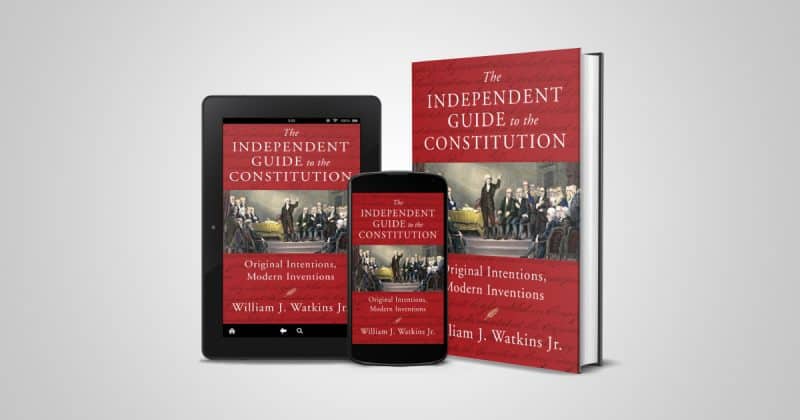
William J. Watkins Jr.’s The Independent Guide to the Constitution: Original Intentions, Modern Inventions is an admirably clear-eyed and disciplined examination of a document that has, over the course of two centuries, been transformed from a charter of limited and enumerated powers into a font of nearly unlimited federal authority. Watkins writes with alarm at how far modern constitutional doctrine has drifted from the Founders’ design—but his book is more than a lament. It is a structured, systematic guide to how the Constitution was meant to work, how it has been distorted, and what might yet be salvaged.
The book’s organizing principle is helpfully straightforward. Watkins proceeds through the Constitution article by article, section by section, clause by clause, and amendment by amendment. For each provision, he explains its original purpose, the historical context in which it was adopted, the manner in which its meaning has been stretched or inverted over time, and, where appropriate, what constitutional fidelity might require today. This makes the book particularly accessible to readers who want something more substantial than polemics but less forbidding than dense legal treatises.
At its core, The Independent Guide is a sustained argument for constitutional restraint. Watkins insists that the Constitution was never intended to function as a living document in the modern sense, a pliable instrument reshaped by judicial fashion or political expediency. Rather, it was designed to bind government actors, not liberate them. The federal government was to be one of limited, enumerated powers, with all remaining authority reserved to the states or the people. The tragedy of American constitutional history, as Watkins presents it, is the steady erosion of that principle.
Two of the most illuminating examples in the book are Watkins’s treatments of the Necessary and Proper Clause and the Commerce Clause, twin pillars upon which the modern administrative state has been constructed. In discussing the Necessary and Proper Clause, Watkins draws out a familiar but crucial interpretive divide between Jeffersonian and Hamiltonian constitutionalism. Thomas Jefferson’s reading was narrow: the clause authorized only those means absolutely necessary to carry out an enumerated power: if a power was not expressly granted, it was not to be inferred merely because it might make execution easier or more efficient.
Alexander Hamilton’s view, by contrast, was expansive: he understood “necessary” to mean useful or conducive, an interpretation that opened the door to implied powers of virtually unlimited scope. Watkins shows how this Hamiltonian reading, initially controversial and contested, gradually became orthodox, particularly once embraced by the Supreme Court. The result was a Constitution increasingly unmoored from enumeration and increasingly hospitable to centralized authority.
The evolution of the Commerce Clause receives similarly instructive treatment. Watkins traces how a provision originally intended to prevent interstate trade barriers and mercantilist rivalries among the states evolved into a justification for regulating nearly every aspect of economic and social life. The transformation is not presented as inevitable or benign. Rather, Watkins documents how judicial reinterpretation, most especially during the New Deal era, converted commerce “among the several states” into a rationale for federal supervision of activities that are neither interstate nor commercial in any meaningful sense.
Throughout the book, this recurring tension between Jeffersonian restraint and Hamiltonian expansion serves as a unifying theme. Watkins does not deny that these debates existed from the beginning; indeed, he treats them as central to understanding American constitutional development. But he is unapologetic in his judgment that the Hamiltonian vision ultimately prevailed and that its triumph has been disastrous for constitutional government.
One might wish, at times, for more. A chapter surveying the broader history of American jurisprudence, particularly the rise of legal realism and its impact on constitutional interpretation, would have been welcome. Likewise, an explicit historiographical section engaging the various schools of originalism, from original intent to original public meaning, could have situated Watkins’s arguments more firmly within contemporary scholarly debates. Yet the absence of these elements does not significantly weaken the book. Watkins’s aim is not to adjudicate every academic dispute, but to provide a clear, principled guide for readers concerned with constitutional fidelity.
In that respect, The Independent Guide to the Constitution succeeds admirably. It is neither a lawyer’s brief nor a historian’s monograph, but something arguably more useful: a constitutional map showing how far the American state has wandered from its founding charter. For libertarians, classical liberals, and anyone uneasy with the scale and scope of modern government, Watkins offers both diagnosis and orientation.
The book’s greatest strength lies in its insistence that constitutional limits matter—or rather, that they once mattered, and could again if taken seriously. While this author’s opinion is that the failures of constitutionalism broadly are so comprehensive that anarcho-capitalism is the only chance liberty in the classical sense has going forward, Watkins’s analysis and arguments are welcome for their correct analysis of the problems facing constitutional government. And in an era when constitutional language is routinely invoked to justify the very excesses it was meant to prevent, The Independent Guide to the Constitution is a timely and valuable contribution to public discourse.