
Dinosaur GenXers like me recall that after the fall of the Berlin Wall, the foreign policy set was busy asking how the United States would cash its forthcoming “peace dividend,” whether NATO would fold up shop having achieved its ostensible purpose, and maybe whether we were entering “the end of history”? How short-sighted. Instead, the pace of war-fighting from the 1950s (the original “peace dividend”), to the 1990s increased by a multitude of twelve. See my chart below.
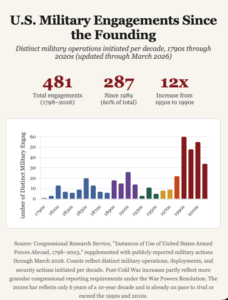 Overall, the United States has engaged in 481 total military engagements since 1798—287 of them since 1989 (60% of total). We’re only six years into the 2020s and it’s already at 34 and on pace to hit ~57 by decade’s end, which would make it the second-busiest decade in U.S. history behind the 1990s. U.S. servicemen have fought in 102 countries For those keeping score, here’s a list of more than 110 military conflicts since 1989:
- January 1989, Libya: Two U.S. Navy F-14s shot down two Libyan jet fighters over the Mediterranean after the Libyan planes showed hostile intent.
- May 1989, Panama: President George H.W. Bush deployed ~1,900 troops to Panama after General Manuel Noriega disregarded the results of the Panamanian election.
- September 1989, Colombia/Bolivia/Peru: The United States sent military advisers and Special Forces teams to Colombia, Bolivia, and Peru to help combat drug producers and traffickers.
- December 1989, Philippines: U.S. fighter planes from Clark Air Base helped the Corazon Aquino government repel a coup attempt, and one hundred marines were sent to protect the U.S. embassy in Manila.
- December 1989, Panama: President George H.W. Bush ordered a full-scale military invasion of Panama to protect American citizens and bring General Manuel Noriega to justice; all forces withdrew by February 1990.
- August 1990, Liberia: A reinforced rifle company was sent to secure the U.S. embassy in Monrovia and helicopters evacuated U.S. citizens from Liberia.
- August 1990, Saudi Arabia: President George H.W. Bush ordered a massive forward deployment of U.S. forces to the Persian Gulf to defend Saudi Arabia after Iraq’s invasion of Kuwait.
- January 1991, Iraq/Kuwait: U.S. forces commenced combat operations against Iraqi forces in Iraq and Kuwait under a United Nations coalition; combat was suspended on February 28, 1991.
- May 1991, Iraq: U.S. forces entered northern Iraq to provide emergency relief to Kurdish populations facing Iraqi government repression.
- September 1991, Zaire: U.S. Air Force transports carried Belgian and French troops into the region and evacuated American citizens after widespread looting and rioting in Kinshasa.
- May 1992, Sierra Leone: U.S. military planes evacuated Americans from Sierra Leone after a military coup overthrew the government.
- August 1992, Kuwait: The United States began military exercises in Kuwait following Iraqi refusal to recognize its new United Nations-drawn border and cooperate with U.N. weapons inspectors.
- September 1992, Iraq: President George H.W. Bush ordered U.S. participation in enforcing a no-fly zone over southern Iraq and aerial reconnaissance to monitor Iraqi cease-fire compliance.
- December 1992, Somalia: President George H.W. Bush deployed U.S. forces to Somalia as part of an American-led United Nations task force to address a crisis the Security Council deemed a threat to international peace.
- January 1993, Iraq: U.S. aircraft shot down an Iraqi plane in the no-fly zone, and coalition forces attacked missile bases in southern Iraq in multiple strikes through mid-January.
- January 1993, Iraq: President Bill Clinton continued the Bush policy on Iraq, with U.S. aircraft firing at Iraqi targets after sensing radar or anti-aircraft threats directed at them.
- February 1993, Bosnia: The United States began airdropping relief supplies to Muslims surrounded by Serbian forces in Bosnia.
- April 1993, Bosnia: U.S. forces joined a NATO operation to enforce a United Nations ban on unauthorized military flights over Bosnia-Herzegovina.
- April-May 1993, Iraq: U.S. planes bombed or fired missiles at Iraqi anti-aircraft sites that had tracked U.S. aircraft enforcing the no-fly zones.
- June 1993, Somalia: The U.S. Quick Reaction Force participated in military action against a Somali factional leader who attacked United Nations forces, with continued air and ground operations through the following months.
- June 1993, Iraq: U.S. naval forces launched cruise missiles against Iraqi Intelligence headquarters in Baghdad in retaliation for an alleged assassination attempt on former President George H.W. Bush.
- July-August 1993, Iraq: U.S. aircraft fired missiles at Iraqi anti-aircraft sites and bombed an Iraqi missile battery displaying hostile intent.
- July 1993, Macedonia: 350 U.S. soldiers deployed to the Former Yugoslav Republic of Macedonia as part of a United Nations force to maintain stability in the former Yugoslavia.
- October 1993, Haiti: U.S. ships began enforcing a United Nations embargo against Haiti.
- February 1994, Bosnia: The United States expanded its participation in United Nations and NATO efforts in former Yugoslavia, with sixty aircraft available for NATO missions.
- March 1994, Bosnia: U.S. planes patrolling the no-fly zone shot down four Serbian Galeb planes.
- April 1994, Bosnia: U.S. warplanes under NATO command fired on Bosnian Serb forces shelling the United Nations safe city of Gorazde.
- April 1994, Rwanda: Combat-equipped U.S. forces deployed to Burundi to conduct potential evacuation of American citizens from Rwanda amid widespread fighting.
- April 1994, Haiti: U.S. naval forces continued enforcing the United Nations embargo around Haiti, having boarded 712 vessels since October 1993.
- August 1994, Bosnia: U.S. aircraft under NATO attacked Bosnian Serb heavy weapons in the Sarajevo exclusion zone at the request of United Nations forces.
- September 1994, Haiti: President Bill Clinton deployed 1,500 troops to Haiti to restore democracy, later increasing to 20,000.
- November 1994, Bosnia: U.S. combat aircraft under NATO attacked Serb bases used to assault the Bosnian town of Bihac.
- March 1995, Somalia: 1,800 combat-equipped U.S. forces deployed to Mogadishu to assist in withdrawing United Nations forces from Somalia.
- May 1995, Bosnia: U.S. fighter aircraft continued enforcing the no-fly zone over Bosnia, with ~500 troops deployed in the Former Yugoslav Republic of Macedonia as part of United Nations peacekeeping.
- September 1995, Bosnia: U.S. aircraft participated in major NATO air strikes against Bosnian Serb forces threatening United Nations safe areas, flying roughly three hundred sorties on the first day alone.
- December 1995, Bosnia: President Bill Clinton ordered ~20,000 U.S. troops to Bosnia as part of NATO’s Implementation Force to enforce the Dayton peace agreement, with ~12,000 more in support roles across the region.
- April 1996, Liberia: U.S. military forces evacuated American and third-country nationals from Liberia after security deteriorated, and responded to attacks on the embassy compound.
- May 1996, Central African Republic: U.S. forces deployed to Bangui to evacuate American citizens and government employees and secure the U.S. embassy.
- December 1996, Bosnia: President Bill Clinton authorized ~8,500 U.S. troops to participate in NATO’s Stabilization Force (SFOR) follow-on force in Bosnia to deter resumption of hostilities.
- March 1997, Albania: U.S. forces evacuated government employees and citizens from Tirana, Albania, and enhanced embassy security amid civil unrest.
- March 1997, Congo/Gabon: A standby evacuation force deployed to Congo and Gabon to provide security for Americans and prepare for possible evacuation from Zaire.
- May 1997, Sierra Leone: U.S. military personnel deployed to Freetown to evacuate U.S. government employees and citizens.
- July 1997, Cambodia: ~550 U.S. military personnel deployed to Thailand for possible emergency evacuation of American citizens from Cambodia during civil conflict.
- June 1998, Guinea-Bissau: A standby evacuation force deployed to Senegal to evacuate Americans from Guinea-Bissau after an army mutiny endangered the U.S. embassy.
- August 1998, Kenya/Tanzania: U.S. military personnel deployed to Nairobi and Dar es Salaam to provide disaster assistance and enhanced security after terrorist bombings of both U.S. embassies.
- August 1998, Albania: Two hundred marines and ten Navy SEALs deployed to the U.S. embassy in Tirana to enhance security against reported threats.
- August 1998, Afghanistan/Sudan: President Bill Clinton authorized airstrikes against Osama bin Laden’s camps in Afghanistan and facilities in Sudan in response to the embassy bombings in Kenya and Tanzania.
- September 1998, Liberia: Thirty U.S. military personnel deployed to augment embassy security in Monrovia and provide evacuation capability amid political instability.
- December 1998, Iraq: The United States and United Kingdom conducted Operation Desert Fox, a bombing campaign against Iraqi facilities deemed capable of producing weapons of mass destruction (WMDs) and other military targets.
- 1998-2001, Iraq: American and coalition forces conducted ongoing military operations against the Iraqi air defense system in response to threats against aircraft enforcing the northern and southern no-fly zones.
- March 1999, Yugoslavia: U.S. forces, in coalition with NATO, commenced air strikes against Yugoslavia in response to its campaign of violence and repression against ethnic Albanians in Kosovo.
- April 1999, Albania: President Bill Clinton ordered ~2,500 additional troops and heavy weapons to Albania to enhance NATO’s air operations against Yugoslavia.
- May 1999, Yugoslavia: Additional U.S. aircraft and several thousand more personnel deployed to support NATO’s ongoing operations against Yugoslavia.
- June 1999, Kosovo: ~7,000 U.S. troops deployed as part of the ~50,000-member NATO-led security force (KFOR) in Kosovo after the end of the air campaign.
- October 1999, East Timor: U.S. military forces deployed to support a United Nations multinational force aimed at restoring peace to East Timor, including the USS Belleau Wood and marines.
- October 2000, Yemen: After a terrorist attack on the USS Cole in Aden, U.S. military security and disaster response personnel deployed to secure the ship and respond to the incident.
- September 2001, Global: Following the 9/11 attacks, President George W. Bush ordered combat-equipped forces to multiple nations in the Central and Pacific Command areas to prevent and deter terrorism.
- October 2001, Afghanistan: U.S. forces began combat operations against al-Qaida and the Taliban in direct response to the September 11 attacks.
- September 2002, Cote d’Ivoire: U.S. military personnel entered Cote d’Ivoire to evacuate American citizens and third-country nationals from the city of Bouake during a rebellion.
- 2002, Philippines: ~600 combat-equipped U.S. personnel deployed to the Philippines to train, advise, and assist Filipino forces in enhancing counterterrorism capabilities.
- 2002, Georgia/Yemen: U.S. combat-equipped forces deployed to Georgia and Yemen to help enhance the counterterrorism capabilities of their armed forces.
- March 2003, Iraq: President George W. Bush directed U.S. forces to commence combat operations against Iraq on March 19 as part of a coalition to disarm Iraq, launching a war whose duration was unknown at the time.
- June 2003, Liberia/Mauritania: Roughly thirty-five combat-equipped troops deployed to Monrovia to augment embassy security and enable possible evacuation, with additional forces sent to Mauritania.
- August 2003, Liberia: ~4,350 combat-equipped U.S. personnel entered Liberian waters to support United Nations and West African efforts to restore order in Liberia.
- 2003-ongoing, Djibouti: American combat-equipped and support forces deployed to Djibouti to enhance counterterrorism capabilities and support operations against international terrorists in the Horn of Africa.
- February 2004, Haiti: Roughly fifty-five combat-equipped troops deployed to Port-au-Prince to augment embassy security during an armed rebellion.
- March 2004, Haiti: Roughly two hundred additional combat-equipped troops deployed to Haiti to prepare for a United Nations Multinational Interim Force, eventually growing to ~1,800 personnel.
- 2004-2005, Iraq: The United States maintained over 135,000 troops in Iraq as part of the Multinational Force, rising to ~160,000 by late 2005.
- July 2006, Lebanon: Combat-equipped helicopters and military personnel deployed to Beirut to evacuate American citizens and designated personnel during the security crisis.
- 2007-ongoing, Somalia: The U.S. military took direct action against members of al-Qaida and al-Shabaab engaged in planning terrorist attacks against the United States.
- 2007-2011, Afghanistan: U.S. forces grew from ~25,900 to a peak of ~99,000, pursuing al-Qaida and Taliban fighters as part of both ISAF and separate U.S. operations.
- 2009-ongoing, Yemen: The U.S. military worked with the Yemeni government to eliminate the threat from al-Qaida in the Arabian Peninsula (AQAP), resulting in direct action against operatives and senior leaders.
- March 2011, Libya: U.S. military forces launched strikes against Libyan air defenses and military targets to enforce a United Nations-authorized no-fly zone and protect civilians from Gaddafi’s forces.
- April-October 2011, Libya: After transferring lead to NATO, U.S. support continued with intelligence, logistics, and unmanned aerial vehicle strikes against defined targets until the mission ended in October.
- October 2011, Central Africa: Roughly one hundred combat-equipped U.S. forces deployed to Uganda, South Sudan, the Central African Republic, and the Democratic Republic of the Congo (DRC) to advise regional forces working to remove Lord’s Resistance Army (LRA) leader Joseph Kony.
- January 2012, Somalia: U.S. Special Operations Forces conducted a rescue operation in Somalia, freeing kidnapped American Jessica Buchanan and Danish national Poul Hagen Thisted.
- September 2012, Libya/Yemen: Combat-equipped security forces deployed to Libya and Yemen after the attack on the U.S. diplomatic post in Benghazi that killed Ambassador Christopher Stevens and three other Americans.
- February 2013, Niger: Roughly one hundred U.S. military personnel deployed to Niger with weapons for force protection to support intelligence collection and share intelligence with French forces operating in Mali.
- April-June 2013, Jordan: Up to seven hundred combat-equipped U.S. troops deployed to Jordan for training exercises and remained at the request of the Jordanian government amid the Syrian Civil War.
- December 2013, South Sudan: U.S. forces evacuated embassy personnel from Juba, and a follow-on evacuation mission near Bor was curtailed after the aircraft came under fire.
- June 2014, Iraq: President Obama deployed 300 military advisers to Iraq to assess and counter the threat from ISIL, with subsequent deployments growing to over 5,200 by late 2014.
- August 2014, Ukraine: A dozen U.S. troops from European Command deployed to Kiev to help investigate the downing of Malaysian airliner MH17 that killed 298 people.
- August 2014, Poland: Six hundred soldiers deployed to Poland as part of Operation Atlantic Resolve to reassure NATO allies in response to Russia’s intervention in Ukraine.
- October 2015, Cameroon: Roughly three hundred U.S. military personnel deployed to Cameroon to conduct airborne ISR operations against the Islamist militant group Boko Haram.
- June-September 2016, Iraq: An additional 1,160 U.S. troops deployed to Iraq to assist in the fight against ISIL, including preparation for the offensive to retake Mosul.
- July 2016, South Sudan: Up to two hundred combat-equipped U.S. forces prepositioned in Uganda and deployed to protect the U.S. embassy after deadly fighting erupted in Juba.
- October 2016, Yemen: U.S. forces conducted missile strikes on Houthi-controlled radar facilities in Yemen after threats to U.S. naval vessels, destroying the targets.
- January 2017, Europe: 3,500 soldiers with tanks and heavy equipment from the 4th Infantry Division deployed to Poland, marking the start of continuous armored brigade rotations in Europe.
- March 2017, Syria: Roughly four hundred Marines and Army rangers deployed to Syria to assist in the fight against the Islamic State.
- October 2017, Niger: Four U.S. servicemembers were killed and two wounded during an advise-and-assist mission in Niger when their patrol was ambushed.
- December 2017, Iraq/Syria: The Pentagon reported 5,200 U.S. troops in Iraq and 2,000 in Syria, with numbers trending down as the fight against ISIS progressed.
- April 2018, Syria: President Donald Trump directed American, French, and British forces to strike Syrian chemical weapons research, development, and production facilities.
- February 2018, Afghanistan: The U.S. Army’s first Security Force Assistance Brigade deployed to Afghanistan to train and advise Afghan National Security Forces.
- September 2019, Saudi Arabia: Roughly two hundred U.S. support personnel with Patriot batteries and Sentinel radars deployed to augment air and missile defenses after attacks on Saudi oil facilities.
- May-June 2019, Middle East: The United States deployed ~14,000 additional forces to the CENTCOM area, including carrier strike groups, Patriot batteries, and additional troops in response to escalating tensions with Iran.
- December 2019, Baghdad: Roughly one hundred marines deployed to reinforce security at the U.S. embassy after it was attacked, followed by ~750 troops from the 82nd Airborne as an Immediate Response Force.
- January 2020, Kuwait: An additional 2,800 troops from the 82nd Airborne deployed to Kuwait, bringing the total rapid deployment to ~3,500 in response to the Baghdad embassy attack and regional tensions.
- February 2020, Africa: The U.S. Army’s 1st Security Force Assistance Brigade deployed to Africa to train and assist African forces and better compete with Russia and China.
- 2019-2020, Syria: After President Donald Trump announced a full withdrawal from Syria in December 2018, the United States reversed course and maintained roughly four hundred troops in the country.
- February 2022, Romania/Poland/Germany: Roughly three thousand troops deployed to Romania, Poland, and Germany as Russia built up forces on Ukraine’s border, eventually growing to over 100,000 U.S. personnel across Europe.
- March-September 2022, Europe: Successive waves of additional forces deployed across Europe including aerial refueling, air support, logistics, and combat units in response to Russia’s invasion of Ukraine.
- May 2022, Somalia: President Joe Biden authorized a small, persistent U.S. military presence in Somalia to advise and assist local forces, reversing the prior episodic deployment model.
- June 2022, Europe: President Joe Biden announced long-term force posture increases across Europe including additional destroyers in Spain, F-35s in the United Kingdom, a rotational brigade in Romania, and a permanent corps headquarters in Poland.
- April 2023, Sudan: U.S. forces evacuated roughly one hundred American personnel from the U.S. Embassy in Khartoum amid armed conflict, coordinating with allies including Djibouti, Ethiopia, and Saudi Arabia.
- October 2023–February 2024, Iraq/Syria: Iran-backed militias attacked American bases over sixty times; the United States conducted retaliatory strikes on IRGC-linked facilities in eastern Syria and Iraq.
- November 2023–ongoing, Red Sea/Yemen: Houthi rebels began attacking commercial shipping and U.S. naval vessels; the United states launched Operation Prosperity Guardian (a multinational naval coalition) in December 2023.
- January 2024–January 2025, Yemen: Operation Poseidon Archer—United States and United Kingdom conducted sustained air and cruise missile strikes against Houthi targets, totaling 774 airstrike events.
- April 2024, Israel/Iran defense: U.S. forces helped defend Israel during Iran’s first direct missile/drone attack.
- November 2024, Israel/Iran defense: United States again assisted Israel defending against a second Iranian attack.
- March–May 2025, Yemen: Operation Rough Rider—Trump escalated strikes significantly against Houthi bases, radar, air defenses, and launch sites. Ceasefire brokered by Oman in May.
- June 2025, Iran: U.S. forces struck Iranian nuclear sites and defended Israel during a third Iran-Israel conflict.
- September 2025–ongoing, Caribbean/Pacific: U.S. military began striking alleged drug trafficking boats using MQ-9 Reapers and AC-130 gunships—over thirty-two strikes killing over 115 people as of December 2025. USS Gerald R. Ford redeployed to Caribbean for Operation Southern Spear.
- December 2025, Nigeria: U.S. bombed ISIS targets in Sokoto state in coordination with the Nigerian government.
- Late 2025, Venezuela: Escalating maximum pressure campaign culminating in the reported capture of Maduro in January 2026.
- January–February 2026, Middle East buildup: Largest U.S. military buildup in the Middle East since the 2003 Iraq invasion.
- February 28, 2026, Iran: Operation Epic Fury launched — joint American-Israeli strikes hitting 1,700+ targets in seventy-two hours, targeting nuclear facilities, missile sites, navy, and regime leadership. Forty-eight senior Iranian leaders killed. Seven U.S. service members killed in retaliatory strikes.