As outrageous as the comportment of the current U.S. president may be to many people throughout the world, there is a silver lining to Donald Trump’s endless series of threats, whether overt or implied, against the citizens of Canada, Venezuela, Greenland, Iran, Colombia, Cuba, and beyond. In a matter of months, Trump has succeeded in revealing what many antiwar critics have been pointing out for years. The fact that plausible moral pretexts for military intervention can be devised and disseminated through the use of persuasive rhetoric—state-promulgated propaganda—in no way demonstrates that war has thus somehow been rendered “just”.
Much of the populace may have been fooled, as happened in the case of President George H.W. Bush’s 1991 war on Iraq (Operation Desert Storm), but that does not mean or in any way imply that the stated casus belli had anything whatsoever to do with why the military was ordered by the president to intervene. The fact that many members of the U.S. congress failed to condemn, and some even condoned, Trump’s surprise attacks on both Venezuela, where he abducted the president, and Iran, where he waged a full-scale war (along with Israel) and eliminated Supreme Leader Khamenei, in addition to many other people, simply underscores how easy it is for a U.S. president to get away with the moral equivalent of murder.
Since the 1991 Gulf War, whenever critics have pointed out that the U.S. government seems “curiously enough” to concern itself primarily with resource-rich countries, deep state regime supporters have retorted that such “theories” are mere conspiracies. Trump caught everyone—“conspiracy theorists” and regime supporters alike—off guard by openly averring that the real reason for taking over Venezuela by force was in fact to gain and control access to their oil. In threatening to annex Greenland, by hook or by crook, Trump’s claim has only been that “We need Greenland!” Obviously, “I need that toy!” or “I need that car!” or “We need that country!” is a statement of neither ownership nor rights. It is the expression of a desire by a person who may or may not have any claim on the property in question. A bank robber may believe that he deserves the contents of a safe holding millions of dollars, but unless he manages to pull off a masterful heist, it will never be his.
Advocates of Realpolitik, who unequivocally reject the notion of a “just” or “moral” war, have always maintained that “might makes right,” that, at least in matters of foreign policy, the strongest party inevitably prevails, and then gets to write the history of what transpired. Most realists about war are not nearly so open about their views as is Deputy Chief of Staff for Policy Stephen Miller: “We live in a world, in the real world…that is governed by strength, that is governed by force, that is governed by power.” Typically, political leaders and their delegates brandish the same tropes deployed by “just war” theorists, who differ primarily in sincerity, at least in those cases where they truly believe in the possibility of a just war. Only through a close historical examination, by peeling away the layers of carefully crafted propaganda used to rationalize military intervention, can the closet realist tendencies of political leaders be seen.
Before the Trump era, the “just war” theory list of bullet-pointed jus ad bellum and jus in bello requirements was recited by realists and just war theorists alike in rationalizing to the populace the use of state-perpetrated mass homicide: legitimate authority, just cause, last resort, proportionality, etc. The first “just war theory” casualty of the Drone Age, under President Barack Obama, was the concept of last resort, which never constrained any leader but even as a rhetorical trope appears by now to have been completely abandoned. The serial bombing of small boats off the coast of Venezuela on the pretext that they have been attempting to transport drugs to the United States is a case in point, given that the same boats could obviously be stopped at the terminus of their journey rather than obliterated in the middle of a vast body of water, where they are not immediately threatening anyone, because there is no one present to harm. Even more spectacular was Trump’s abrupt abandonment of negotiations underway to wage war on Iran and “take out” the leadership of that land.
Legitimate authority has been one of the less-questioned constraints on what have historically been regarded as just wars, but President Trump’s astonishing use of military force in both Venezuela and Iran has caused many people to reflect upon how preposterous it is that a single man should have the power to upend the lives of people all over the world. Why should it be that an elected official in one country should possess the power to control or even end the lives of people living in entirely different places, when those people never appointed him their leader? The truth in “American Exceptionalism” is that the U.S. government has indeed been permitted since World War II to invade and plunder countries, provided only that some sort of high-minded pretext, a so-called just cause, has been proffered to the taxpaying public.
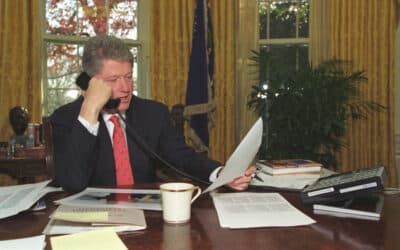
President George H.W. Bush refused to negotiate with Saddam Hussein in 1991 during Iraq’s border dispute with Kuwait, opting instead to mobilize the U.S. military. Serbian President Slobodan Milosevic was committing war crimes against the Kosovars, insisted President Bill Clinton in the midst of a domestic “blue dress” scandal before bombing Belgrade. The Taliban had given shelter to mortal enemies Al Qaeda before September 11, 2001, asserted President George W. Bush before waging a war on Afghanistan. Saddam Hussein had a program for the development of weapons of mass destruction and was in cahoots with Osama bin Laden, argued the Bush Jr. administration before attacking Baghdad. Moammar Gaddaffi was planning a genocide, calmly explained President Obama before undertaking, along with NATO, a bombing campaign to “liberate” the Libyan people. And so on. In waging war on Iran, President Trump’s exceptional pretext appears to have been that he had “a feeling,” informed not only by cabinet advisers such as Secretary of War Pete Hegseth, but also Trump’s son-in-law, Jared Kushner, that Iran might be preparing to target the United States. This despite Trump’s having claimed to have completely “obliterated” Iran’s nuclear program only months before, in yet another abrupt attack.
On occasion, some of the governments of the world have disagreed with the claims of U.S. leaders that war had become necessary, but the wars proceeded unimpeded because enough of the rest of the world had capitulated and so few foreign leaders dared to demur. All it has ever taken to override niceties such as the written letter of the United Nations Charter or the Universal Declaration of Human Rights, or even the Geneva Conventions, was a “coalition of the willing,” a group of politicians who agree to agree, whether on substantive or pragmatic (opportunistic) grounds. After Trump’s second major assault on Iran, some of the usual suspects, including Britain’s Prime Minister Keir Starmer, decided to stand with the U.S. government, despite the fact that they would have expressed reservations, had they been asked in advance what should be done.
There has been quite a bit more resistance among foreign officials to President Trump’s repeatedly asserted desire to annex entire sovereign nations, including both Canada and Greenland, which has now to be taken seriously, given his unexpectedly bold actions in Venezuela and Iran. In attempting to persuade his supporters that there is a MAGA pretext for his coveted Greenland acquisition, President Trump has asserted (without evidence) that if the United States does not move in, then either China or Russia will. It has become clear by now that the military industry lobbyists who sold Trump the glittering “Golden Dome” initiative (a reimagined Reagan-era star wars program for the twenty-first century) have also persuaded him to believe that control over Greenland is key to the project’s success.
That rival powers will “move in” on Greenland if the United States does not is a line of reasoning which could be used to rationalize all manner of interventionist mischief, and in fact was a familiar trope, mutatis mutandis, throughout the Cold War. Indeed, the primary justification offered for the protracted U.S. military presence in Vietnam was none other than that, if Vietnam fell to the evil Communists, then the rest of the world would follow. This “domino theory” rhetoric was so effective that the governments of some countries, including Australia, agreed to sacrifice some of their own soldiers to help the U.S. military to stop what were said at the time to be the inexorable Communists. The domino theory was refuted upon the fall of Saigon, and yet the same “If we don’t do it, then they will,” logic has been resurrected and indelibly impressed upon Trump’s mind to the point where he often seems quite sincerely to believe that he has no choice but to acquire Greenland: “We are going to do something on Greenland, whether they like it or not.”
To insist that a plot of land is strategically important and then to take it by force has needless to say transpired throughout human history as the maps of the world have been drawn and redrawn. Since the end of World War II, however, governments of the world have generally acquiesced to the status quo demarcation of territories and agreed to attempt to cohabit the planet peacefully as it is currently carved up. What this has meant in reality is that the government of the United States has been the only one permitted repeatedly to intervene to overthrow recalcitrant leaders—those who do not bow to U.S. demands—and foment uprisings with the avowed aim of “spreading democracy” and removing U.S.-hostile dictators from power.
After decades of much of the world’s docile compliance with the U.S. superpower, Trump’s effective transformation of the U.S. hegemon into an amoeba-like blob prepared to absorb entire land masses—from Gaza to Venezuela to Iran to Cuba to Canada to Greenland—has been a cause for pause. As Canadian Prime Minister Mark Carney so succinctly put it: “If you’re not at the table, you’re on the menu.” Here, too, Trump has unwittingly shed light on a basic feature of reality which people are inclined to forget. States are artifacts, created by groups of persons who draw borders and draft rules for living in that space.
A confusion arises in conflating states with persons, as though they had a right to exist. But states are not moral persons because they lack every right-conferring characteristic possessed by human beings. States are artifacts, altogether devoid of capacities such as reason and invulnerable to pain. Any group of people could create a new state, or cleave off (secede) to bifurcate a state into two. To say that the head of a state has the right to kill people—even many people—in virtue of his political status would imply (assuming that premeditated, intentional homicide is wrong) that the same person both possesses and does not possess the right to murder with impunity. And yet, centuries of habits of thought die hard, which is how we have arrived at a place where the president of the United States, whoever he may be, is permitted to act on his “feelings” in opting to destroy the lives of many human beings located far from U.S. shores, even when they pose no direct and immediate threat to any U.S. citizen.
As a brash nationalist, Trump embraces the U.S. state as somehow sacred while denying that any other place, save Israel, possesses the same sanctity. But given that Trump has encircled himself with “Yes” men and women, who lavish praise on every idea which pops randomly up in his mind—or is inserted by someone else (as is plausible in the cases of Venezuela, Iran, and Greenland)—who is going to stop him, and how? The “Make America Great Again” movement has transmogrified into a push for global hegemony on an entirely new level, and it is difficult to see how all of this could end except in a World War at the culmination of which territorial lines may indeed be redrawn.