
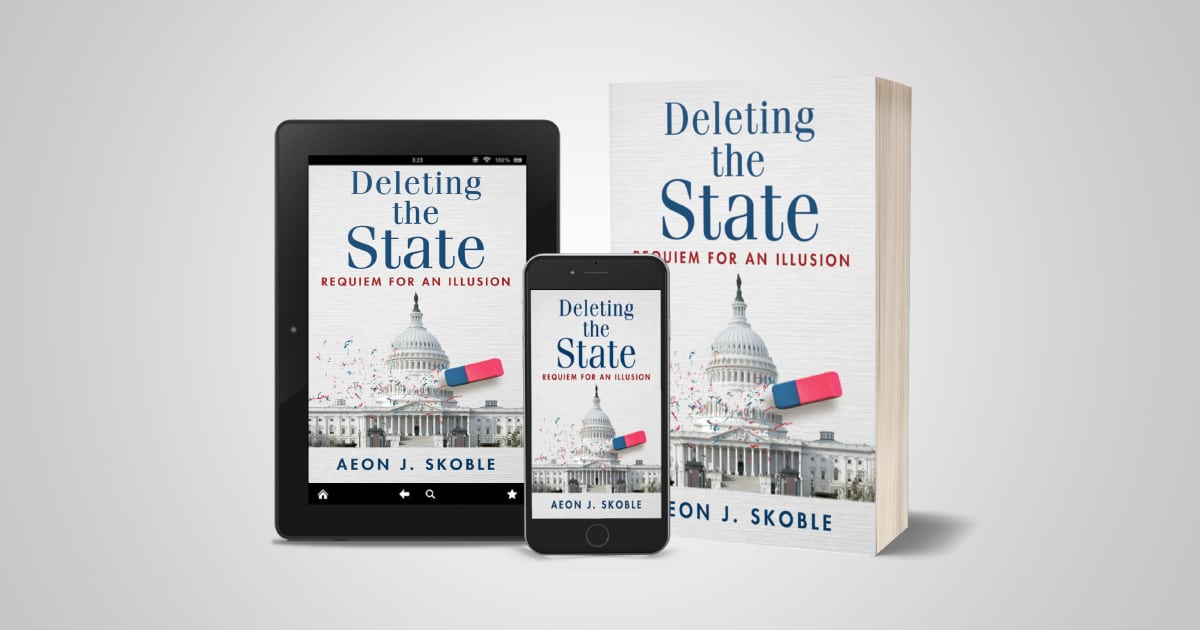
In 2008, a book appeared called Deleting the State: An Argument About Government. It was a trim volume, barely a hundred pages of actual text, but it hit me with the force of a hundred pounds from the very first page. As an undergraduate political science student, I had by that point read Robert Nozick, but I had yet to encounter Murray Rothbard or the broader Austrian and anarcho-capitalist tradition. Aeon Skoble’s book was therefore the first work I encountered that seriously challenged the legitimacy of the state itself. Now the Independent Institute has done a new generation of readers a service by issuing a second edition of this compact but provocative anarcho-capitalist work.
Skoble, Bartlett Chair in Free Speech and Expression at Bridgewater State University, frequent contributor to FEE, and Fellow at the Fraser Institute, begins his argument without hesitation. “Centralized, coercive political authority—the State—is not necessary.” From the very beginning, he presses the claim that even the minimal-state version of libertarianism ultimately fails to justify the institution it seeks to preserve. Minimal-state libertarians argue that the state is required to perform certain essential functions, typically the protection of rights through police, courts, and national defense. But Skoble rightly insists that this position is internally inconsistent. The same principles that lead libertarians to oppose most forms of state coercion, he argues, also undermine the legitimacy of the minimal state.
To see why, Skoble first clarifies what he means by “the state.” The state is not simply a set of useful institutions for organizing social cooperation. Rather, it is an institution that claims a monopoly on the legitimate use of force within a given territory. That monopoly allows it to compel obedience and extract resources in ways that would be considered criminal if performed by private individuals. Libertarians typically object to coercion because it violates individual rights. Yet the minimal-state position effectively grants an exemption for one institution to do precisely what libertarian principles condemn when done by anyone else.
From there Skoble examines the standard arguments offered in defense of political authority. One of the most common is the “public goods” argument: certain essential services, particularly defense and dispute resolution, are supposedly impossible to provide through voluntary arrangements. According to this familiar but mistaken view, the state exists because markets would fail to provide these goods efficiently. Skoble challenges this assumption perfectly, arguing that historical and theoretical examples illustrate that voluntary institutions can and often do provide many of the services typically associated with government. For example, insurance mechanisms, private arbitration, and competitive security arrangements offer possible models for organizing protection and dispute resolution without centralized coercion.
Of necessity, Skoble engages the social contract tradition, which claims that political authority arises from implicit or hypothetical consent. Like Rothbard in his initial response to Nozick, Skoble points out that this line of reasoning fails to establish genuine legitimacy. Consent that cannot be withheld without penalty is not meaningful consent. If individuals are born into a system that asserts authority over them without their explicit agreement, and if exit from that system is difficult or costly, the claim that such authority rests on voluntary consent becomes tenuous.
Throughout the book, Skoble returns to a simple but powerful framework: if we take seriously the liberal commitments that most defenders of the minimal state share, namely that individuals possess rights, that persons are moral equals, and that coercion requires strong justification, then the burden of proof rests squarely on those who defend centralized political authority. And when those principles are applied consistently, the case for even a minimal state becomes impossible to sustain.
In essence, Skoble takes the core principles of classical liberalism, individual rights, moral equality, the requirement that authority be justified, and the belief that institutions should promote peace and prosperity, and shows that centralized political authority struggles to meet those standards. If peaceful cooperation and dispute resolution can emerge from voluntary arrangements, the moral case for a coercive monopoly begins to dissolve.
As far as the second edition is concerned, the core text remains largely unchanged. The additions consist primarily of a new preface and conclusion. The latter will be of particular interest to readers already familiar with debates within libertarian political theory; for it is there that Skoble addresses criticisms raised by several prominent philosophers, including David Gordon, Jan Narveson, William Everdell, and Stephen Kershnar. These critics press questions about enforcement, coordination, and the potential instability of anarchic legal systems. Skoble’s response is characteristically measured. While acknowledging the challenges involved, he maintains that the objections fail to demonstrate that coercive political authority is necessary. The mere possibility of institutional difficulties does not establish that the state offers a morally preferable alternative.
What makes Deleting the State particularly compelling is its clarity. Skoble does not attempt to overwhelm the reader with technical argument or abstract theorizing. Instead, he presents a concise and accessible case for reconsidering one of the most fundamental assumptions of modern political life: that the state is both inevitable and necessary. In doing so, he invites readers, libertarian and non-libertarian alike, to revisit the basic question that underlies all political theory: why should anyone have the authority to rule others?