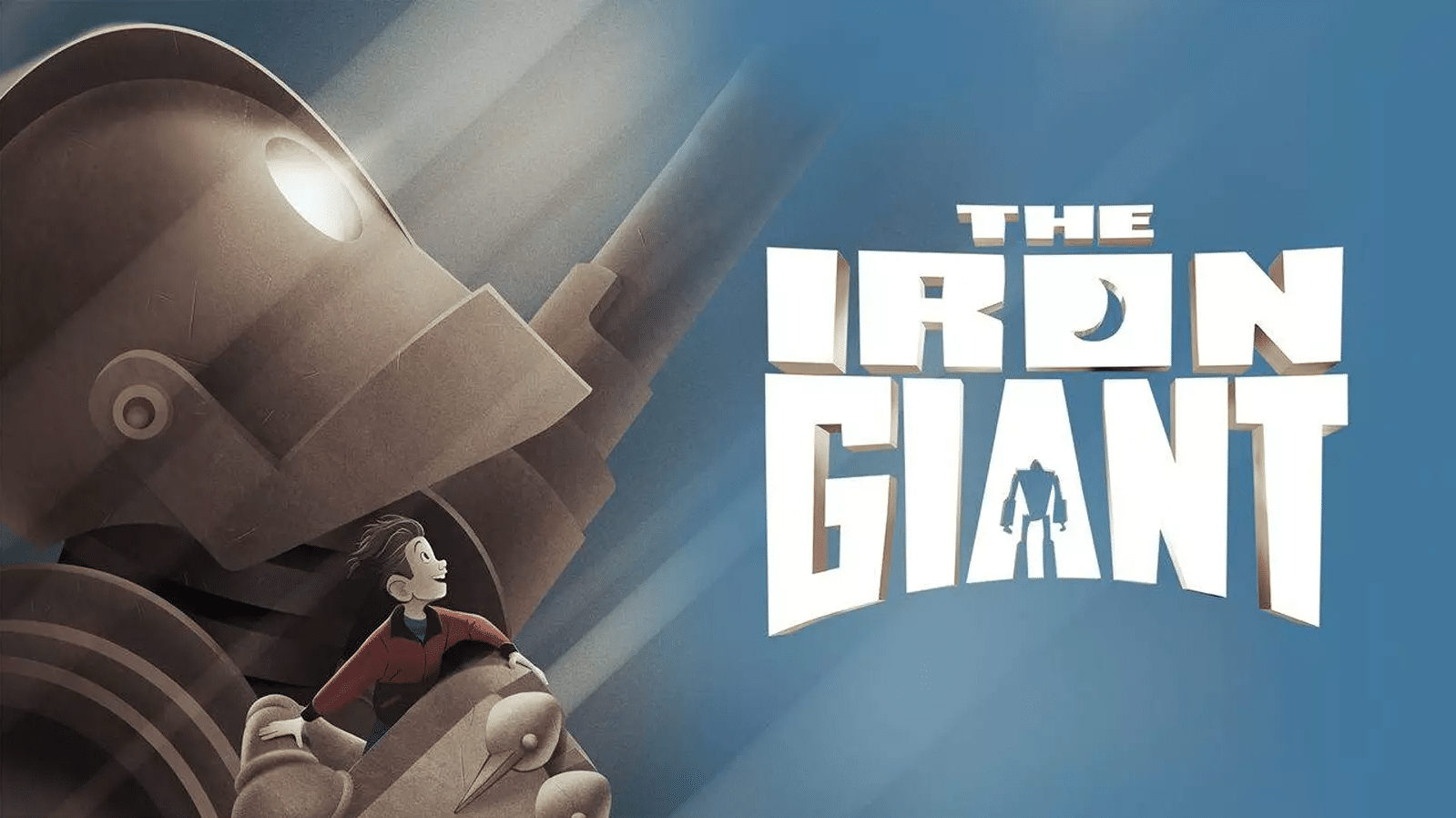
Among the films that formed my childhood, the Iron Giant is a black sheep.
From its loving treatment of classic sci-fi horror to its somber handling of nuclear holocaust, the film is deeper than any of us realized as kids.
Of course now, as adults, and especially as we share our favorite films with our own children, we’re picking up on more of these themes.
For example, in context, the film’s tagline: “we are who we choose to be” is a surprisingly mature take on generational militarism and institutionalized violence.
Waking from the haze of his forgotten past, the Iron Giant crash lands on planet Earth. With his memory seemingly erased, he must reinvent himself. As he romps around the coast of Maine, he encounters a young boy named Hogarth Hughes.
Hogarth is the latchkey kid of a struggling single mother. Through visual clues, we learn that Hogarth’s father was a pilot in the US Air Force. We don’t know exactly what happened to his father, but he can infer that he died.
By his interests, we can tell that Hogarth idolizes his father. Despite this, Hogarth is a dreamer who does not fit in with his macho all-American peers.
One night, Hogarth saves the Iron Giant from an electric shock at a power sub-station. Hogarth adopts the robot and, with help from Dean, a small-town eccentric, the trio of outcasts teach each other how to forge their own paths in life.
Hogarth comes to know the Iron Giant as a gentle machine with a good heart—its programming damaged in the crash landing and presumed years of space travel. As the story progresses, we realize that the locals’ fear of the machine is justified. It’s latent programming makes it a machine of mass death.
The struggle between the trio’s latent programming and their conscious dreams and desires forms the crux of the conflict in this gem of a film.
We should have learned from it.
In 1999, the Cold War had been over for almost a decade. The US stood in its claimed “Unipolar Moment.” The character of the Iron Giant parallels that moment.
As a nation, we had a chance to redefine ourselves. To herald an age of unparalleled prosperity and cooperation between former enemies. To bask in the hard-fought triumph over the old world.
Instead, we’ve succumbed to our latent programming. Drunk off former glory, we’ve chosen the left hand path, a demand of complete submission to our “rules based order.”
The only lesson, then, that we can yet heed from this film, is personal. How do we overcome the trauma of growing up in this society?
I suppose that’s for us to decide.
This blog post appeared first on Patrick MacFarlane’s email newsletter. Sign up for free here.