The recent ceasefire between Israel and Iran may have paused the most intense phase of direct military confrontation, but it has done nothing to resolve the deeper questions about Middle Eastern stability that have emerged since October 7, 2023. Behind the temporary calm lies a profound transformation in Israeli strategic thinking, one that has moved from containment to active regional reorganization.
Israel is not a normal democracy that abides by the rule of law or legal restraint. It is very much an expansionist state with bold ambitions and a demonstrated willingness to break international law. The events of the past two years have made this reality impossible to ignore.
The “Greater Israel” project, a term that has carried two primary meanings over the decades, has moved from the ideological fringe into the governing coalition of Israeli politics. In its narrower, post-1967 usage, “Greater Israel” referred to Israeli sovereignty over the West Bank, Gaza Strip, and Golan Heights. In its maximalist, biblicist form, drawn from Genesis 15:18, it invokes the territory stretching “from the river of Egypt unto the great river, the river Euphrates,” a vast area encompassing parts of modern Jordan, Syria, Lebanon, and potentially reaching into Iraq.
Once confined to religious nationalists and settler ideologues, this expansionist vision now sits at the cabinet table. Finance Minister Bezalel Smotrich has called for Israel to “expand to Damascus,” displayed a map showing Jordan as part of Israel at a 2023 speech in Paris, and settler leader Daniella Weiss has publicly stated that “the real borders of Greater Israel are the Euphrates and the Nile.”
Netanyahu’s coalition agreement explicitly declares that “Jewish people have an exclusive and indisputable right to all parts of the Land of Israel” and that “the government will promote and develop settlements in all parts of the Land of Israel.” As Al Jazeera reported in February 2026, figures like Smotrich and Ben Gvir, once regarded as outside the mainstream, “are now in government, reflecting a wider radicalisation within Israeli society itself.”
Perhaps most striking is that this rhetoric is no longer confined to the religious right. Opposition leader Yair Lapid, an ostensibly secular figure, stated in February 2026 that he supports “anything that will allow the Jews a large, broad, strong land,” adding that “the borders are the borders of the Bible.” When even centrist politicians invoke biblical mandates to justify territorial expansion, the ideological transformation becomes undeniable.
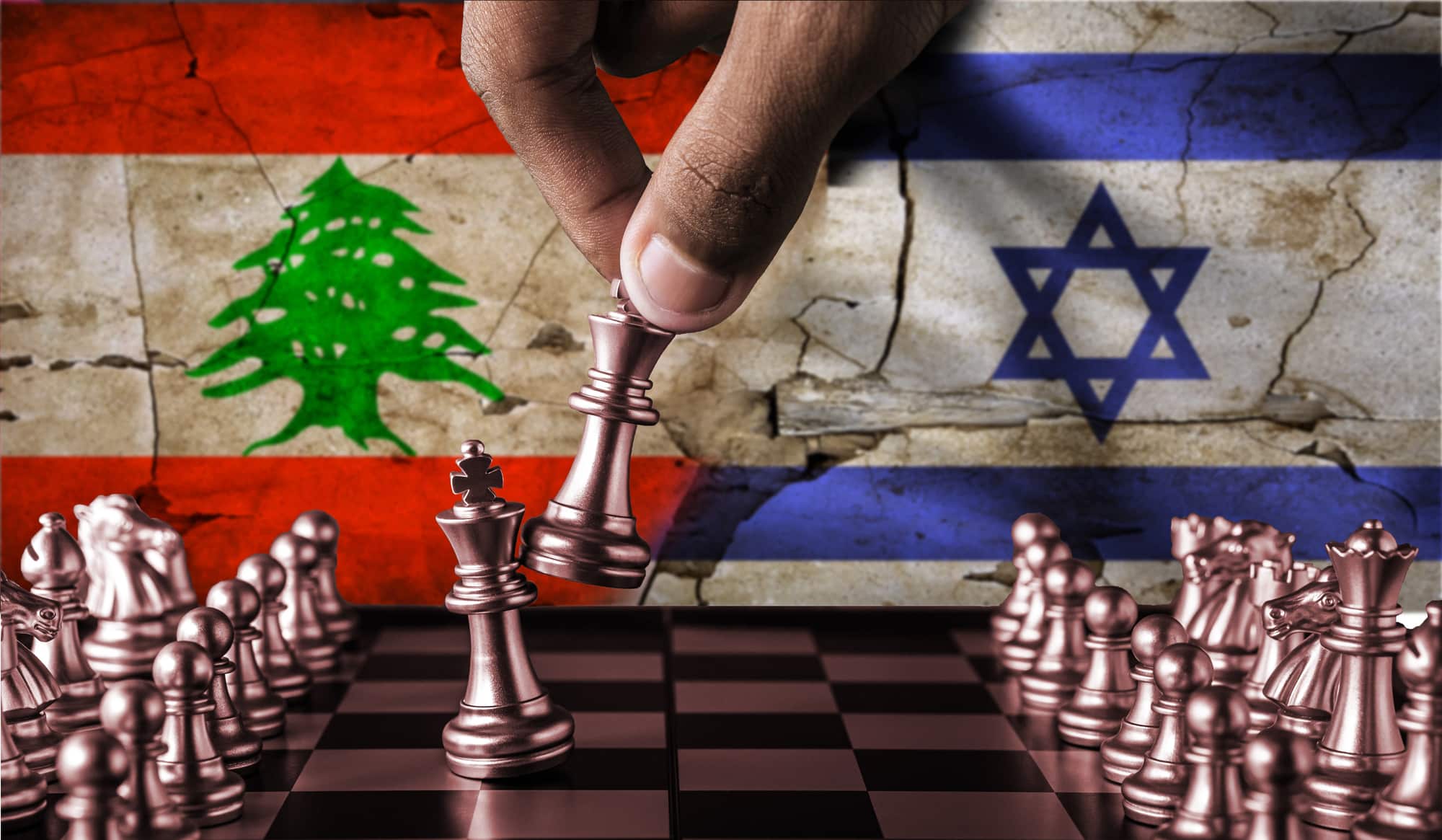
The conflict with Hezbollah has catalyzed a significant shift in Israeli policy regarding Lebanon’s territorial integrity. The previous doctrine of containing Hezbollah has given way to explicit calls from senior Israeli officials for the permanent occupation and annexation of territory up to the Litani River, approximately thirty kilometers north of the current border.
Smotrich has repeatedly asserted that the military campaign in Lebanon must result in a “change of Israel’s borders.” On March 23, 2026, he told an Israeli radio program that the campaign “needs to end with a different reality entirely, both with the Hezbollah decision but also with the change of Israel’s borders.” He then declared at a Knesset faction meeting that “the Litani must be our new border with the state of Lebanon, just like the Yellow Line in Gaza and like the buffer zone and peak of the Hermon in Syria,” adding, “I say here definitively, in every room and in every discussion, too.” Al Jazeera reported that these were “the most explicit” statements by a senior Israeli official on seizing Lebanese territory since the current military operations began.
Defense Minister Israel Katz has adopted a complementary posture. He announced at the end of March that the IDF will maintain “security control over the entire area up to the Litani River” and that “hundreds of thousands of residents of southern Lebanon who evacuated northward will not return south of the Litani River until security for the residents of the north is ensured.”
The shift toward annexation is bolstered by the emergence of Uri Tzafon, a movement founded in late March 2024 that advocates for the establishment of Jewish civilian settlements in southern Lebanon. The group, whose name means “awaken, O North” in Hebrew, has organized conferences focused on what it describes as the “occupation of the territory and settlement” of southern Lebanon. Its leaders have invoked conquest, expulsion, and settlement as the necessary sequence for transforming the region.
Senior rabbi Yitzchak Ginsburgh wrote in a public letter that “after the conquest and expulsion of the hostile population, a Jewish settlement must be established, thus completing the victory.” Eliyahu Ben Asher, a founding member of Uri Tzafon, told Jewish Currents that “the Israeli-Lebanese border is a ridiculous colonial border,” building on his earlier assertion that “what is called ‘southern Lebanon’ is really and truly simply the northern Galilee.”
In mid-2024, the group used drones and balloons to drop eviction notices on Lebanese border towns, informing residents that “they are in the Land of Israel, which belongs to the Jewish people, and that they are required to evacuate immediately,” according to a post the group made on its Telegram channel. In February 2026, dozens of Uri Tzafon activists crossed the border fence near the Lebanese town of Yaroun and planted trees inside Lebanese territory in what the group called a “moral and historical step.” The IDF detained two individuals and called the crossing “a serious criminal offense.” By April 2026, Jewish Currents reported that Uri Tzafon’s once-marginal ideas had gained “broad governmental and public support,” with the movement’s leaders now setting their sights on territory beyond the Litani, toward the Zaharani River, another dozen miles deeper into Lebanon.
The pursuit of “Greater Israel” and the annexation of buffer zones draw on a lineage of Israeli strategic thought that advocates for the fragmentation of rival Arab states. This lineage includes the 1982 Yinon Plan, an article published in the Hebrew journal Kivunim (“Directions”) and authored by Oded Yinon, who had served as a senior official in the Israeli Foreign Ministry and as a journalist for The Jerusalem Post. Yinon argued that the borders drawn by colonial powers were inherently unstable and that Israel’s security would be best served by what he called the “dissolution of the military capabilities of Arab states east of Israel.” He specifically proposed that Iraq should be divided into separate Kurdish, Sunni, and Shiite entities, and that Syria and Lebanon should similarly fragment along sectarian lines.
The deterioration of relations between Israel and Turkey represents one of the most significant diplomatic casualties of the post-October 7 era. Israeli leadership has designated Turkey not merely as a problematic partner but as a strategic adversary whose regional ambitions require a coordinated counter-alliance.
Foreign Minister Israel Katz spearheaded this posture with highly personalized and escalatory rhetoric. Following Turkish President Recep Tayyip Erdoğan’s July 28, 2024, speech suggesting that his country might intervene in Israel “just as we entered Karabakh, just as we entered Libya,” Katz responded on X that Erdoğan was “following in the footsteps of Saddam Hussein” and that he “should remember what happened there and how it ended,” posting a photograph of Erdoğan alongside the former Iraqi dictator. Katz also instructed Israeli diplomats to “urgently dialogue with all NATO members” to push for Turkey’s condemnation and expulsion from the alliance, calling Turkey “a country which hosts the Hamas headquarters” and describing it as part of “the Iranian axis of evil.”
Beyond rhetoric, Netanyahu has articulated a vision for a regional counter-alliance. On February 23, 2026, ahead of Indian Prime Minister Narendra Modi’s visit to Israel, Netanyahu announced a proposed “hexagon of alliances” that would include Israel, India, Greece, and Cyprus, along with unnamed Arab, African, and Asian states. He stated that the initiative was designed to counter “the radical axes, both the radical Shia axis, which we have struck very hard, and the emerging radical Sunni axis.” While Netanyahu did not explicitly name Turkey as leading the Sunni axis, Israeli political discourse and analysts have pointed to Turkey under Erdoğan as the primary concern, with former Prime Minister Naftali Bennett recently describing Turkey as “the new Iran.”
The shifts in Israeli rhetoric and doctrine since October 7 have had profound implications for its international standing. The “Greater Israel” rhetoric and the annexation of southern Lebanon have led to what observers describe as a “dark new phase” in Israel’s relations with the international community. Long-standing partners, including the United Kingdom, have suspended trade negotiations and imposed sanctions on individuals involved in the settler movement, citing the strident rhetoric of Israeli ministers as a primary cause.
The military campaign against Iran in early 2026 and the subsequent Iranian retaliation through the closure of the Strait of Hormuz triggered the world’s biggest oil supply disruption since the 1970s. The reclassification of the Strait as a maximum war-risk zone led to insurance premiums surging by over 1,000% contributing to a global fuel crisis and massive volatility in financial markets. Within Israel, the economic damage from the multi-front war has been estimated at over $11.5 billion.
As Israel moves to dismantle the borders of the twentieth century, the resulting shockwaves are rattling both regional alliances and global energy markets. The Jewish state’s transformation into an expansionist power has turned former partners into strategic adversaries, making the recent ceasefire feel like a brief intermission in a much larger drama. In this new Middle East, the map is being redrawn by force, and the cost of that ink is being felt from the Litani River to the Strait of Hormuz.