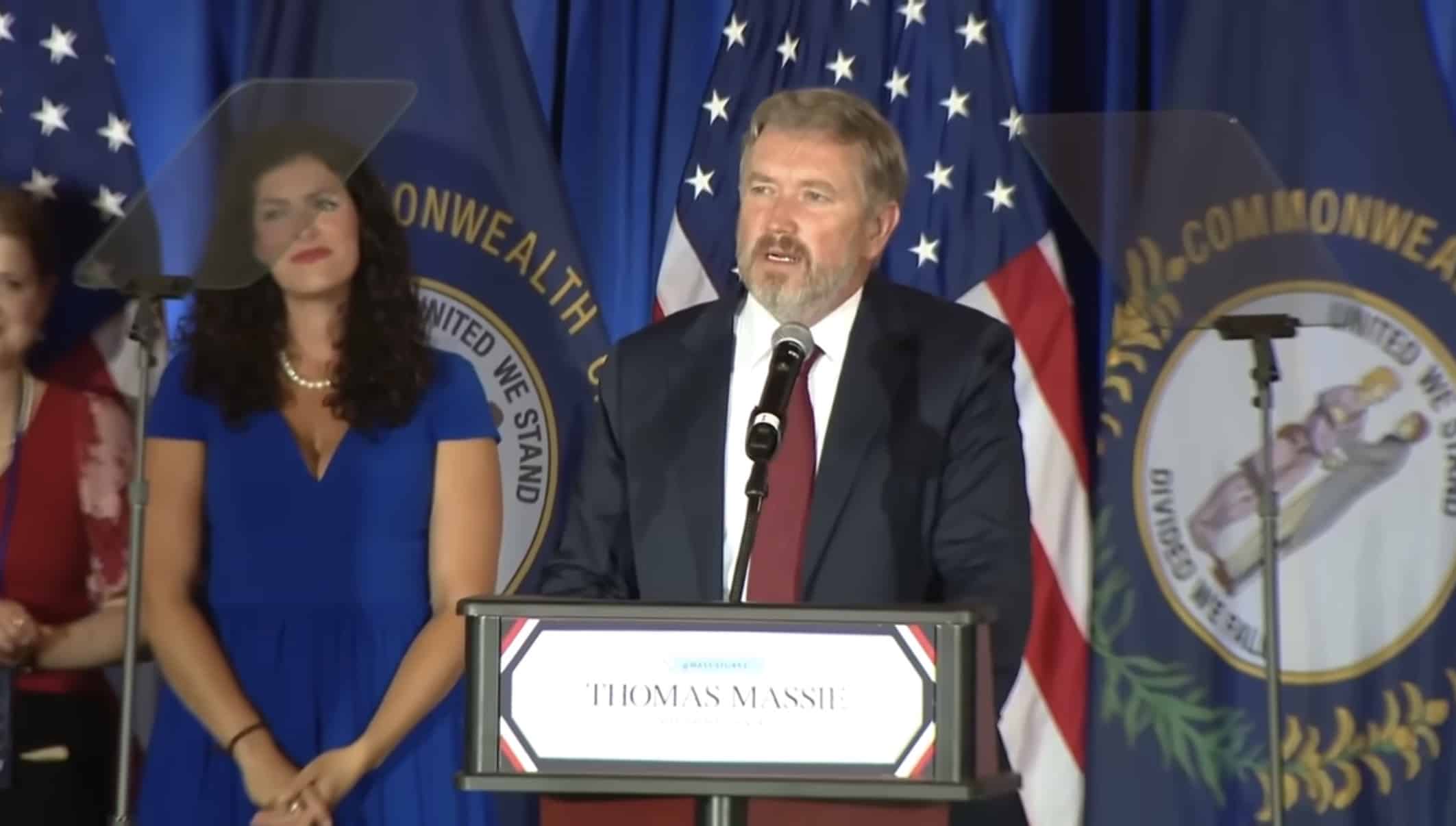
Representative Thomas Massie (R-KY) is one of the good guys. In fact, he’s one of the very few members of Congress who believes what he says about limited government, individual freedom, and the U.S. Constitution. If you support these things, you’ll support Thomas Massie, and if you oppose him, it’s because you oppose these things.
We’ve just seen the DC Republican establishment come out in an unprecedented campaign against an incumbent member of their own party because Donald Trump told them to. This action is profoundly meaningful and instructive about the system of governance we have in this country. First, it shows how deeply corrupted the political system is, not only by money, but even more fundamentally by morally compromised leaders. Second, it shows that we are not going to vote ourselves into a system of limited government and constitutional liberty. The statist juggernaut unleashed against Massie runs the very system that preserves itself in power. Finally, it illustrates how mass “democracy” is a system of elite rule, and that populism in mass politics is itself is a mask elites wear to perpetuate their control over the state system and the people it rules.
Massie is an MIT-educated engineer and successful businessman who has served the 4th congressional district of Kentucky as an articulate and courageous advocate. He earned the monicker “Mr. No” for his consistent opposition to big spending bills and legislation that authorized bloated and intrusive government. If that reminds you of Dr. Ron Paul’s nickname “Dr. No,” you’re right on. Massie and Paul are cut from the same cloth and both have served as indefatigable fighters for freedom in the United States Congress, even when the cool kids of big government attacked and ridiculed them.
Massie earned a lifetime rating of 93% from the Conservative Political Action Committee and a lifetime Liberty Score of 96% from Conservative Review by voting against big spending and debt, against foreign aid and adventurism, for gun rights, for civil liberties and government transparency, and generally for the individual and against big government. If you want to find someone who should be a hero to the rightwing in general and to Republicans in particular, Thomas Massie is your man.
But then he voted against Donald Trump’s “Big Beautiful Bill.” He voted against the bill because it will increase the deficit by $4 to $5 trillion over the next decade and is projected to add 28% to the United States’ debt-to-GDP ratio, which will mean higher long-term interest rates and reduce economic growth as government debt soaks up more capital. Deficit spending is a classic Keynesian method for artificially increasing demand, which has the negative side effect of producing inflation. Trump’s tax cuts in the Big Beautiful Bill have been offset by his economically illiterate policy of tariffs, which have fueled inflation as a de facto tax on Americans. And the working class will not get a dime back from the refunds businesses will receive, who paid the tariffs whose implementation process the Supreme Court properly held was unconstitutional. Trump’s fragile ego cannot tolerate any criticism of his bad economic policies, and Massie’s common sense refusal to go along is more than Trump could stand.
The president declared political war on Massie, who demanded that Trump follow through on his campaign pledge to release the Epstein Files and expose the child sex trafficker’s immoral behavior and the coterie of his rich and powerful friends. After Trump began his second term, however, then-Attorney General Pam Bondi informed Trump that he, too, was in many of the Epstein documents. After this, Trump became adamantly opposed to releasing them. In fact, he reacted with apoplectic fury against Republicans who had always supported him, such as then-Rep. Marjorie Taylor Greene. Massie led the fight to pass the Epstein Files Transparency Act, which led to the release of files extensively redacted and withheld by the Department of Justice and FBI.
In the aftermath of the Epstein Files fight, Donald Trump led an attack on Massie of unpredecent scale, something I have not seen in decades of closely observing American politics. Massie did not support Trump’s Iran War, being fought “at the request of Israel,” and PACs and billionaire donors who do support that war spent $19 million to defeat Massie, an incredible sum whose total makes it the most expensive House primary in U.S. history.
And they won. Thomas Massie, one of a vanishingly few memberso f congress who stands for limited government, individual liberty, and the Constitution was defeated 55-45%. The Republican Party is now the private property of Donald Trump, and if you are an elected Republican, Donald Trump owns you. You will pretend to believe whatever he says and do whatever he tells you to do. And that, as they say, is that.
So much for populism too. Massie’s defeat exemplifies Robert Michel’s Iron Law of Oligarchy, which holds that political parties, including those purporting to represent popular interests, will eventually represent the interests of the elites who run them. The elites who defeated Massie do not represent the people of Kentucky or, indeed, the people of this country. And remarkably, millions of ignorant people will celebrate the defeat of the member of Congress who championed their interests like no other. This brings to mind H.L. Mencken’s remark:
“As democracy is perfected, the office of the President represents, more and more closely, the inner soul of the people. On some great and glorious day, the plain folks of the land will reach their heart’s desire at last, and the White House will be occupied by a downright fool and a complete narcissistic moron.”
The populist ideology on which Trump rode into power was an illusion. His supporters have formed a personality cult that will not hold the man accountable for his promises, ones it’s now clear he never meant to keep. But this is not simply about Donald Trump. The political system is designed to perpetuate itself, and it will protect the interests of political and bureaucratic elites, big business, and the military-industrial complex because these are the centers of political power in American society. These power centers can bring to bear enormous resources against anyone who challenges them, and the political system designed and run by them will operate to defeat anyone bold and courageous enough to challenge them.
We’re not voting our way out of this.