American political successions in recent years happen counterintuitively: implicit hand-offs between two nominally opposing sides. This strange reality is where we derive our notion of “the uniparty” and the media its notion of “partisanship.” Through the “partisan” lens favored by media, our politics appears divided between a party, the Republicans, in hock to Israel, the “big five” weapons contractors, real estate, Wall Street, and Silicon Valley; and a party, the Democrats, in hock to powerful “progressive” or “Left” nonprofits like ActBlue, the Southern Poverty Law Center, the Center for American Progress, and the Open Society Foundations.
But the “uniparty” theory of the case shared by many politically disenfranchised Americans is a more accurate read of our political reality. Indeed, Democrats are as in hock to corporate and military interests as Republicans, and the newer “New Democratic” Party they are promising as a replacement to Donald Trump is his mirror image—there to serve the same interests under a different and deceptive cultural guise. Tracing the development of the modern Democrats from the late 1980s and early 1990s, and how that development shapes them today, shows that every sector of the party—from “neoliberals” to “progressives” to the Left—is de facto arbitered by military corporate interests which determine its policies and propaganda.
The initial cooption of Democrats by the military-corporate complex forty years ago is a familiar story, but largely one told by the political Left which is loyal to those economic groups left behind by this cooption, and largely unfamiliar to Americans at large. The story, which I have traced in part in past reports for the Libertarian Institute and elsewhere, goes something like this. In the 1970s and the 1980s, financiers used their influence to underwrite philanthropic ventures in New York City that gave them access to institutional and then political power at the expense of unions and activists—a top-down model of consolidating authority that they then transferred to the Democratic Party at large. During these years, what the scholar Dylan Gottlieb calls “a new generation of politicians and donors — people like Gary Hart, Chuck Schumer and Bruce Wasserstein,” took over the mantle of Democratic politics. In 1992, Michael Steinhardt and Al From at the Democratic Leadership Council and Martin Peretz and Leon Wieseltier at The New Republic along with David Geffen and Jeffrey Katzenberg in Hollywood created the platform for Bill Clinton. In 2008, Penny Pritzker, George Soros, and House Speaker Nancy Pelosi, with help from sympathetic media like S.I. Newhouse’s and David Remnick’s New Yorker, created the platform for Barack Obama.
These financial and political and journalistic and policy operators quietly refocused the Democratic Party to depend on corporations, so that “Goldman Sachs employees and their families donated more to Bill Clinton’s…campaign than any other firm” and “Barack Obama…raise[d] more money from Wall Street lawyers and law firms than any presidential candidate in history.” During both administrations, government largesse flowed accordingly. Under Clinton, the fifty major weapons contractors were condensed, based on Pentagon pressure, into the “big five,” with a lock on government contracts, and under Clinton and Obama these companies made their bones off of a spate of interventions or proxy fights abroad: in Bosnia, Kosovo, Afghanistan, Iraq, Libya, and Syria.
Under Clinton, Wall Street investment banks and Silicon Valley technology companies also consolidated based on government backing and thrived off alleged “deregulation.” And under Obama these corporations further concentrated, so that 2015, the penultimate year of Obama’s presidency, was “the biggest year ever…in worldwide dealmaking…not just for the total value of the deals but for the number of so-called mega-deals, which refers to any deal that exceeds $5 billion.” The structural legacy of the Democratic Party since the end of the Cold War, then, is political dependency on those very military corporate networks which Democratic rhetoric would seem to belie.
A surprising and instructive place to begin tracing these networks and their priorities as well as their distance from Democratic rhetoric is the pages of The Wall Street Journal, which has recently become a favorite gathering space for neoliberal or “business-friendly” Democrats. This is surprising because it was not thirty years ago that the Journal’s op-ed pages were leading the crusade for the impeachment of Bill Clinton. It is instructive because today some of Clinton’s most prominent allies are appearing in them. Indeed, on three days at the end of April (20th, 22nd, and 23rd), the pages ran op-eds by Clinton’s defender during his impeachment as well as Jeffrey Epstein’s close friend, Alan Dershowitz (“Why I’m Becoming a Republican); by Clinton’s Secretary of Housing and Urban Development, Andrew Cuomo (“Trump is on the Right Track in Renewing Penn Station”); and by Clinton’s Deputy Chief of Staff and a possible contender for the Democratic presidential nomination in 2028, Rahm Emanuel (“Trump’s research cuts play into China’s Hands”). These op-eds nicely encapsulate the three political pillars of Democrats’ military corporatism as they have practiced it since the 1990s: reshaping their key voting constituency; funding monopolist development projects; and hinging America’s future on conglomerates’ relationship to China.
Dershowitz assigns his move to Republicans to what he calls Democrats’ abandonment of both Israel and of “moderation,” both of which he hopes the party re-finds:
“…perhaps they’ll wise up and move back to the center, where I (and others) could rejoin [them].”
This “center” was a concept first successfully articulated via the Democratic Leadership Council and Bill Clinton’s 1992 campaign platform the “New Covenant” or the “New Choice” or the “Third Way.” Whatever its name, it was a platform which, thanks to the ministrations of the political strategists Stanley Greenberg and James Carville, “redrew our political map” by “help[ing] to shift the Democratic Party away from the unions, Black Americans and urban bosses of the New Deal coalition and toward the interests of metropolitan professionals.” The political economic focus of this “New Democratic” Party adjusted accordingly, based off the urban development ethos of Michael Steinhardt, now embraced by Cuomo in his Wall Street Journal op-ed. It was Steinhardt along with a roster of other financiers and Steinhardt’s protégé Michael Bloomberg who, as I reported for the Libertarian Institute in October, used government largesse towards financiers and philanthropy to change the landscape of New York City with real estate development and “public spaces” funded by private money. It was this development which made this city and imitators like Miami and San Francisco playgrounds for tech operators and tourists, while driving out productive industry and the middle class.
This was the most tangible expression of a broader pattern: power percolated to the top of society while alienating the middle and working class and the people at the bottom. And the underwriting engine for these elite operators’ growing power—what kept politically dissatisfied Americans politically inactive in the 1990s and early 2000s even as power slowly concentrated behind the scenes—was a seemingly prosperous economy of low consumer costs based on America’s relationship with China, which Rahm Emanuel in The Wall Street Journal makes the linchpin of our development today. The difference is that, where Clinton did this in the 1990s in the name of importing consumer products and exporting American media, Emanuel does it in the 2020s in the name of government investment in Silicon Valley to compete with China. In the end, these different forms of Chinese-centric policy enrich the same groups via lowering production costs or incentivizing government investment: financiers, technologists, and “the metropolitan professionals” who work for them.
The clearest articulation of the Democratic project of the 1990s as repackaged for 2026 is the “Abundance Agenda”: the brainchild of Ezra Klein, the columnist and podcaster at The New York Times; and Derek Thompson of The Atlantic. The “Abundance Agenda,” as I have reported in the past, is monopolist corporatism dressed up as small government practicality. It is a series of proposals to weaken public and regulatory oversight of tech and urban development projects, from Google’s Waymo cars to Michael Bloomberg’s public parks to various real estate schemes helmed by a small rotating band of connected developers. This is not deregulation for the small business owner; it is deregulation for corporate welfare at the expense of local government, and it is being embraced most energetically by Democratic politicians backed by corporate interests.
These include Daniel Lurie, the Mayor of San Francisco, who is relying on philanthropy from Silicon Valley to “fix” the city; and Ritchie Torres, the self-identified “progressive” congressman from New York. Congresspeople Elissa Slotkin (D-MI), Jake Auchincloss (D-MA), Marie Gluesenkamp Perez (D-WA), Tom Suozzi (D-NY), and Jared Golden (D-ME) are also Abundance supporters. Rising Democratic politicians linked to Abundance or its supporters include U.S. Representatives from New York and California Pat Ryan and Jimmy Panetta; Governors of Virginia and New Jersey Abigail Spanberger and Mikie Sherrill; and former Deputy Secretary of the Air Force and current San Antonio mayor Gina Ortiz Jones. Ryan, Panetta, Spanberger, Sherrill, Ortiz Jones, and Slotkin are former intelligence officers; and Spanberger, Sherrill, and Slotkin are eager adapters of Rahm Emanuel’s defense-tech-friendly policies towards China.
Almost all of these players, along with nationally “electable” Democrats in “red” or “purple” states like Senator Ruben Gallego (D-AZ), Senator Michael Bennet (D-CO), Miami Mayor Eileen Higgins, and Texas senatorial nominee James Talarico, are members of Majority Democrats. According to The New York Times, Majority Democrats is “a new group of elected officials from all levels of government [with] outsized ambitions to challenge political orthodoxies and remake the party” whose “structure resembles that of the Democratic Leadership Council, the once-influential group that successfully pushed the party to the middle in the Clinton era.” One of its strategists is Seth London, who, in a post-2024 election memo, recommended that the Democratic Party should imitate the Democratic Leadership Council and referenced as crucial to the party’s coming success the Abundance Agenda. London’s CV, not surprisingly, is peppered with financial connections, and so is Abundance: among them Michael Bloomberg, Reid Hoffman, James and Kathryn Murdoch, and the Walton Family, along with the lesser-known but influential operators Rob Granieri, Edward Fishman, Mark Heising, and David Nierenberg.
But why is a political economic agenda of billionaires outlined in The Wall Street Journal the most powerful agenda-setter for purportedly “progressive” Democrats? The reason is straightforward. The most powerful constituency of the new Democratic Party as shaped by funders like Michael Steinhardt, George Soros, Penny Pritzker, and Michael Bloomberg is the one constituted of “metropolitan professionals,” or, in the scholar Dylan Gottlieb’s words, “Yuppies,” who staff the corporate conglomerates these operators own. Though the Yuppie constituency does not share the Journal’s cultural values, it does share the Journal’s economic interests; and, at the hands of strategists like Stanley Greenberg and David Axelrod and David Plouffe, this fact has functioned to create a new progressive Democratic definition of “dispossessed.” At their hands, protecting the dispossessed has come to mean expanding “equal opportunity” to various minority groups or ideological interests that might appeal to Democrats’ Yuppie constituents: in other words, combating injustice in ways that do not affect the political economic structures on which Yuppies or their underwriters rely.
Early moves in this direction came with Martin Peretz’s and David Geffen’s push for gay rights before and during the Clinton administration, but the decisive shift came at the hands of David Axelrod and David Plouffe in the run-up to Barack Obama’s 2012 reelection campaign. As the scholars K.C. Johnson and Stuart Taylor explain, “the Democratic defeat in the 2010 midterm elections focused Obama’s attention on how identity politics could rally his base,” and so “the administration took high-profile positions in favor of marriage for same-sex couples, permitting ‘dreamers’ to remain in the United States and mandating contraceptive coverage in Obamacare.” After Obama’s victory in the 2012 election, an overtly identitarian strategy emerged from Obama’s success. In the words of Bill Clinton’s strategist Stanley Greenberg, in his 2018 book RIP GOP: How the New America is Dooming the Republicans, an America that is “secular, racially diverse, and fueled by immigration,” and filled with “non-traditional family structures,” independent women, and “dynamic cities” means the “[Republican] party’s imminent demise.”
Rhetoric on this register reinforced the perception of moral and political stakes at play, even as the reality was politics-as-usual. Indeed, the groups’ progressivism courted were disproportionally upper-middle class (white collar beneficiaries of affirmative action; college-educated women; gay rights campaigners) or they were groups which benefited the upper-middle class (illegal immigration provided cheap labor). And initiatives to help these groups were undertaken predominantly through regulations and lawsuits, empowering administrative agencies, courts, and single-issue nonprofits. Progressivism’s overall effect, then, was to add regulations to the military corporate complex (more bureaucrats at the Pentagon; racial sensitivity training and eco-friendly policies in administrative agencies; formal or informal partnerships between those agencies and the Southern Poverty Law Center or the Open Society Foundations) without diminishing its power. Its unintended effect was to provide Donald Trump fuel against Democrats and Democrats fuel against Donald Trump, since much of Donald Trump’s second term has been devoted to sweeping away these regulations, particularly when it comes to Trump’s ostentatiously deregulated approach to ICE, Israel and AI.
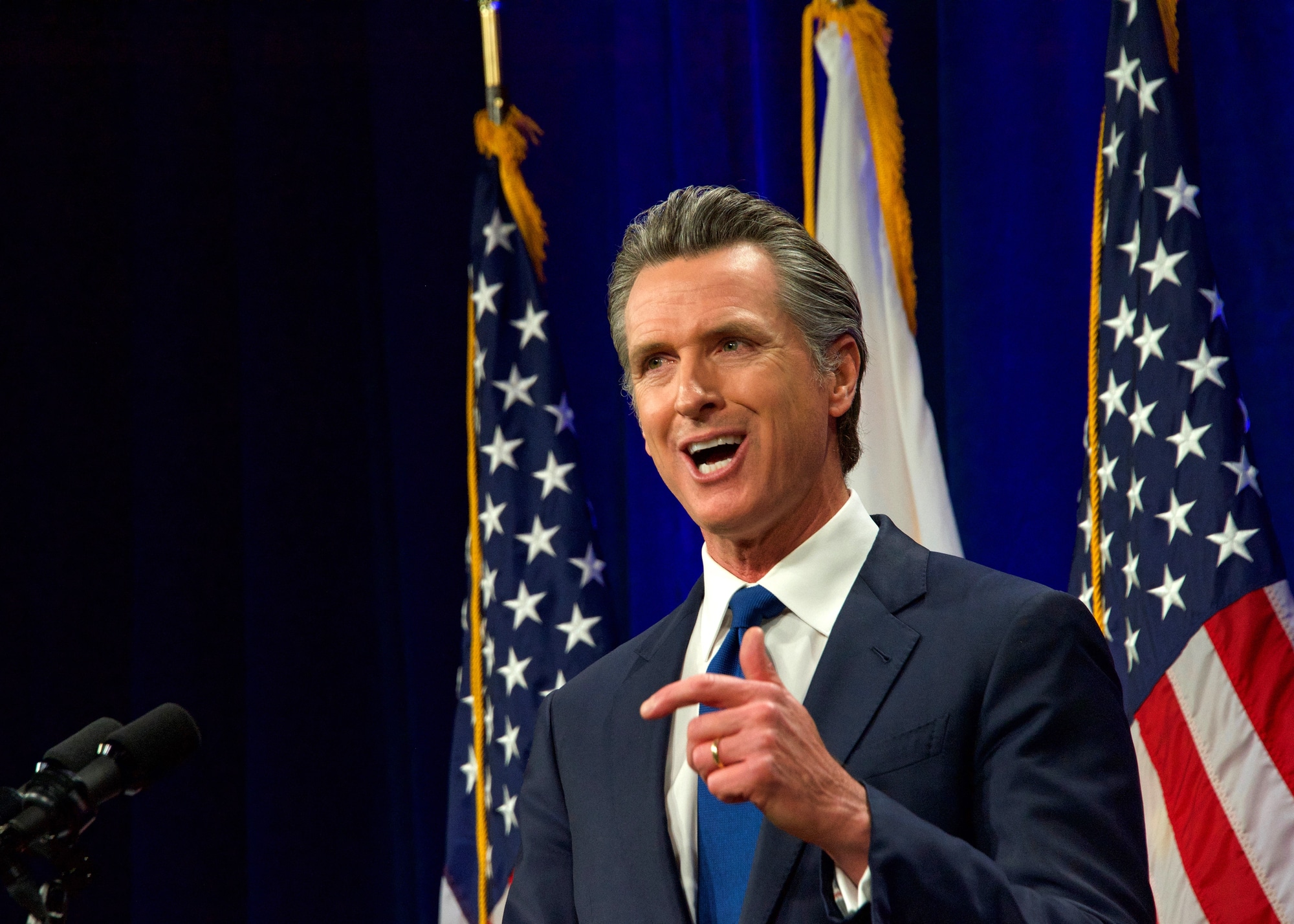
The senior members of the group of Democratic politicians who use progressivism as their spear against Trump are lawyers like Senator Adam Schiff (D-CA) and Representative Jamie Raskin (D-MD). Their “rising stars” include Senator Brian Schatz (D-HI), who is Senate Minority Leader Chuck Schumer’s choice as Schumer’s successor as party leader. Their newer members include Alex Bores, a candidate running on a platform of AI regulation in New York’s 12th Congressional District. And their presidential contenders are Governors J.B. Pritzker of Illinois and Gavin Newsom of California. Schiff, Raskin, Schatz, Pritzker, and Newsom have heavy ties to defense technology and financial industries and (in Newsom’s and Schatz’s cases) to the Abundance Agenda, while Bores is running for U.S. Congress in a district which encompasses much of Manhattan and is home to Michael Steinhardt, Michael Bloomberg, and a number of their allies. All of them oppose the current policies of ICE and Israel, but none of them target the consolidated structures of corporate-government power on which ICE and Israel depend.
It might be supposed that an effective counterbalance to the neoliberal and progressive sectors of the Democratic Party comes from the Left since they seem to focus on questions of political economy like redistribution and antitrust. Indeed, Senator Bernie Sanders (I-VT) put the Left’s program best in 2025 when he said that aggressive promotion of identity politics was “what the liberal elite [tries to do].” In Sanders’s summing up of his own view, “Is every gay person brilliant or wonderful or great? No, of course not, everyone’s a human being. The issue is: what do you stand for? And that gets you back to the issue we discussed earlier: class politics.“ This class-over-lifestyle approach seems like a fairly defined brief for mobilizing poor, working, and middle class voters demonstrably shortchanged by a system run on corporate finance underwritten by government. But the exercise of often decisive military corporatist influence extends even to the most viable standard-bearer of Sanders’s revived Left, New York City Mayor Zohran Mamdani, and candidates running in the 2026 congressional elections on Mamdani’s platform.
Mamdani’s chief political strategist, and the chief political strategist of senatorial candidates Graham Platner in Maine and Dan Osborne in Nebraska, is Morris Katz, whose early political contact, thanks to an introduction from his father, a well-known movie director in Tribeca, was Melissa DeRosa, Andrew Cuomo’s closest aide. Since this initial introduction, Katz has moved away from pure establishmentarianism to combativeness with that establishment over issues like welfare and antitrust, but he and his candidates have not changed their rhetoric, which is reliably universalist. Namely, an appeal to concepts like “politics of humanity” or “dreaming and hope” that vacuum out the political economic context of any situation in the name of “pious uplift.” In the words of Susan Sontag, this perspective “systematically denies the determining weight of history—of genuine and historically embedded differences, injustices, and conflicts” by “purporting to show that human beings are born, work, laugh, and die everywhere in the same way” to suggest “a world in which everybody is…immobilized in mechanical…identities and relationships” that make politics “irrelevant.”
Nowhere is the language of universalism more visible than at the Open Society Foundations, the project of George Soros which, as I have also reported for the Libertarian Institute, spent the 1990s and 2000s reliably “piggybacking” on military interventions executed by Democratic presidential administrations in the name of “universal ideals.” The Foundation’s former Director, Patrick Gaspard, is a close adviser to Zohran Mamdani and the former director of the Center for American Progress or CAP. CAP is funded in part by the Soroses, and it is the brainchild of John Podesta, the influential adviser to Bill and Hillary Clinton. Hillary Clinton is famously the mentor of Huma Abedin, who is now married to Alex Soros: George Soros’s son who now directs the Open Society Foundations.
Based on these connections alone, much of what is said in public by progressive players like Mamdani and Katz begins to seem less relevant: plays in a game to parlay with those Zionists who have a lock on Democratic institutions rather than to meaningfully combat them. And, along these lines, it is not necessarily a coincidence that Zohran Mamdani seems to be embracing aspects of the Abundance Agenda. This may alienate portions of his base (labor unions, environmental groups, anti-gentrification activists) but it appeals to New York’s institutional arbiters. Namely, Governor Kathy Hochul; Congressman Ritchie Torres; The New York Times editorial board; as well as New York City’s police commissioner Jessica Tisch; Tisch’s close friends Ivanka Trump and Jared Kushner, a real estate developer; and President Donald Trump, whose control over federal largesse is necessary for Mamdani’s welfare agenda. Despite differences over welfare policy and rhetoric, the distance from The Wall Street Journal to the pages of the democratic socialist magazine Jacobin, a key supporter of Mamdani’s, is not always so far as it may seem. This criticism is shared by some Leftists themselves: people like the Seattle activist Kshama Sawant, who sees Mamdani courting the universalist and globalist establishment to the detriment of his base in the working class.
There is a particular intellectual style shared across the sectors of this newer New Democratic Party; and its function if not its intent is to distract from questions of who has power and how they are using it. Its guiding concept, a cousin of universalism, is “reason”: in the definition of a recent article in David Remnick’s New Yorker, “to accept that one’s deepest convictions may fail to command assent from others who are no less sincere or thoughtful, and then to propose terms of political coöperation that others can appreciate.” Interestingly, The New Yorker locates its model for public reason in the place most Democrats seem to be locating their new politics:
“Bill Clinton’s…‘triangulation,’ Tony Blair’s Third Way, and Barack Obama’s insistence on being the most reasonable person in the room.”
These leaders were, indeed, known for their rhetoric, which relied on concepts like “complexity” and “pragmatism.” In practice this meant all-night “grapplings” with “tough issues” of morality or peace; or else detail-heavy and sometimes hyperkinetically minute proposals for “reforming” government, a tactic Rahm Emanuel, an acknowledged master of it in the Clinton White House, has reanimated today. All of this complexity and pragmatism existed under a universalist philosophical veil: the notion that “reasonable people” who all believe in the same undefined abstractions (“human rights” and “democracy,” “hope and change”) can “set aside their differences” and “find common ground” through discussion and debate.
There is a lot of this talk occurring in Democratic circles today. In Morris Katz’s words, politics means “an increased fluency and understanding that we can disagree while being agreeable.” For Rep. Ritchie Torres, it means that “everyone should have a seat at the table, everyone’s voice should be heard, but no one’s gonna have veto power.” For Adam Kirsch in The Atlantic, “the essence of democracy” is “rational discourse” and “thoughtful back-and-forth argument.” For Ezra Klein in The New Yorker, democracy means “building political coalitions around disagreement.” What “reason” or “pragmatism” stands for in this variant is not the formation of public opinion, which as conceived by James Madison would play itself out at the local level on various issues then form a rough consensus throughout the republic based on the free flow of information and debate. What reason or pragmatism stands for in this variant, instead, is elites speaking to elites: a kind of senior debate society of the powerful which functions to elide questions of what actual interests they functionally serve.
Indeed, very few people attuned to Bill Clinton’s or Tony Blair’s or Barack Obama’s administrations would describe them as committed to public reason. Clinton and his political strategists James Carville and Stanley Greenberg were recognized experts at covering electoral bases using stealth emotional triggers, playing to white voters with one hand and black voters with another and splitting the baby on gay rights, while quietly reallocating power to corporate conglomerates and administrative agencies under the aegis of “pragmatism.”
Obama, aided by David Axelrod and David Plouffe, was instrumental in upping the emotional ante of government via identity politics. Gavin Newsom has taken this essentially manipulative approach to an even higher register. He has begun to traffic in criticisms of Republicans using slang like “gay” which is deeply offensive to progressive LGBTQ+ voters but which attracts white men who support Trump, even as he claims to be using this language to “bait” Republican opponents. All the while he is strongly supporting LGBTQ+ rights but making an exception for men’s participation in women’s sports. This is textbook triangulation of a Clintonian kind.
Another Clintonian practitioner is U.S. Senator from Georgia Jon Ossoff, who manages to triangulate between neoliberal center, progressive, and Left. He “supported the Laken Riley Act, an immigration bill written by congressional Republicans that calls for the detention of undocumented immigrants if they are arrested for minor crimes”; he “condemns Trump’s antidemocratic and racist tendencies in a way that excites party activists”; and he “uses Bernie Sanders–like rhetoric to…slam corporations and the super-wealthy. “
What will be the result of a “newer” Democratic Party run along these tried-and-true models? What the last thirty years suggest is an endless bait-and-switch. There has been domestic militarization at home (on black crime and white nationalism) in the name of national security. There have been military interventions abroad (Bosnia, Kosovo, Libya, Ukraine) in the name of human rights. There has been government investment in corporations (the Gramm-Leach-Bliley Act; “free trade” and outsourcing to China; monopolist real estate projects that displace the working and middle class) in the name of “growth.” And there has been “redistribution” (Obamacare, multiple stimulus packages) in the name of human rights and minority advancement. What there has not been is any redistribution of power to legislatures or small business associations or private sector unions or local politics; or an investment in working and middle class independence and productivity. This is a system for institutional “winners,” run by institutional “winners” that operates with the stick of monopolist development and the carrot of government welfare.
An instructively stark lens through which to consider what this system might look like going forward in America comes from “Liberal” Israelis’ Democratic-underwritten policy toward Palestine—not by coincidence, since many of the operators behind America’s modern Democratic Party are Jewish Zionists who, as I have investigated for the Libertarian Institute and elsewhere, succeeded WASPs as arbiters of American institutions forty years ago. In 1993, a year after Clinton’s “triangulation” had won him the White House, he presided over the Oslo Accords between Israel and Palestine. This was arguably the Democrats’ first massive military corporate development project, begun by Clinton and continued by Obama, under the guise of reasoned attention to detail and a commitment to “universal” human rights.
According to Palestinian historian Rashid Khalidi, after the Oslo Accords and despite widespread “euphoria” about them among Palestinians, “conditions grew much worse for all but a very small number of individuals whose economic or personal interests were intertwined with the Palestinian Authority”: what the anti-Zionist Jewish scholar Norman Finkelstein calls “collaboration-building to facilitate a burden-free Israeli occupation.” Under this system, “there were consistent denials of permission to travel and move goods from one place to another as a labyrinthine system of permits, checkpoints, walls, and fences was created.” This was part of a larger process of severing Gaza from the West Bank, which was itself severed from Jerusalem, effectively cleaving the Palestinian territory in thirds. But this was a process partially concealed by a raft of Israeli nonprofits and Israeli corporations that made a presence in the Palestinian territories in the name of “development” and “peace.” Indeed, it was in these years that progressive outlets funded by Soros and Pritzker and other Israeli-linked financiers expanded their commitment to amalgamating Palestinian rights with human rights and LGBTQ+ and women’s rights. This was a version of Yuppie progressivism for the Levant that was put in place even as Palestinians’ sovereignty was being effectively dismantled underneath them.
The overall aim of this process was articulated by Israel’s Liberal Zionist Prime Minister Shimon Peres, who “express[ed] a vision for transforming the Gaza Strip” into a version of the techno-authoritarian city-state of Singapore based on “trade, tourism, and technology.” And now, with the Netanyahu government having spent fourteen years of blockade and three years of genocide strangling Palestinians’ effort at sovereignty via Hamas, Peres’s are exactly the “values” being expressed by Jared Kushner for “remaking” Gaza today. Essentially, Peres’s and Kushner’s plan for Gaza is the Abundance Agenda applied abroad. Its endpoint is the current population being either displaced or forced to turn to low-level service work for corporations underwritten by government in the name of “progress,” “aspiration,” and “enlightenment.” And where America will end up under Democrats is not too different, in broad strokes, than where Gaza will end up under “liberal” Israelis: a techno-corporate “utopia” underwritten by government where uplifting progressive rhetoric and an occasional welfare program disguises the power imbalances underneath. This is not, in any sense, a real alternative to the overt military corporatism of Republicans under Donald Trump. It is military corporatism with a universalist, humanitarian, progressive face.