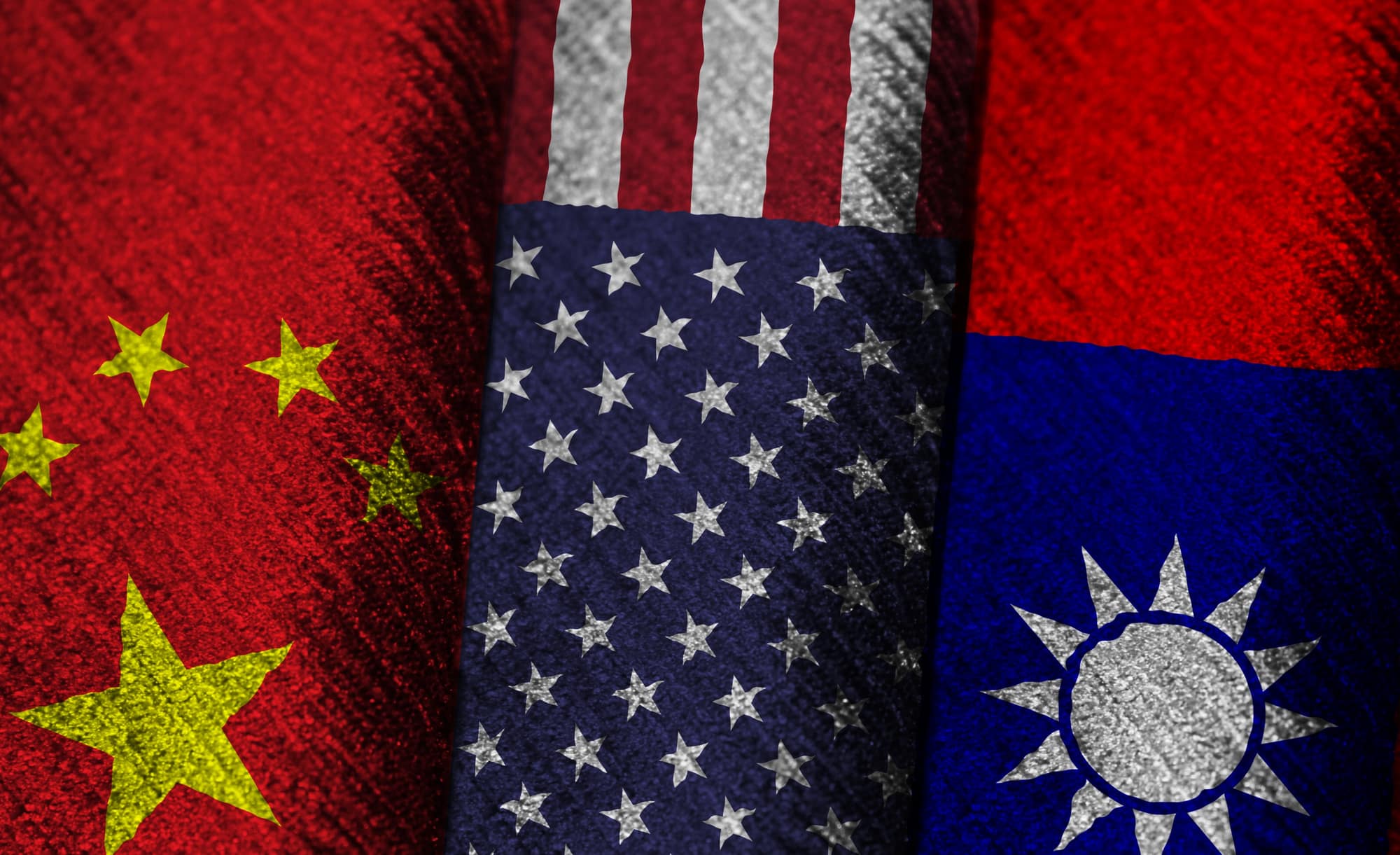
In recent years, critics on both sides of the aisle have taken aim at the longstanding policy of strategic ambiguity toward Taiwan. They argue that Washington should abandon ambiguity and embrace “strategic clarity,” explicitly pledging to fight China over Taiwan. Others, such as Hoover Institute Fellow Eyck Freymann, have offered more sophisticated sounding alternatives like “structured ambiguity,” attempting to codify precisely what America would and would not do in various contingencies, particularly involving gray zone activities.
But abandoning a long-established policy that, whatever its faults, has prevented a major war between great powers for over half a century, in favor of a new policy, would be a serious mistake.
To understand why, let’s start with strategic ambiguity. Its origins lay in Richard Nixon’s opening to China. Years of increasing Sino-Soviet tensions opened the door to this diplomatic revolution of the early 1970s. With Washington and Beijing both seeing value in balancing against Moscow, efforts at normalizing diplomatic relations between the two began in earnest.
Taiwan was the major sticking point.
The resulting framework for normalization, the only one possible, was a carefully constructed kicking of the can down the road. In the 1972 Shanghai Communiqué, the United States acknowledged that Chinese on both sides of the Taiwan Strait maintained there was but one China and that Taiwan was part of China. Importantly, Washington did not itself endorse Beijing’s sovereignty claim. Instead, it merely acknowledged the Chinese position.
This balancing act became even more delicate in 1979 when the Jimmy Carter administration formally completed the recognition of the People’s Republic of China while severing official diplomatic relations with Taipei. Congress, in response, passed the Taiwan Relations Act, which established an unofficial relationship with the island and authorized the sale of defensive arms.
With the prior mutual defense treaty of 1954 now gone, a new policy evolved: strategic ambiguity.
The genius, if one can use the term, of strategic ambiguity was that it created uncertainty for everyone involved.
Beijing could not know with certainty whether an invasion of Taiwan would provoke American military intervention. Taipei could not know with certainty that Washington would ride to its rescue if it formally declared independence. Both sides therefore had incentives to avoid unilateral changes to the status quo.
The arrangement was intentionally awkward. It was also remarkably successful.
For decades, the Taiwan Strait remained relatively stable. Taiwan developed into a prosperous democracy. China experienced its meteoric economic rise. The United States maintained productive, if often contentious, relations with both. Trade flourished across the strait even as political disagreements persisted.
The policy’s success rested on a simple but often overlooked reality: ambiguity restrained both Beijing and Taipei.
Today, however, a growing chorus in Washington insists that ambiguity itself invites aggression. Drawing heavily on analogies to the war in Ukraine, advocates of strategic clarity argue that the United States should make an explicit commitment to Taiwan’s defense.
The theory is straightforward. If Beijing knows with absolute certainty that America will intervene, deterrence will be strengthened.
The problem is that deterrence is a two-way street.
An explicit American security guarantee could just as easily embolden Taiwanese politicians inclined toward formal independence, believing that the United States had effectively removed the military risks associated with such a declaration. From Beijing’s perspective, strategic clarity might appear less like deterrence than a gradual abandonment of the understandings that have governed Sino-American relations since the 1970s, crossing a clearly delineated “red line” and provoking the very conflict it purported to prevent.
A somewhat more cautious proposal is “structured ambiguity,” which seeks to clarify certain commitments while preserving flexibility elsewhere. Specifically, its advocates hope to eliminate misunderstandings by clearly outlining what actions would precipitate what responses, including gray zone activities, while avoiding the rigidity of strategic clarity vis a vis U.S. military intervention in the event of an unprovoked invasion from the mainland.
But one suspects that this is merely ambiguity with additional paperwork, and a landscape filled with potential tripwires and chances for uncontrollable escalation.
For one of the central problems of diplomacy is that it is to a great extent a contest of perceptions. The more policymakers attempt to specify precisely where every line is drawn, the more opportunities arise for those lines to be tested.
A more restrained foreign policy would seek to reduce the risk of entanglement rather than refine the conditions under which American forces might eventually be committed to war.
Of course, from the non-interventionist perspective the entire debate is misguided. The United States has no treaty obligation to defend Taiwan—and needs none. American taxpayers have little interest in another potentially catastrophic conflict halfway around the globe; the American and world economy has everything to lose from such a confrontation; and there is little reason to think Washington would “win” such a conflict 90 miles from China’s coast in any event.
Unfortunately, that option receives little consideration in establishment circles. The debate instead centers on how Washington can more effectively manage a rivalry with Beijing while maintaining its existing commitments.
If those are the available choices, prudence suggests preserving the arrangement that has kept the peace.
Strategic ambiguity is imperfect. It frustrates politicians, pundits, and think tank analysts precisely because it lacks the satisfying certainty of a formal guarantee. But diplomacy is often successful because it leaves room for uncertainty. Not every problem requires a definitive answer. As my undergraduate professor used to say, paraphrasing Bismarck: diplomacy is the art of the possible.
The greatest danger to peace in the Taiwan Strait at this point may not be ambiguity itself but the temptation in Washington to move beyond it. History is filled with policymakers who believed they could engineer a more stable international order through greater precision and firmer commitments.
History is also filled with the unintended consequences of those efforts.