September 1 is the anniversary of the start of World War II in Europe. On that date in 1939, Nazi Germany launched an invasion of Poland from the west and a few weeks later, the Soviet Union invaded from the east. Adolf Hitler and Joseph Stalin signed a non-aggression pact shortly before they carved up Poland but that ceasefire didn’t last beyond June 1941.
World War II has been heralded for more than fifty years as the “Good War”—in contrast to subsequent U.S. military debacles in Korea, Vietnam, Afghanistan, Iraq, and Iran. But World War II cannot be glorified without hiding a heap of lies and millions of corpses.
Less than six months before the war started in Europe, H.L. Mencken warned in The Baltimore Sun, “The main reason why it is easy to sell war to peaceful people is that the demagogues who act as salesmen quickly acquire a monopoly of both public information and public instruction.” Looking at the peril of another world war, Mencken predicted, “On the day war is declared, the Espionage Act will come into effect, and all free discussion will cease…Any argument against the war itself, and any criticism of the persons appointed to carry it on, will become aid and comfort to the enemy.” Mencken wrote, “A few weeks of [pro-war] razzle-dazzle will suffice to convert most people to the war and to intimidate and silence the stray recalcitrant who holds out.” Thanks to massive pressure to conform and submit, “The dissenter is not only suspected by all his neighbors; he also begins to suspect himself.” Unfortunately, the U.S. government vindicated Mencken’s worst fears on censorship during the war and far beyond.
President Franklin Roosevelt worked ceaselessly and shamelessly to drag America into the European conflict. He capped off his 1940 reelection campaign by promising voters, “Your president says this country is not going to war.” FDR portrayed World War II as a fight for democracy, which required endless hornswoggling of the American public regarding U.S. allies.
The Roosevelt administration engineered a movie tribute to Stalin—Mission to Moscow—that was so slavish that Russian composer Dimitri Shostakovich observed that “no Soviet propaganda agency would dare to present such outrageous lies.” In his 1944 State of the Union address, Roosevelt denounced those Americans with “such suspicious souls—who feared that I have made ‘commitments’ for the future which might pledge this Nation to secret treaties” with Stalin at the summit of Allied leaders in Tehran the previous month. Roosevelt helped set the two-tier attack that permeated much of postwar American foreign policy—denouncing cynics, while betraying foreigners whom the U.S. government pretended to champion.
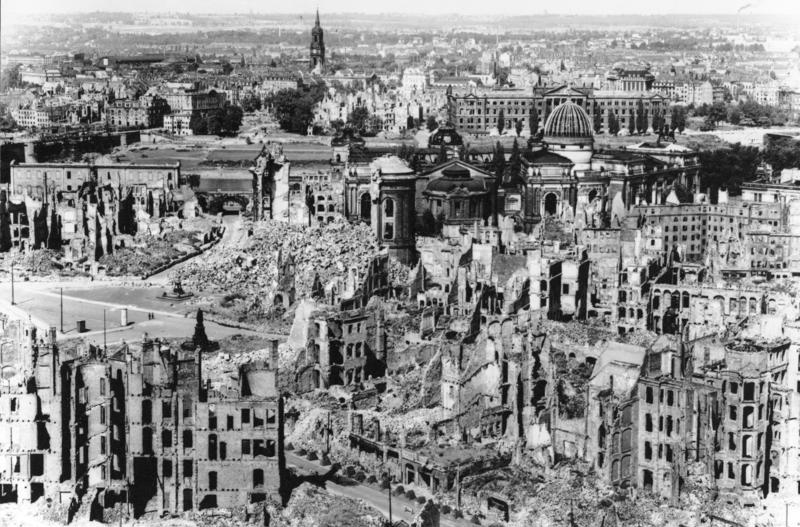
In a private conversation at the Yalta conference in early 1945, Roosevelt assured Stalin that he was feeling “more bloodthirsty” than when they previously met. Immediately after the Yalta conference, the British and American air forces turned the German city of Dresden into an inferno, killing up to 50,000 civilians. The Associated Press reported that “Allied air bosses” had adopted “deliberate terror bombing of great German population centers as a ruthless expedient to hasten Hitler’s doom.” Ravaging Dresden was intended to “‘add immeasurably’ to Roosevelt’s strength in negotiating with the Russians at the postwar peace table,” as Thomas Fleming noted in The New Dealers’ War. Vast numbers of dead women and children became simply one more poker chip. Shortly after the residents of Dresden were obliterated, Roosevelt pompously announced, “I know that there is not room enough on Earth for both German militarism and Christian decency.” Government censorship and intimidation helped minimize critical coverage of the civilian carnage resulting from U.S. carpet-bombing of cities in both Germany and Japan.
Prior to the Yalta conference, Roosevelt confided to the U.S. ambassador to Russia that he believed that if he gave Stalin “everything I possibly can and ask for nothing in return, noblesse oblige, he won’t try to annex anything and will work with me for a world of democracy and peace.” Stalin wanted assurances from Roosevelt and British Prime Minister Winston Churchill that millions of Soviet citizens who had been captured during the war by the Germans or who had abandoned the Soviet Union would be forcibly returned. After the war ended, Operation Keelhaul forcibly sent two million Soviets to certain death or long-term imprisonment in Siberia or elsewhere. Aleksandr Solzhenitsyn called Operation Keelhaul “the last secret” of World War II and it was covered up or ignored by Western media until the 1970s. Those mass deaths facilitated by the U.S. and British governments rarely rate even an asterisk by the media-beloved historians who tout the “Good War.”
Many American soldiers and sailors died because of FDR’s boundless hatred of Germans. In the final years of the war, FDR gave a huge boost to Nazi propaganda when he floated plans to subjugate the German people permanently by banning all factories and even airplanes in the conquered territory. The president told Treasury Secretary Henry Morgenthau Jr., “We either have to castrate the German people or you have to go to treat them in such manner so they can’t just go on reproducing people who want to continue the way they have in the past.” FDR declared that after the war, every German “should be fed three times a day with…Army soup,” adding that “they will remember that experience all their lives.” Cordell Hull, Roosevelt’s long-serving Secretary of State, condemned the Morgenthau plan (as it became known) as an “extreme starvation plan.” (David Beito’s book, FDR: A New Political Life, is an excellent source on FDR’s conniving.) The combination of the Morgenthau Plan and the bombing of civilian areas in Dresden, Hamburg, and other German cities, killing nearly 600,000 civilians, may have spurred far more Germans to keep fighting to the death.
In the final communiqué from Yalta, Roosevelt, along with Churchill and Stalin, declared that “a new situation has been created in Poland as a result of her complete liberation by the Red Army.” Liberation? Tell that to the Marines. A few weeks later, on March 1, 1945, FDR gave a speech to Congress touting his triumph at Yalta, declaring, “The decision with respect to the boundaries of Poland was, frankly, a compromise…It will include, in the new, strong Poland, quite a large slice of what now is called Germany.” He agreed with Stalin at Yalta on moving the border of the Soviet Union far to the west—thereby effectively conscripting eleven million Poles as new Soviet Union citizens.
Roosevelt told Congress that the deal at Yalta was “the most hopeful agreement possible for a free, independent, and prosperous Polish people.” But he betrayed the exiled Polish government in London and signed off on Soviet-style elections with no international observers—effectively giving Stalin unlimited sway on choosing Poland’s rulers. Any illusions about Soviet benevolence towards Poland should have been banished when the Red Army massacred the Polish officer corps at Katyn Forest—an atrocity that the U.S. government assiduously covered up (and blamed on the Nazis) during the war and long after.
Poland was “compensated” for the loss of territory to the Soviet Union with a huge swath of Germany, a simple cartographic revision that spurred vast human carnage. But post-war atrocities against Germans were almost totally ignored for the remainder of the twentieth century. In 2012, historian R. M. Douglas, author of Orderly and Humane: The Expulsion of the Germans After the Second World War (Yale University Press), vividly captured the carnage that continued after the war formally ended:
“Between 1945 and 1950, Europe witnessed the largest episode of forced migration, and perhaps the single greatest movement of population, in human history. Between 12 million and 14 million German-speaking civilians -the overwhelming majority of whom were women, old people, and children under 16 -‘were forcibly ejected from their places of birth in Czechoslovakia, Hungary, Romania, Yugoslavia, and what are today the western districts of Poland. As The New York Times noted in December 1945, the number of people the Allies proposed to transfer in just a few months was about the same as the total number of all the immigrants admitted to the United States since the beginning of the 20th century. They were deposited among the ruins of Allied-occupied Germany to fend for themselves as best they could. The number who died as a result of starvation, disease, beatings, or outright execution is unknown, but conservative estimates suggest that at least 500,000 people lost their lives in the course of the operation.
Most disturbingly of all, tens of thousands perished as a result of ill treatment while being used as slave labor (or, in the Allies’ cynical formulation, ‘reparations in kind’) in a vast network of camps extending across central and southeastern Europe – many of which, like Auschwitz I and Theresienstadt, were former German concentration camps kept in operation for years after the war. Ironically, no more than 100 or so miles away from the camps being put to this new use, the surviving Nazi leaders were being tried by the Allies in the courtroom at Nuremberg on a bill of indictment that listed ‘deportation and other inhumane acts committed against any civilian population’ under the heading of ‘crimes against humanity.’
By any measure, the postwar expulsions were a manmade disaster and one of the most significant examples of the mass violation of human rights in recent history. Yet although they occurred within living memory, in time of peace, and in the middle of the world’s most densely populated continent, they remain all but unknown outside Germany itself.”
George Orwell denounced the “relocation” as an “enormous crime” that was “equivalent to transplanting the entire population of Australia.”
Philosopher Bertrand Russell protested, “Are mass deportations crimes when committed by our enemies during war and justifiable measures of social adjustment when carried out by our allies in time of peace?”
But the German civilians killed after the war were simply another asterisk ignored by Good War chroniclers.
Jon Utley was a legendary conservative-libertarian philanthropist who rescued The American Conservative and also generously supported Antiwar.com. Utley’s mother, Frida Utley, did piercing writing on the post-World War II abuses in Germany. Her pathbreaking work is archived here. She wrote, “Some twelve million people were expropriated and driven from their homes for no other crime than that of being Germans. Out of a total of twelve to thirteen million people who had committed the crime of belonging to the German race, four or five million are unaccounted for. More people have been rendered homeless by an Allied peace than by a Nazi war.”
Nazi Germany committed great crimes against humanity and that regime deserved to be terminated by its opponents and its victims. But humanity was ill-served when the victors were permitted to expunge all of their own atrocities and lies. Legendary war correspondent Ernie Pyle offered a far more honest assessment of World War II than did FDR: “The war gets so complicated and confused in my mind; on especially sad days, it’s almost impossible to believe that anything is worth such mass slaughter and misery.” The halo that kowtowing historians slapped over World War II made it far easier ever since for politicians to drag America into military quagmires.