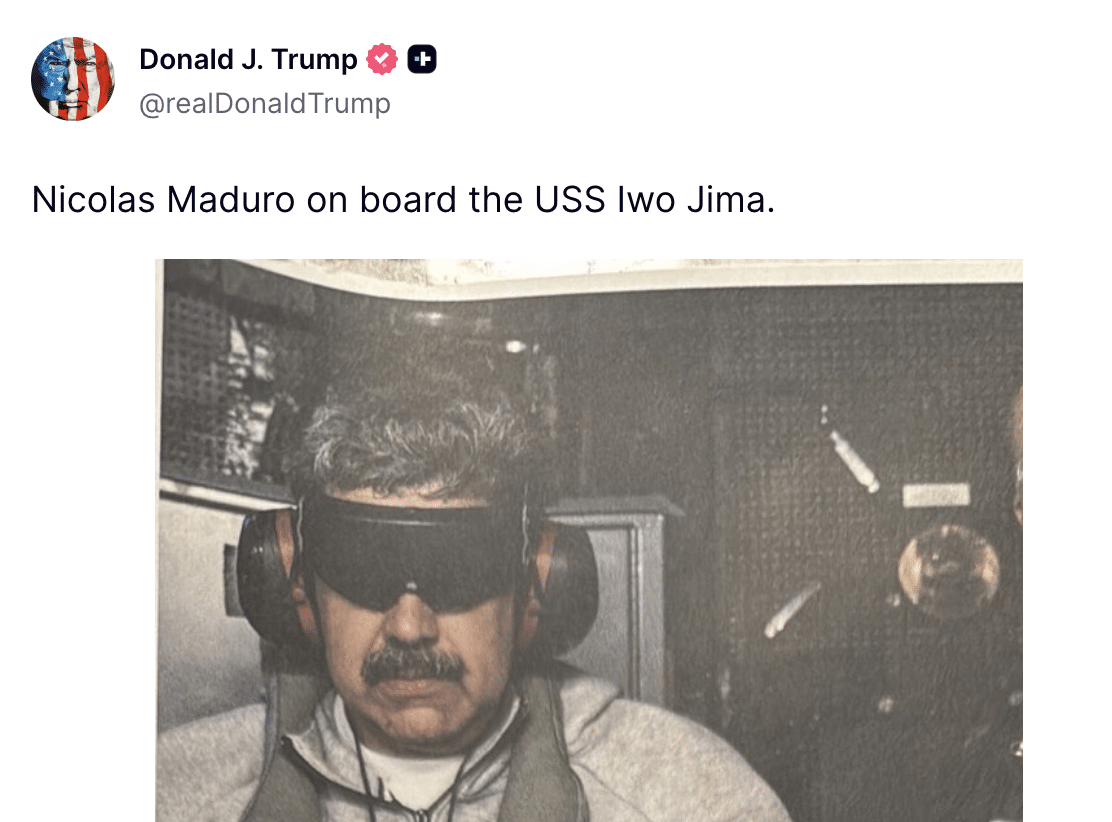
On January 3, 2026, the world watched in shock as American bombers, warships, and helicopters executed a lightning strike on Caracas, disabled Venezuelan air defenses, and whisked President Nicolás Maduro and his wife away to the United States. The Manhattan U.S. Attorney said Maduro would face a four‑count indictment, including a narco‑terrorism conspiracy and gun crimes under Title 18; President Donald Trump boasted at a press conference that U.S. troops would “run” Venezuela until a friendly government could be installed and that American oil companies would “fix” the country with profits from Venezuela’s vast reserves. For supporters of limited government, this operation encapsulates nearly every error the Founders warned about: it is an undeclared war, a law‑enforcement action masquerading as combat, and a naked bid for resources that subverts sovereignty and undermines the rule of law.
The raid, code‑named Absolute Resolve, unfolded with precision reminiscent of the 1989 seizure of Manuel Noriega. More than 150 aircraft from twenty bases and ships provided cover as U.S. Army Delta Force operators infiltrated the Venezuelan capital by helicopter, knocked out communications, and overpowered a small Venezuelan security detail. According to the Associated Press, the assault killed dozens of Venezuelan soldiers and civilians, and the vice president of Venezuela, Delcy Rodríguez, said many were unaccounted for. Trump told reporters the mission succeeded without any American casualties and declared that the U.S. would “run” Venezuela for a period, but he refused to provide evidence of the drug allegations or casualty numbers.
The U.S. Justice Department unsealed a superseding indictment that charges Maduro with four crimes: narco‑terrorism conspiracy, cocaine importation conspiracy, possession of machine guns and destructive devices, and conspiracy to possess such weapons. Prosecutors allege that Maduro and his associates used diplomatic passports to transport tons of cocaine and consorted with Colombian cartels. The indictment’s gun counts rely on the federal firearms statute, Title 18 § 924 (c) and (o), which penalizes possession of machine guns during drug crimes—a relic of 1960s gun‑control laws. By dusting off obscure weapons provisions to charge a foreign head of state, the Justice Department has given the operation a veneer of lawfulness. As Ilya Somin of Reason points out, capturing a national leader overseas is not “purely a law‑enforcement action”; it is the use of military force abroad and thus requires congressional authorization.
To persuade Americans that the raid was legitimate, the administration framed it as the capture of a “wanted drug lord.” Yet, even the U.S. Drug Enforcement Administration acknowledges Venezuela is not a major hub for cocaine; Colombia and Peru produce far more. Likewise, the indictment’s reliance on gun‑control provisions underscores the thinness of the case. Section 924 (c) makes it a crime to possess machine guns during a drug offense, a statute passed in the 1960s; Section 924 (o) criminalizes conspiracies to commit such possession. These are the same sorts of technical offenses that Manhattan prosecutors leveraged in 2024 to convict Donald Trump of falsifying business records related to hush‑money payments. In that case, prosecutors turned state bookkeeping infractions into felonies by tying them to alleged violations of federal campaign law, a creative use of statute widely criticized as “lawfare.”
Applying decades‑old U.S. gun laws to a foreign head of state is an even more egregious stretch. U.S. courts assert universal jurisdiction only over piracy and genocide; they do not normally prosecute foreign officials for domestic crimes. As legal scholar Michael Ramsey observes, the U.S. Constitution places “the decision to go to war, as well as the regulation of the war, in Congress,” meaning the president cannot simply label a military operation an arrest to circumvent Article I. To treat Maduro’s capture as law enforcement is to pretend that high‑altitude bombing and special‑forces raids are equivalent to serving a warrant. This rhetorical sleight of hand undermines due process and sets a precedent for extraterritorial “arrests” anywhere U.S. prosecutors conjure an indictment.
The Constitution vests the power to declare war solely in Congress. James Madison wrote in 1798 that the executive is the branch of government most inclined to “engage in war” and therefore the decision was entrusted to the legislature. In Helvidius No. 4, he warned that allowing the executive to interpret treaties and decide on war “may lead us into wars” and that the “power to declare war” is exclusively vested in Congress.
The strike on Venezuela violates this principle. No one credibly claims that Maduro’s alleged crimes constituted an attack on the United States; there was no congressional declaration or authorization. Judge Andrew Napolitano observes that the War Powers Resolution itself cannot cede Congress’ power—it unconstitutionally delegates a core function. He warns that secret briefings are no substitute for public debate. Reason writer Eric Boehm argues that even if Maduro conspired to import drugs, capturing him with bombs and troops is not self‑defense and therefore requires congressional approval. He notes that if an indictment suffices to launch a war, why not have indicted Saddam Hussein rather than seek congressional authorization? Ignoring the law and public will is a “high crime,” and sets a precedent for future presidents to wage war at will.
Ilya Somin reminds us that the 1989 Panama precedent does not apply. In that case, President George H.W. Bush asked Congress to authorize an invasion; the capture of Noriega was conducted amid a larger conflict and soon ratified by Congress. There has been no such ratification for Venezuela. Somin stresses that capturing a foreign leader through aerial bombardment is an act of war, “not a straightforward law‑enforcement operation,” and the administration’s refusal to seek authorization makes the raid illegal.
Resource hunger underlies the operation. Trump’s own statements reveal that the occupation will be financed by Venezuela’s petroleum. At the post‑raid press conference, he announced, “We are in Venezuela now, and we are going to stay. We’ll run the country until it can transition to a safer, freer Venezuela. It won’t cost the American taxpayer a dime because we’re going to get the oil flowing.” President Trump also threatened a “second, larger attack” if resistance continued. In other words, the justification is not an imminent threat to Americans but a promise of resource exploitation.
Vice President Rodríguez condemned the strike as an “imperialist attack” motivated by U.S. “greed for energy,” urging Venezuelans to defend their natural resources. Of note, the United States had seized Venezuelan oil tankers months earlier and President Trump boasted he would “keep the oil.” López Cárdenas, a Venezuelan legal scholar, said the attack aims to install a “subservient government that delivers resources,” warning that it signals to other developing nations that their sovereignty depends on nuclear deterrence.
Indeed, the message seems to be: If you lack the power to resist us, your resources are ours.
The U.S. government’s ability to snatch a foreign leader sets a dangerous precedent. If the world’s most powerful military can abduct the president of a sovereign nation under the guise of enforcing domestic laws, then international norms mean little. As the Libertarian Institute’s Kym Robinson argues, governments often euphemize war as “intervention” or “police action,” but when bombs fall, innocent people suffer. Presidents from both parties have come to view starting wars as “presidential,” treating foreign lives as collateral. This operation signals to developing nations that only nuclear weapons can guarantee sovereignty. Such a message undermines diplomacy and encourages arms races. Contrary to an off-color post from the official White House X account, “Might makes right” is not the message the United States should be sharing with the world.
Murray Rothbard’s just‑war theory posits that war is only just when it is purely defensive and prohibits targeting civilians or using disproportionate force. Shipping narcotics or engaging in corruption, while criminal, does not constitute an armed attack warranting aerial bombardment. There is no refuge for ordinary Venezuelans when cruise missiles rain down; to them, it is war, no matter the euphemism. Each life lost in such a raid is an innocent person robbed of their future because politicians seek geopolitical advantages.
The raid on January 3, 2026, reveals the dangers of ignoring constitutional limits, exploiting lawfare to justify violence, and pursuing empire in the name of justice. President Trump’s announcement that U.S. forces would “run” Venezuela until oil revenues repaid the cost shows the nakedness of the motive. The Justice Department’s decision to indict a foreign head of state under archaic gun statutes demonstrates how easily prosecutors can weaponize law for political aims. Congressional silence betrays its duty; as Madison warned, the executive is the branch most disposed to war, and the Founders vested the decision in the legislature to prevent presidents from plunging the nation into conflict.
Those who cherish freedom should reject the notion that America must police the world. The United States cannot promote liberty abroad by violating it at home. By bombing Caracas and seizing its leader without authorization, the administration has shown contempt for the Constitution, international law, and the lives of ordinary Venezuelans. Such a precedent invites other powers to respond in kind, erodes the moral standing of the United States, and moves the world closer to a grim order where sovereignty belongs only to the strong. It is time to heed the Founders’ admonitions and demand that our leaders respect the rule of law, the rights of nations, and the lives of those who dwell beyond our borders.