
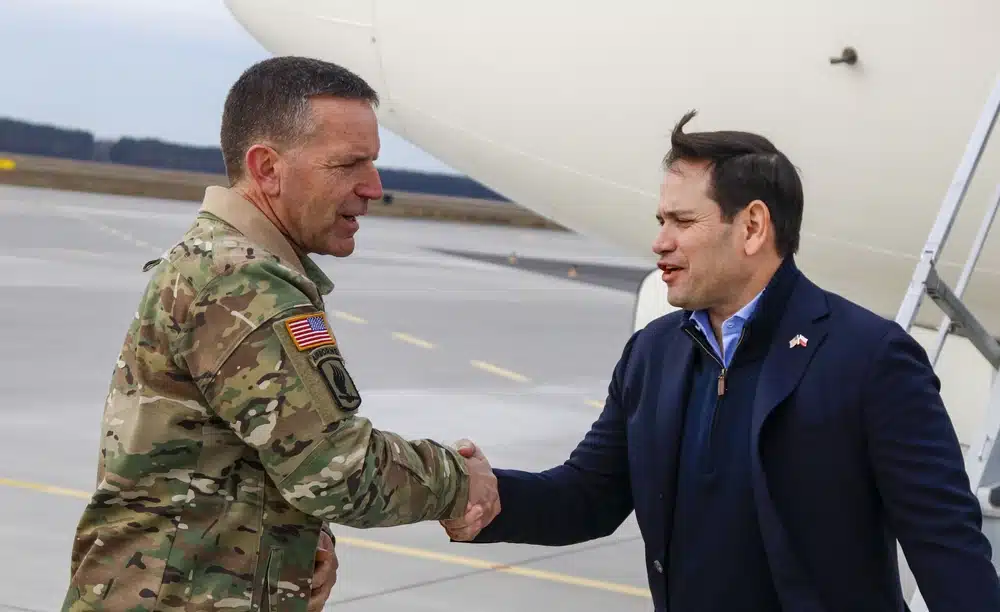
Marco Rubio did something unusual on Capitol Hill last Monday. He told the truth.
Standing outside a classified Gang of Eight briefing on March 2, the Secretary of State explained to reporters exactly why the United States launched Operation Epic Fury four days earlier:
“We knew that there was going to be an Israeli action. We knew that that would precipitate an attack against American forces, and we knew that if we didn’t preemptively go after them before they launched those attacks, we would suffer higher casualties.”
That is not a description of the United States defending itself. It is a description of the United States pre-fighting a war Israel started, to absorb less of the blowback from Israel’s decision. The “imminent threat” President Donald Trump invoked to bypass Congress was not Iran preparing to strike America. It was Iran preparing to respond to Israel—a response that would endanger American forces only because those forces are deployed across a region on behalf of a security architecture that serves Israeli interests, not American ones. American soldiers stationed across the Middle East are not there to protect Kansas. They are there to project power on behalf of a foreign policy consensus built in Washington by people who have never had to send their own children.
Seven American service members are now dead. The Pentagon has confirmed the most recent, Sgt. Benjamin N. Pennington, 26, of Glendale, Kentucky, who died Sunday of injuries sustained in a March 1 Iranian attack in Saudi Arabia. Six others—Army reservists from Iowa—were killed by a direct Iranian strike on a makeshift operations center at a civilian port in Kuwait on the same day. Trump himself has said there will likely be more. Defense Secretary Pete Hegseth has now put the timeline at eight weeks—twice his initial estimate. The tab, as always, goes to the American taxpayer, who was told, repeatedly, that the forever wars were over.
Congress has since had its chance to weigh in. It declined.
Israeli Prime Minister Benjamin Netanyahu, for his part, did not bother pretending. In a video statement from the roof of Tel Aviv’s Kirya military complex, he announced jubilantly that American firepower had allowed him to accomplish “what I have yearned to do for forty years: smite the terror regime hip and thigh.”
Forty years. That is not a defensive calculation. That is a generational ambition, funded by American taxpayers and now executed with American lives. Netanyahu did not say Israel was forced to act. He did not claim he had exhausted every alternative. He said he had yearned for this moment. The man whose military and intelligence apparatus has shaped American Iran policy for decades finally got what he wanted—and American soldiers are paying for it with their lives while Congress votes to stay out of it.
When Netanyahu then turned around and told Fox News’s Sean Hannity that Trump “can’t be dragged” into anything, he wasn’t contradicting Rubio—he was trying to contain the political damage Rubio had caused. But the sequence of events doesn’t change based on what either man says about it now. Axios reported that it is “highly unlikely Netanyahu would’ve struck Iran without Trump’s green light” and that “if Trump had preferred to keep negotiating, the strike would have been postponed.” Two men made this decision together. One of them gets to call it a forty-year dream. The other’s constituents get the body bags.
Iran’s own Foreign Minister put it plainly: Rubio had “admitted what we all knew: the U.S. has entered a war of choice on behalf of Israel. There was never any so-called Iranian ‘threat.'”
This is how these wars always begin. A legal threshold—”imminent threat”—gets quietly redefined until it means something that would be unrecognizable to anyone who has read the Constitution. The War Powers Act exists precisely to prevent a president from unilaterally committing American forces to hostilities without congressional approval. The “imminent threat” carve-out was intended for Pearl Harbor scenarios; a foreign power actively attacking the United States, leaving no time for deliberation. It was not intended to cover pre-fighting a third country’s war against a nation that had not attacked the United States and was, at the moment the bombs fell, still sitting at the negotiating table with American diplomats.
What Rubio described is not a legal gray area. It is an open admission that the threat to American forces was entirely conditional—contingent on Israeli action that Washington apparently endorsed in advance. The sequencing he outlined—Israel acts, Iran retaliates against the United States, therefore we preempt—only generates an American casus belli if Washington has already agreed to be part of the operation. The United States was not dragged in. It volunteered, without a vote of Congress, without a declaration of war, and without the 27% of Americans who support this war being consulted in any meaningful sense. The other 43% who actively oppose it were not asked either.
The Founders were explicit about this. Article I, Section 8 grants Congress, not the president, the power to declare war. That provision was not an oversight or a formality. It was a deliberate check, born from hard experience with monarchs who dragged nations into wars for dynastic reasons that had nothing to do with the people who fought them. The situation Rubio described—the United States entering a war because a foreign government’s strategic preferences created the conditions for American casualties—is precisely what that check was designed to prevent.
The administration’s public justifications have been a rotating carousel. Before the bombs fell, Trump claimed Iran’s nuclear program was an intolerable threat—while simultaneously boasting at the State of the Union that his June 2025 strikes had “obliterated” it. After the bombs fell, the White House ran through regime change, Iran’s ballistic missiles, its navy, its proxy networks, its terrorist financing, and a collapsed deal negotiation. At one point Trump cited frustration with Iranian negotiating tactics, apparently a new legal basis for war. Senator Mark Warner (D-VA), after his classified briefing, counted publicly, “We have seen the goal for this operation change now, I believe, four or five times.”
The nuclear clock claim, the most legally serviceable of the lot, was specifically dismantled by the Arms Control Association’s Daryl Kimball. Iran lacked the capability to quickly weaponize its uranium stockpiles, and its major enrichment facilities had already been severely damaged by the June 2025 strikes. The Stimson Center concluded that Trump’s diplomacy looked “less like negotiation and more like pretext for undertaking regime change.” Meanwhile, Pentagon officials, in private briefings to congressional staff, acknowledged that Iran had not been planning a preemptive strike on American forces—walking back the very claim used to justify the war’s opening hours. That correction was delivered quietly, in a closed room. The original lie ran on every network for twenty-four hours while the bombs were falling.
We have seen this film before. The weapons inspectors who said Iraq was disarmed. The Curveball intelligence that turned out to be fabricated. The “slam dunk.” The forty-five minute WMD claim. The mission accomplished banner. Each time, the corrections came after the dying had begun. Now we have a Secretary of State standing on Capitol Hill, ten days into a war, explaining that the imminent threat to America was actually a threat to Israel—and a Washington press corps asking, essentially, whether the operation is on schedule.
The fracture Rubio’s statement opened was not limited to Democrats. On the populist right, the reaction was immediate and furious. The Daily Wire’s Matt Walsh wrote:
So he’s flat out telling us that we’re in a war with Iran because Israel forced our hand. This is basically the worst possible thing he could have said. https://t.co/68cs255Zoj
— Matt Walsh (@MattWalshBlog) March 2, 2026
Pro-Trump commentator Mike Cernovich called it a “record scratch moment.” The America First wing of Trump’s coalition—the voters who were told, at rally after rally, that this president would end the forever wars, bring the troops home, and stop bleeding treasure for other countries’ benefit — recognized instantly what Rubio had conceded.
Trump’s own record on this is damning by his own standard. He spent years attacking predecessors Barack Obama, George W. Bush, and the bipartisan foreign policy establishment for exactly this pattern: using American military power to serve agendas that had nothing to do with American security. He ran three presidential campaigns, in part, on ending it. He is now prosecuting a war that his own Secretary of State has explained was timed around Israeli military planning. The Washington Post quotes multiple U.S. officials with intelligence access who saw “no sign the country had posed an imminent threat to the United States.” The neoconservatives who cheered for Iraq, Libya, and Syria never went away. They dressed differently for the second act and waited.
Then came the votes. On Wednesday, March 4, the Senate rejected a war powers resolution 53 to 47—almost entirely along party lines. Senator Rand Paul (R-KY) was the only Republican to vote for it. Democrat John Fetterman (D-PA) was the only member of his party to vote against. The next day, the U.S. House followed suit, rejecting its own war powers resolution 219 to 212. Two Republicans—Thomas Massie (R-KY) and Warren Davidson (R-OH)—crossed over. Four Democrats voted with the majority to kill it.
The margins tell you everything. The Senate’s was comfortable. The House’s was razor-thin—a clarifying snapshot, as the AP put it, of political support for a president’s unilateral decision to go to war. But the outcome was the same. Congress, which alone holds the power to declare war under Article I, chose to stand aside while a war launched without its approval continued to kill Americans.
Speaker Mike Johnson’s (R-LA) argument for doing nothing was instructive: it would be “dangerous” to limit the president’s authority while US forces are already in the field. That argument, stated plainly, is that once a president has created facts on the ground—by committing troops to hostilities Congress never approved—Congress loses its constitutional role. The war is its own authorization. The republic that emerges from that logic is not one the Founders would recognize. As Representative Jamie Raskin (D-MD) put it on the floor, “The framers weren’t fooling around. It’s up to us.” Congress then voted to prove him wrong.
For good measure, the House separately passed a nonbinding resolution declaring Iran the most significant backer of state-sponsored terrorism, 372 to 53. That one sailed through. The one that would have asserted the constitutional war-making power of the legislative branch failed by seven votes.
The constitutional question is not complicated. The War Powers Act gives the president sixty days before requiring congressional authorization, but that window was designed for genuine emergencies where action cannot wait for deliberation, not for premeditated preventive wars planned over months and launched while active diplomacy was still underway. Brookings called it plainly, “This is a premeditated, preventive war, not a defensive action to address an imminent threat to the United States.” The Arms Control Association made the same point before the bombs fell: such a war, without congressional approval, “would violate the Constitution and the 1973 War Powers Act” as well as Article 2(4) of the United Nations Charter.
The war is now in its eleventh day. CENTCOM reports striking over 3,000 targets inside Iran. At least 1,332 Iranians have been killed. Iran has named a new supreme leader, Mojtaba Khamenei, 56-year-old son of the man the U.S. and Israel killed, with deep ties to the Revolutionary Guard, signaling no softening in Tehran’s posture. Russia is reportedly providing Iran with intelligence on U.S. military positions. Hegseth has not ruled out boots on the ground. Senator Tim Kaine (D-VA) called the votes “not a one and done” and promised further efforts through the appropriations process. That is small comfort to the families of seven dead soldiers.
The United States has no vital national interest in who governs Tehran. It has no legal basis for this war. It has no plan for what comes after—no answer to who runs Iran when the bombing stops, no answer to whether a more desperate successor regime is more or less likely to pursue nuclear weapons, no answer to what happens if the Strait of Hormuz closes permanently and oil doubles. What it has, right now, is a Secretary of State who said out loud that American soldiers are positioned as trip wires inside a strategic logic set by Jerusalem, a Congress that just voted to rubber-stamp that arrangement, and a new Iranian supreme leader who has close ties to the Revolutionary Guard and every reason to be more hardline than his father.
Netanyahu got his forty-year ambition. American families are getting folded flags. And Congress, given the chance to say something about it, looked away.