
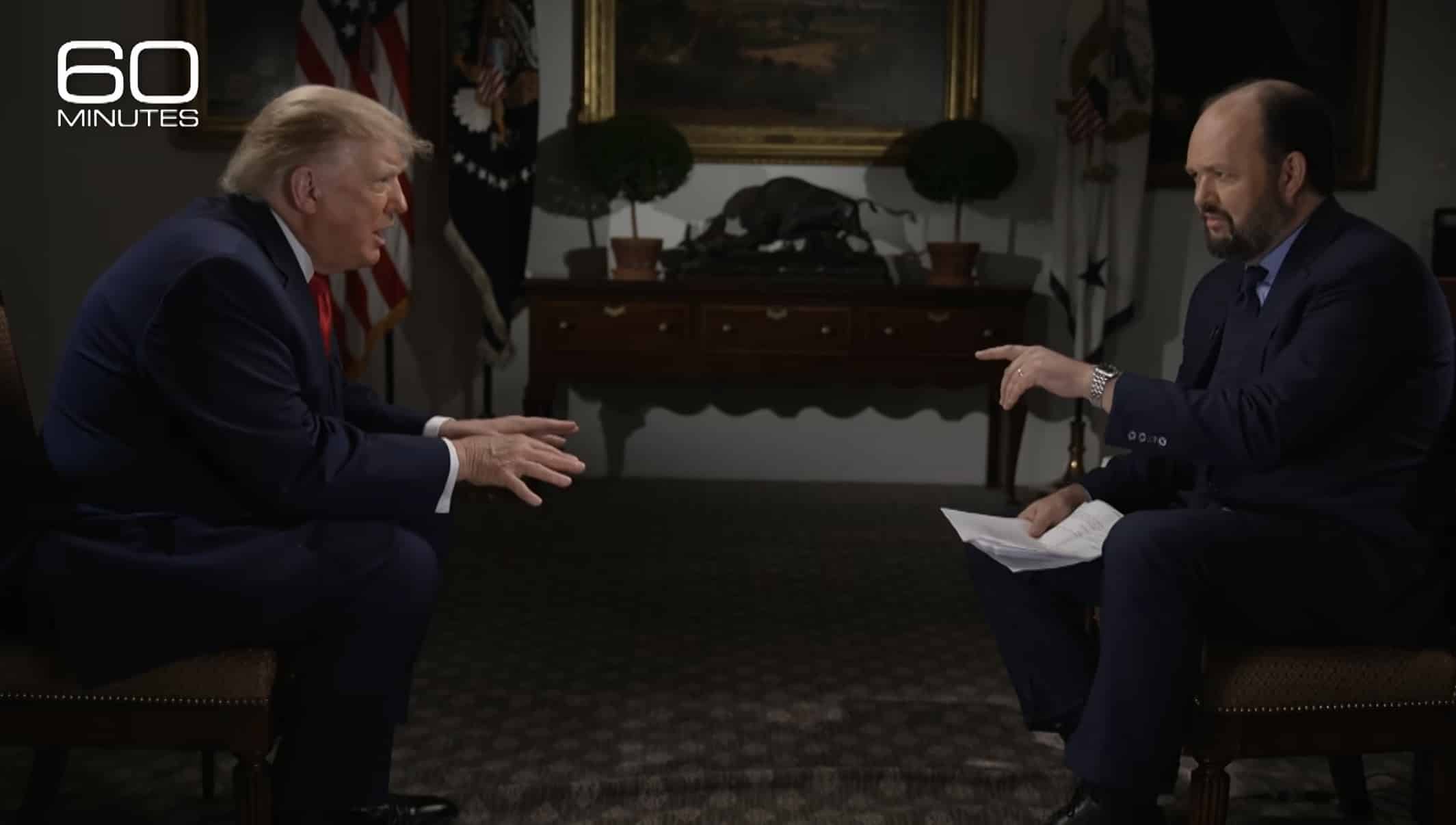
Five days after his party suffered a spectacular loss in the midterm elections, President Donald Trump sat down for a nearly half hour interview with Ross Douthat of CBS News. On foreign policy, Trump made three particularly shocking statements.
The day after the midterms, Vice President J.D. Vance posted a postmortem in which he placed the war on Iran first. “The reason we lost,” he said, “is the war.” Trump told CBS that he didn’t disagree. A few days earlier, he told NBC news that Vance was right, but that the discontent wasn’t with the war but with the consequence that the war “drove the gasoline up a little bit.” Trump repeated that sentiment to Douthat, saying, “They didn’t like the war. They didn’t like the fact that gasoline went up.”
Would he do it again, though, despite the impact it had on the control of Congress? “My answer,” Trump said, “is an emphatic yes because you can’t let Iran have a nuclear weapon…I’ve stopped them from having a nuclear weapon.”
But that’s not true. You cannot stop Iran from having something it wasn’t trying to get. The most recent Annual Threat Assessment of the U.S. Intelligence Community clearly assesses that “Iran is not building a nuclear weapon.” In March, Director General of the International Atomic Energy Agency (IAEA) Rafael Grossi verified that the IAEA has found “no evidence that Iran is building a nuclear bomb.”
War was not necessary to prevent Iran from building a nuclear weapon. Had Trump wanted to do that, he could have preserved the JCPOA nuclear agreement, with which the International Atomic Energy Agency had repeatedly verified that Iran was completely and consistently in compliance, instead of pulling out of it in his first term. Or, in his second term, he could have seen negotiations through when Iran was willing to negotiate placing itself under maximum inspections, converting its stockpile of 60% enriched uranium, capping its enrichment at the 3.67% needed for a civilian energy program and even, reportedly, being willing to suspend enrichment for a number of years. He could have explored Iran’s willingness to negotiate becoming a member of a nuclear enrichment consortium that would distribute roles across member countries, denying itself access to the full enrichment process.
The Trump administration has long provided the legal justification for its action in Venezuela, including the invasion of the country and the kidnapping of its president, that it was not a war. Secretary of State Marco Rubio explained that the operation was “largely a law enforcement function.” He said to “remember, at the end of the day, at, at its core, this was an arrest of two indicted fugitives of American justice, and the Department of War supported the Department of Justice in that job.”
But in defending the job Secretary of Defense Pete Hegseth had done, Trump told Douthat, “Look, we’ve won two wars. We’ve won Venezuela…” Trump also called the mission “a war” in his General Assembly address in September.
The Trump administration has had a long list of reasons for the invasion of Venezuela. But in his interview, Trump did not mention narcoterrorism, democracy, regional instability, his corollary to the Monroe Doctrine or the interests of the people of Venezuela. He boasted only of one accomplishment: “We’ve won Venezuela and taken out billions and billions and billions of dollars already.”
Perhaps most shockingly, Trump referred to Venezuela as an American territory: “You could call it a territory, you could call it whatever you want. We won that war in less than one hour.” In a press conference following the military action in Venezuela, Trump had already said that the United States was “going to run the country until such time as we can do a safe, proper, and judicious transition.” Rubio tried to nuance the statement by saying that the U.S. would not be “running” Venezuela but would be “running policy” in Venezuela. But when asked the next day who was in charge in Venezuela, Trump responded, “We’re in charge.”
One of Trump’s most outrageous statements came in a discussion of the expense of keeping the Strait of Hormuz open by indefinitely escorting tankers through with a U.S. naval escort. Trump said that it’s “not very expensive” but that when “this whole thing” is over, “those countries that we’ve protected are going to pay us back any and all costs that we’ve had for the war ’cause without us, they wouldn’t exist.
But the Iran war painfully proved to the countries the United States promised to protect that American protection had become more of a liability than an asset. The war that they had strongly cautioned and lobbied against proved that the bases they had been sold as a network of defense against Iran were, instead, magnets for Iranian missiles and drones.
The U.S. did not protect anyone. They drew the Gulf countries into a war that was against their interest. That war caused unimagined damage to their military bases, their oil facilities, their infrastructure, their tourism and their reputation as safe places to travel and invest. Rather than pay back the United States, these countries are more likely to divest from it in the form of defensive partnerships like the Mecca Defense Agreement between Saudi Arabia, Pakistan, and Turkey and the Badr Memorandum between Pakistan, Turkey, Qatar, and Indonesia.
These three statements illustrate the Trump administration’s insensitivity to diplomacy and international law and to the geopolitical consequences of these insensitivities.