


One of the most enduring assumptions of modern finance is that investors should not be able to consistently earn above-market, risk-adjusted returns. While exceptions are possible, one of the least surprising is to be found among America’s major defense contractors. Examining their historical performance, we find an industry whose combination of lobbying, political entrepreneurship, barriers to entry, market concentration, and privileged access to government procurement has helped the defense industry to produce profits for itself far above the returns of the broader market over that same period.
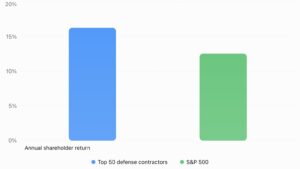
In 1992, economist Robert Higgs published “Profits of U.S. Defense Contractors,” examining the financial performance of the fifty largest American defense contractors between 1970 and 1989. His findings were striking. Defense contractors averaged an annual shareholder return of 16.24%, compared with 12.51% for the S&P 500. Their returns on investment and assets also exceeded those of the broader market. Importantly, Higgs found that investing in defense contractors was not significantly riskier than investing in comparable nondefense companies.
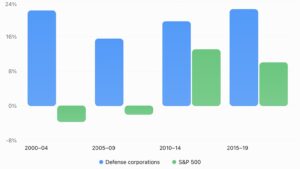
 More recently, the Department of Defense commissioned a comprehensive examination of the industry’s financial health, published in April 2023. Drawing on research conducted by the University of Virginia’s Darden School of Business, the study compared defense contractors with commercial companies and major stock-market indices between 2000 and 2019.
The results were again revealing. Defense corporations produced annualized shareholder returns of 22% between 2000 and 2004, 15.5% between 2005 and 2009, 19.5% between 2010 and 2014, and 22.3% between 2015 and 2019. They outperformed the S&P 500 in all four periods.
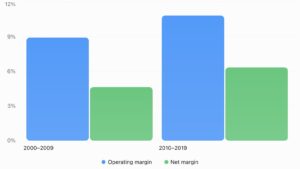
 The same Pentagon study found that defense contractors outperformed commercial counterparts in eight of nine financial metrics, including return on assets, return on equity, and total shareholder return. Operating margins averaged 8.9% during 2000–2009 and 10.8% during 2010–2019. Net margins increased from 4.6 to 6.3%
This is not surprising when we think about what distinguishes defense contractors from ordinary businesses.
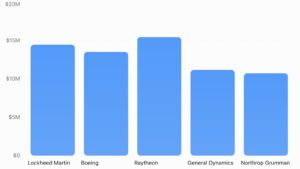
Start with lobbying. According to Brown University’s Costs of War, in 2021, the five largest American defense contractors—Lockheed Martin, Boeing, Raytheon, General Dynamics, and Northrop Grumman—spent approximately $65 million on federal lobbying. In the same fiscal year, they received nearly $104 billion in Pentagon contract awards, an almost unbelievable return on investment.
 In their 2023 Journal of Law and Economics article, “The Lion’s Share: Evidence from Federal Contracts on the Value of Political Connections,” Şenay Ağca and Deniz Igan found that firms engaging in lobbying received approximately one-third more in defense contracts than firms that did not lobby during an unexpected expansion of defense spending following the September 11 attacks. Similar relationships appeared for campaign contributions and government-connected corporate board members.
Weird—almost like political connections influence procurement.
Political influence is only part of the story, however. The defense industry has also become extraordinarily concentrated. Following the Cold War, the Pentagon actively encouraged consolidation among defense manufacturers. The number of major prime contractors declined from 51 to five. By 2023, those five companies were prime contractors on more than 74% of the Defense Department’s major acquisition programs.
 The government thus helped create the concentrated industrial structure within which it now conducts much of its procurement. High capital requirements, specialized technologies, security clearances, regulatory barriers, and established relationships with government agencies make entry extraordinarily difficult. In many procurement categories, the government has relatively few viable suppliers.
The Pentagon’s own 2023 financial study identifies another advantage: government contract financing. Unlike ordinary commercial customers, the Defense Department frequently finances product development, provides contract financing, uses cost-type contracts, and offers predictable payment arrangements. The report concludes that these arrangements substantially improve contractor cash flow and that the financial returns generated by contract financing can exceed stated contract profit rates and the contractors’ cost of capital.
 In other words, the government is simultaneously the industry’s largest customer, financier, regulator, and architect of its competitive environment.
To top it off, the benefits of procurement contracts are concentrated among corporate shareholders, executives, employees, suppliers, and congressional districts, while the costs are dispersed among taxpayers. Contractors therefore have every incentive to organize politically to preserve and expand the market upon which their fortunes depend, on the backs of the American people, whose interests go totally unrepresented.
The MIC is not merely a collection of companies that happen to sell weapons to the government. It is an institutional arrangement in which political influence, market concentration, and government procurement reinforce one another—and buoyed by a revolving door between the halls of Congress, the Pentagon, K-Street, and the boardrooms of the same firms, Raytheon, Lockheed, et cetera.
In the words of Libertarian Institute Director Scott Horton, while their parasitical existence and activities are understandable, considering the incredible money to be squeezed from the helpless American people, it is unacceptable.