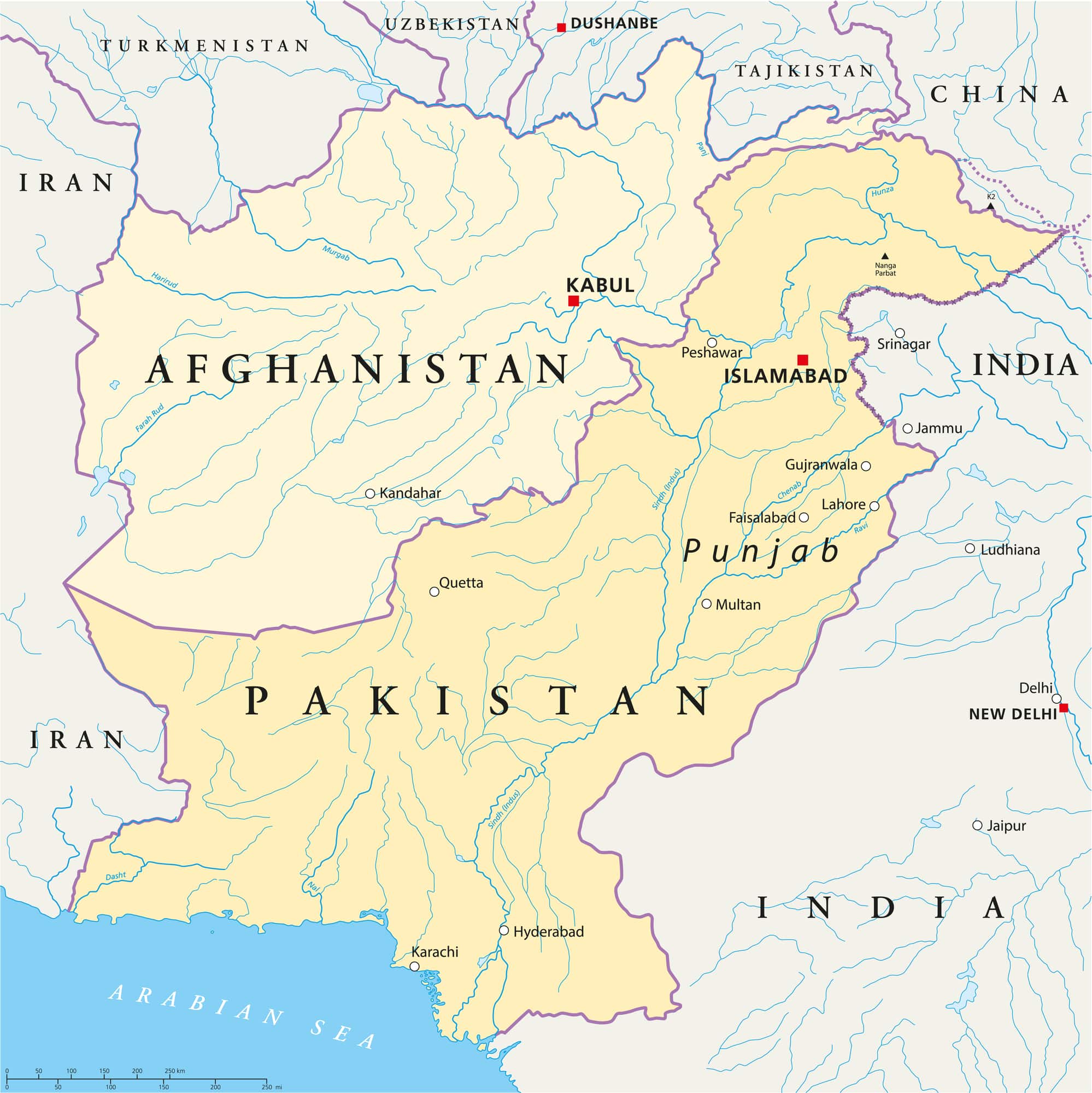
In late February, longstanding tensions between Pakistan and Afghanistan erupted into open conflict, marking one of the most severe escalations since the Taliban regained control of Kabul in 2021. What began as targeted Pakistani airstrikes against militant camps in eastern Afghanistan has spiraled into cross-border offensives, artillery exchanges, and strikes on major Afghan cities, including Kabul and Kandahar. Pakistan’s Defense Minister Khawaja Asif declared an “open war” with the Taliban government following Afghan retaliatory attacks on Pakistani border positions.
This flare-up, rooted in disputes over border security, militant safe havens, and the contested Durand Line, has resulted in hundreds of casualties on both sides, with Pakistan claiming to have killed over three hundred Taliban fighters and affiliated militants, while Afghanistan reports significant Pakistani losses.
The conflict threatens to destabilize an already fragile region, drawing in broader geopolitical forces and underscoring the perils of unresolved historical grievances in South Asia. As of late February the fighting shows no signs of abating. Afghan forces have launched drone attacks on Pakistani military camps in border areas like Miranshah and Spinwam, prompting further Pakistani air and ground responses. International calls for mediation are mounting, but both sides appear entrenched, with Pakistan refusing dialogue amid ongoing hostilities.
This situation not only highlights the failure of previous ceasefires but also amplifies the risks of a broader conflagration in a nuclear-armed neighborhood.
The relationship between Pakistan and Afghanistan has been fraught with suspicion, proxy warfare, and mutual interference virtually since before their modern incarnations, but the dynamics intensified dramatically in the 1980s. During the Soviet invasion of Afghanistan (1979-1989), Pakistan became a frontline state in the Cold War proxy conflict. With substantial backing from the United States, Saudi Arabia, and other Western allies, Pakistan’s Inter-Services Intelligence (ISI) agency funneled arms, training, and funds to Afghan mujahideen fighters resisting Soviet occupation. This period saw the influx of millions of Afghan refugees into Pakistan, the radicalization of Pashtun communities straddling the border, and the establishment of madrassas that would later incubate extremist ideologies.
The Soviet withdrawal in 1989 left Afghanistan in chaos, paving the way for civil war among mujahideen factions. In the mid-1990s, Pakistan played a pivotal role in the rise of the Taliban, a Pashtun-dominated Islamist movement that emerged from these refugee camps and madrassas. Viewing the Taliban as a means to secure “strategic depth” against India, Pakistan’s primary rival, Islamabad provided military, logistical, and diplomatic support to help the group seize Kabul in 1996. This alliance allowed Pakistan to influence Afghan affairs, counter Indian presence in the region, and suppress Pashtun nationalist movements that challenged the Durand Line, the colonial-era border drawn in 1893 that Afghanistan has never formally recognized.
The events of September 11, 2001 upended this arrangement. Under pressure from the United States, Pakistan ostensibly joined the Global War on Terror as an ally, providing bases and intelligence for the U.S.-led invasion that toppled the Taliban. However, Islamabad’s support was duplicitous; elements within the ISI continued to harbor Taliban leaders and facilitate their insurgency against NATO forces. This double game persisted throughout the twenty-year occupation, with Afghan governments in Kabul accusing Pakistan of sheltering militants like the Haqqani Network, while Pakistan countered that Afghanistan allowed anti-Pakistan groups, such as the Tehrik-i-Taliban Pakistan (TTP), to operate from its soil.
The U.S. withdrawal in August 2021 and the Taliban’s simultaneous return to power exacerbated these tensions. No longer constrained by American oversight, the Taliban government in Kabul has refused to rein in the TTP, which has launched increasingly bold attacks inside Pakistan. Border skirmishes have become routine, often involving artillery and small arms fire over the Durand Line. Pakistan’s efforts to fence the border, aimed at curbing smuggling, militancy, and undocumented migration, have been met with Afghan resistance, including the destruction of fencing by Taliban forces. Underlying these disputes is the ethnic Pashtun divide: the Taliban draws support from Pashtun communities on both sides, fueling irredentist claims that challenge Pakistan’s territorial integrity.
This historical backdrop reveals a pattern of strategic maneuvering where both nations have used proxies to advance their interests, often at the expense of regional stability. External powers, particularly the United States, have compounded the problem through interventions that prioritized short-term gains over long-term peace, leaving a legacy of distrust and armament.
The current crisis traces its immediate origins to a series of terrorist attacks in Pakistan attributed to militants based in Afghanistan. On February 21, 2026, the Pakistan Air Force conducted airstrikes on alleged TTP and Islamic State-Khorasan Province (ISIS-K) camps in Afghanistan’s Nangarhar, Paktika, and Khost provinces.
Pakistani officials claimed these strikes were in retaliation for bombings in Islamabad, Bajaur, and Bannu that killed dozens. The operation reportedly targeted seven militant hideouts, with Pakistan asserting minimal civilian casualties, though Afghan sources disputed this, claiming civilian deaths in the dozens. Tensions simmered for several days before erupting again. On the night of February 26, Afghan Taliban forces launched a major offensive against Pakistani military posts along the Durand Line, capturing several positions and inflicting heavy losses, according to Kabul’s claims, up to fifty-five Pakistani soldiers killed and seventeen posts overrun.
Pakistan denied these figures, reporting only two security personnel deaths while claiming to have repelled the assault and killed 297 Taliban fighters.
In response, Pakistan escalated dramatically on February 27, bombing Kabul, Kandahar, and other Afghan cities, including military hubs in Paktia province. Defense Minister Asif’s declaration of “open war” followed, signaling Islamabad’s frustration with what it perceives as Taliban complicity in harboring anti-Pakistan militants. Fighting has since intensified across multiple border sectors, including Chaghi in Balochistan and areas in Khyber Pakhtunkhwa. Reports indicate the use of heavy artillery, rocket launchers, machine guns, drones, and even tanks, with mutual ground incursions. Afghan media documented Pakistani jets hovering over Kabul and chaotic scenes of ambulances and tanks mobilizing.
By February 28, casualties mounted: Pakistan reported over 331 Afghan Taliban and allied terrorists killed, while Afghanistan claimed to have shot down a Pakistani fighter jet and captured its pilot, a claim Islamabad denied.
Meanwhile, border villages have been evacuated, and trade routes closed, exacerbating economic strains in both impoverished nations. The Taliban’s refusal to crack down on the TTP, combined with Pakistan’s aggressive fencing and deportation of Afghan refugees, has created a vicious cycle of retaliation.
The Pakistan-Afghanistan conflict matters not just for the immediate human toll but for its potential to unleash cascading instability in South Asia. Pakistan, a nuclear-armed state with an arsenal estimated at over 170 warheads, faces severe internal pressures from economic woes, political unrest, and rising militancy. A destabilized Pakistan risks extremist groups like the TTP gaining ground, potentially accessing nuclear materials or provoking a domestic crisis that spills over borders. Such a scenario would be catastrophic, inviting intervention from global powers and heightening the risk of miscalculation in a region already shadowed by nuclear threats.
Geopolitically, Afghanistan serves as Pakistan’s “strategic depth,” a buffer against India, its archrival with whom it has fought multiple wars over Kashmir. Islamabad has long viewed control or influence over Kabul as essential to preventing encirclement by a pro-Indian Afghan government. The current Taliban regime, while ideologically aligned with elements in Pakistan, has instead emboldened anti-Pakistan insurgents, undermining this strategy. If the conflict draws in India, perhaps through support for anti-Taliban factions, or prompts Chinese involvement to protect its Belt and Road investments, the result could be a proxy war engulfing the region.
Ultimately, this strife underscores the folly of external meddling and the enduring costs of unresolved colonial legacies. Without genuine dialogue, de-escalation, and economic cooperation, the Durand Line will remain a powder keg, threatening not only bilateral peace but the stability of nuclear-armed neighbors. The international community must prioritize diplomacy over arms, lest this border skirmish ignite a far larger fire.